
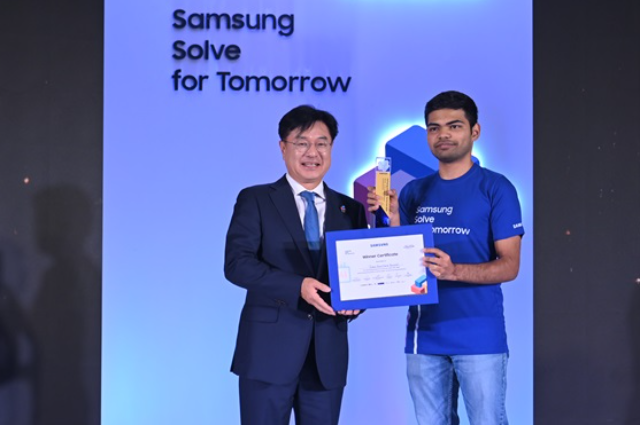
In a nation where technology often races ahead of social consciousness, a 19-year-old engineering student from Bengaluru has reminded us that the most meaningful innovations emerge not from laboratories alone, but from lived human experience. Tushar Shaw's journey from observing his visually impaired neighbour’s daily struggles to developing Perceivia, an AI-powered navigation device, offers a compelling narrative about youth-driven social innovation in contemporary India.
The Genesis of Compassionate Technology
What distinguishes Shaw's story is its deeply personal origin. Growing up adjacent to someone directing the world without sight provided him a close understanding of challenges that most people merely intellectualise. The simple acts we take for granted like crossing streets, recognising acquaintances and locating everyday objects, became indicative of observations about accessibility gaps in our built environment. This closeness to lived difficulty was transformed by intellectual understanding into concrete action.
His creation, Perceivia, represents an attempt to translate visual information into alternative sensory experiences. By combining audio sensors with object-recognition cameras and AI-driven spatial analysis, the device constructs what Shaw aptly describes as a "sensory map" of one's surroundings. Users receive information about their environment through vibrations and voice feedback, where a technological interpretation of the world compensates for absent vision.
The device doesn't merely detect obstacles; it identifies objects, estimates distances, and even recognises voices and faces. This multidimensional approach acknowledges that independence for visually impaired individuals requires more than basic direction finding and it demands social recognition, spatial awareness, and environmental understanding.
The Democratic Promise of Competitions
Shaw's success illuminates the transformative potential of structured innovation platforms like Samsung Solve for Tomorrow. This nationwide programme, which challenges young minds to address real-world problems through technology, provided more than financial support; it offered legitimacy, mentorship, and a framework for translating ideas into viable products.
The competition's thematic structure, which was spanning to AI for inclusion, health and hygiene, environmental sustainability, and sports technology reflects an understanding that India's developmental challenges require multifaceted responses. Shaw's project, selected under the AI for inclusion category, competed alongside innovations addressing equally pressing national concerns, creating an ecosystem where diverse solutions could flourish simultaneously.
What's particularly noteworthy is the programme's comprehensive support structure. Shaw mentions receiving guidance on market research, partnership development, and entrepreneurial fundamentals skills rarely taught in conventional engineering curriculam. This holistic approach recognises that technical competence alone cannot bridge the gap between prototype and product. The one crore rupee development support at IIT Delhi further demonstrates institutional commitment to nurturing these innovations beyond initial recognition.
Technical Audacity and Iterative aspect of Humility
Shaw's candid admission that his ambition initially exceeded his technical capabilities reveals an important truth about innovation where it often begins with innocence. Without formal training in computer vision or hardware design, he ventured into complex technological terrain, propelled by conviction rather than credentials.
His use of Google's Gemini 2.0 Flash model for screen description functionality demonstrates resourcefulness in leveraging cutting-edge AI tools. More significantly, his methodology of building facial and object recognition features using datasets from visually impaired volunteers demonstrates participatory design. Rather than assuming he understood his users' needs, he invited them into the development process, allowing their experiences to shape the technology.
This iterative approach, where theoretical designs were continuously being challenged by practical testing, reflects mature engineering thinking. Shaw's acknowledgment that "what worked in theory often needed to be rethought in practice" underscores a fundamental lesson that assistive technology cannot be developed in isolation from those it aims to assist.
Beyond the Prototype: Democratizing Accessibility
The real measure of Shaw's vision lies not in what he's achieved but in what he aspires towards. His goal is to make Perceivia as commonplace as conventional spectacles, reframing assistive technology from specialised equipment to universal design. This ambition challenges the market logic that treats accessibility as a niche concern rather than a fundamental right.
His commitment to affordability is particularly crucial in the Indian context, where economic barriers often compound physical ones. Many assistive technologies remain prohibitively expensive, by creating a secondary exclusion based on purchasing power. Shaw's determination to make the device accessible "for people across India" acknowledges that true inclusion requires economic consideration alongside technical innovation.
His future plans for testing with larger user groups, collaborating with mobility trainers, and developing indoor navigation features suggest an understanding that first-generation success is merely a foundation. The device must evolve through continuous engagement with diverse environments and user needs.
The Larger Implications
Shaw's story prompts reflection on how we cultivate innovation in India. His success suggests that young people, when provided appropriate platforms and resources, can address complex social challenges with fresh perspectives. The Samsung Solve for Tomorrow model by combining competition, mentorship, and incubation support, offers a replicable framework for channelling youthful creativity towards national priorities.
Moreover, his journey highlights the importance of close experience. Technology developed by those familiar with the problems it addresses often demonstrates greater nuance than solutions imposed from a distance. Shaw's neighbour wasn't merely an inspiration but an unwitting collaborator, whose daily reality shaped the device's functionality.
As India positions itself as a global technology leader, stories like Tushar Shaw's remind us that technological advancement must be measured not only by sophistication but by inclusivity. The true test of our innovation ecosystem lies in whether it can produce solutions that serve not just the digitally connected elite but the millions crossing various forms of marginalisation.
Perceivia may be one student's project today, but it represents something larger than a generation willing to direct its technical capabilities towards building a more accessible tomorrow. That vision, more than any device, offers a genuine reason for optimism.
. . .
References: