
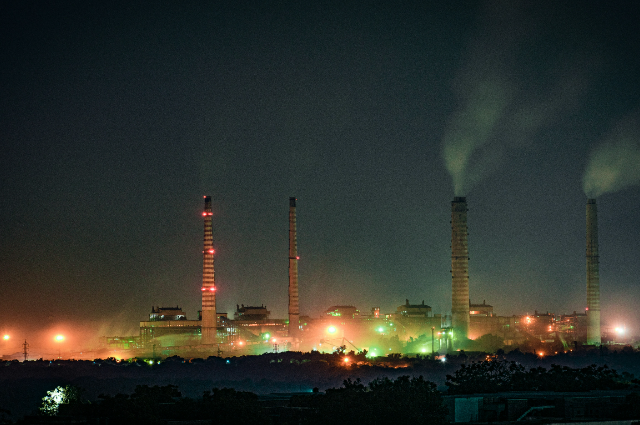
Photo by Anirudh on Unsplash
On the morning of February 24, 2026, hundreds of contract workers gathered at the main gate of the Indian Oil Corporation Limited (IOCL) refinery in Baholi, Panipat where a sprawling complex that sits roughly 100 kilometres from Delhi and stands as one of India's most critical energy installations. What followed was not spontaneous rage. It was the eruption of a grievance that had been simmering for years, bottled up by powerlessness, ignored by management, and invisible to a wider public that simply turns on its gas stove or fills its tank without a second thought about who makes it possible.
By mid-morning, stones were being pelted, vehicles were being vandalised, and the Central Industrial Security Force (CISF), the paramilitary outfit tasked with guarding strategic industrial assets, had fired two warning shots in the air to control what had become an unmanageable crowd. Two CISF personnel were injured. The refinery's main gate was, for a few hours, a scene of confrontation rather than commerce. It did not have to come to this.
The Anatomy of Discontent
The demands of the protesting workers were not revolutionary. They were, in fact, embarrassingly basic. Workers alleged that they routinely clocked 12-hour shifts but were paid for only eight hours, with no overtime compensation. Salaries were frequently delayed. Unjust wage deductions were common, and beyond the question of money, the conditions at the worksite were described as undignified, with no clean drinking water near work areas, inadequate toilet facilities, and poor health and hygiene standards overall. Workers also demanded transportation to and from the facility.
Read these demands carefully, and you will find nothing extreme. No demand for ownership. No demand to shut the refinery. Just the desire to be paid fairly for hours actually worked, to drink clean water, to use a toilet. That these demands had to be expressed through a violent confrontation at a high-security national installation, no less, tells us everything about how thoroughly the system has failed these workers.
The Contract Labour Trap
The Panipat protest is a window into a structural problem that runs through India's industrial economy. Contract workers form the operational backbone of large public-sector units like IOCL, performing the same essential tasks as permanent employees, yet enjoying none of their protections. They are hired through contractors, insulating the principal employer from legal accountability. They cannot easily unionise. They can be replaced and because of this instability, they endure conditions that permanent staff would never accept.
This is not unique to Panipat. Across refineries, steel plants, coal mines, and ports, this two-tier workforce has become the norm. The permanent employees with their provident funds, paid leave, and job security are the visible face of public-sector enterprise. The contract workers are the invisible foundation beneath them, often working longer hours for a fraction of the pay, with none of the safety net.
The irony is stark and at a facility as strategically important as the IOCL Panipat Refinery, the workers who keep it running are denied basic amenities that any dignified workplace should provide as a matter of course.
The Strategic Dimension
One cannot ignore the setting. The Panipat Refinery is not a small private firm. It is a major asset of Indian Oil Corporation, a Maharatna public-sector enterprise that is among India's largest companies. It refines millions of tonnes of crude oil annually. Its uninterrupted operation is a matter of national energy security.
This strategic importance is precisely why the protests deserve more than a law-and-order response. A refinery that sits on worker resentment is a refinery that is vulnerable not merely to protests, but to the kind of disengagement and quiet negligence that safety incidents are made of. Workers who feel disrespected and exploited do not bring their best attention to a job that demands constant vigilance. In an environment where a single lapse can trigger an industrial disaster, the welfare of workers is not a peripheral concern. It is a core operational and safety imperative.
What Must Change?
Worker unions have made clear that protests will continue if demands go unaddressed. Management and the administration would be wise to treat this not as a threat but as an opportunity. The demands on the table of eight-hour shifts, overtime pay, timely salaries, and basic facilities are eminently reasonable and legally mandated in many cases under existing labour law. Compliance is not charity; it is an obligation.
More broadly, the Panipat episode must prompt a rethinking of how India's public-sector enterprises manage their contract workforces. The falsehood that a contractor is wholly responsible for workers operating within a public-sector plant needs to be pulled to pieces. Principal employers must be held accountable for the conditions in which all workers on their premises are permanent or contract and spend their working lives.
At its core, the Panipat refinery protest is a story about dignity. Workers who power one of India's essential industrial engines are asking to be treated as human beings to be paid for the hours they work, to have water when they are thirsty, to have access to a toilet. The fact that these requests escalated to stones and warning shots is not a reflection of worker chaos. It is a reflection of how completely they had been unheard. India cannot build the industrial future it aspires to on the backs of an invisible, exploited workforce. Panipat is a reminder that sooner or later, the invisible make themselves seen, and the manner in which they do so depends entirely on whether anyone was willing to listen before it came to that.
. . .
References: