
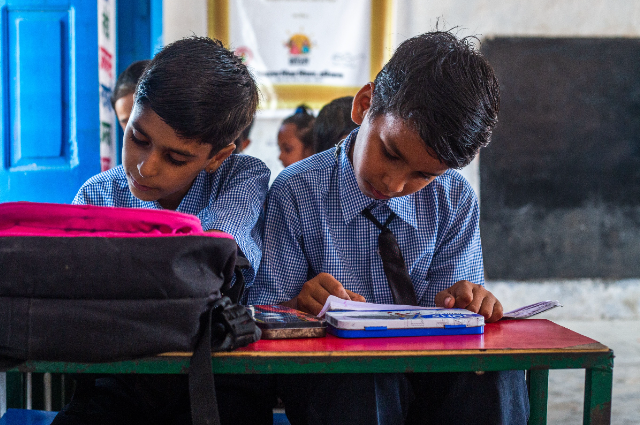
India’s greatest strength is its children, and the quality of education they receive today will determine the strength, prosperity and character of the nation tomorrow. With more than ten lakh government schools serving millions of children across the country, strengthening public education must become a national priority. While India has made considerable progress in school enrolment, teacher availability and infrastructure, significant gaps still remain in many government schools, particularly in basic facilities, teacher availability, accountability, technology and learning outcomes. Addressing these challenges cannot be the responsibility of governments alone; it requires a collective effort involving governments, teachers, parents, local communities, corporate organisations, philanthropists, alumni and Indians living abroad. A transparent, properly audited and time-bound five-year national programme could identify the needs of every government school, mobilise resources and ensure that every child has access to a safe, dignified and quality learning environment. “Government Schools Thik Karo!” should therefore become more than a slogan—it should become a national commitment to our children and to a Stronger Bharat.
Why do we need to strengthen government schools and teachers?
Our children are the future citizens of India. If we provide them with quality education, competent teachers, safe classrooms and the facilities necessary for learning, they will in turn contribute to a stronger, more educated and more prosperous nation. Therefore, strengthening government schools should not be regarded merely as an education-sector programme; it is a nation-building responsibility.
The scale of the government-school system itself explains why this issue deserves urgent attention. According to UDISE+ 2024–25, India has 1,013,322 government schools, representing about 69% of all schools. These schools educate approximately 12.16 crore students, or about 49% of all school students, and employ around 51.5 lakh teachers, or about 51% of India's school teachers.
These figures tell us something crucial: government schools are not a marginal part of Indian education—they are the backbone of school education for millions of families.
Teachers are the most important investment.
India has crossed the milestone of one crore school teachers overall. UDISE+ reports 10,122,420 teachers in 2024–25, of whom approximately 51.5 lakh are in government schools. The overall pupil-teacher ratio has also improved substantially; at the national level, it is approximately 20:1 at primary, 17:1 at upper-primary, 15:1 at secondary and 23:1 at the higher-secondary level.
This is encouraging, but teacher numbers alone cannot guarantee quality education. What matters is the availability of teachers in every school, the presence of subject-specific teachers where required, regular attendance, classroom engagement, continuous professional development, learning outcomes, and accountability.
UDISE+ 2024–25 still recorded 20,817 zero-enrolment schools and 104,125 single-teacher schools nationally, with more than 33.7 lakh students enrolled in single-teacher schools. This data demonstrates that averages at the national level can sometimes conceal serious problems at the individual-school level.
Infrastructure is equally important.
A child cannot be expected to learn effectively in an environment that lacks basic facilities. UDISE+ 2024–25 shows considerable progress, but gaps remain. Nationally, about 97.3% of schools reported girls' toilet facilities, 95.9% hand-washing facilities, 83% playground facilities, 64.7% computer facilities and 63.5% internet facilities. Facilities for children with disabilities remain a much larger concern, with only about 35.6% of schools reporting CWSN-friendly toilets.
Therefore, the objective should not simply be “more schools” or “more teachers". It should be:
The objective should include better schools, adequate teachers, accountable teachers, appropriate infrastructure, technology, and improved learning outcomes.
Accountability should be constructive, not punitive.
Government teachers today are generally much better qualified and better paid than in the past, and many are doing excellent work under difficult circumstances.
Therefore, we should not present the issue as an attack on teachers. Instead, we should demand professional accountability.
A modern government school system should have transparent indicators such as the following:
- teacher attendance and punctuality;
- student attendance and retention;
- subject-wise teacher availability;
- learning outcomes;
- regular assessment of students;
- teacher training and professional development;
- school infrastructure;
- availability of teaching-learning materials;
- functioning toilets, drinking water and electricity;
- digital and library facilities; and
- periodic social audits involving parents and local communities.
Such measures would make accountability a mechanism for improvement rather than punishment.
Government schools deserve the same confidence as private schools.
One of the most significant challenges is public perception. Many parents who can afford private education prefer private schools, while government schools increasingly serve children from economically weaker and disadvantaged communities. This can create a cycle in which declining public confidence leads to declining enrolment, which, in turn, reduces community pressure for improvement.
We need to reverse that cycle: A government school should not be considered a school for the poor. It should be considered a school for every citizen.
The quality of a government school should be satisfactory enough that a government employee, farmer, businessperson, professional or any other citizen can confidently choose it for their children.
The larger national question?
India cannot become a genuinely “Stronger Bharat” without creating a strong public education system. We can build highways, industries, digital infrastructure and smart cities, but the most valuable infrastructure remains human capital.
With more than 10 lakh government schools, over 12 crore students and more than 51 lakh government-school teachers, even a modest improvement in the quality of this system could transform the future of millions of Indian children.
Therefore, the demand should not simply be "Increase the education budget.” It should be:
“Invest every rupee wisely, measure every outcome honestly, make every school accountable, support every teacher and provide every child an equal opportunity to learn.”
That is how “Government School Thik Karo!” can become more than a slogan. It can become a national movement for better schools, empowered teachers, educated children and a stronger India.
Government School Thik Karo! — A Call for Better Schools and a Stronger Bharat.
Strengthening government schools across India must be one of our highest national priorities. In this context, what the Cockroach Janatha Party (CJP) has initiated through the slogan “Government School Thik Karo!” — Better Schools — is a welcome and timely step. The broader vision of “Stronger Bharat” is meaningful because a strong nation can only be built through strong educational institutions and well-equipped schools.
The CJP's proposal to audit government schools is a positive beginning. However, such an audit must be carried out within the legal and administrative framework, with the necessary permissions and cooperation of the respective state and central governments. If direct auditing is difficult, the party can constitute responsible committees, collect publicly available information, seek school-wise data from government authorities, identify infrastructure gaps, and present the findings to the concerned departments. It can also mobilise public support and legitimate resources for improving basic school facilities, wherever permitted.
India has approximately 10 lakh government schools and around 11 crore children enrolled from the pre-primary/nursery level to Class X. This represents the educational future of an enormous section of our young population. Even today, many government schools face basic challenges such as inadequate classrooms, insufficient benches and blackboards, poor maintenance, shortages of teachers, and inadequate sanitation facilities. In particular, the availability of safe and separate toilet facilities for girls deserves urgent attention.
As we move towards celebrating 80 years of India's independence, we should honestly recognise both the achievements of our education system and the gaps that still require attention. Education is the foundation of human development, economic progress and nation-building. Our children are not merely students in today's schools; they are the future citizens, professionals, leaders and nation-builders of tomorrow.
The growing awareness among students, parents, teachers, youth organisations and civil society about the condition of government schools is therefore encouraging. The CJP's initiative has brought renewed attention to the important question of how to assess, strengthen, and transform our government schools. The CJP's initiative has renewed attention on the crucial question of how to assess, strengthen, and transform our government schools.
The idea deserves constructive engagement from governments, political organisations, civil society and citizens. A nationwide school-infrastructure audit, if properly organised, transparently implemented, and supported by government authorities, could identify the most urgent needs and help prioritise resources. A proposal could also be considered to dedicate a substantial share of available public welfare resources—including suitable PM CARES Fund resources, subject to applicable rules and approvals—to essential school infrastructure.
Ultimately, such a proposal should not be viewed merely as a political initiative. It is a national cause. Let us support every genuine effort that seeks better classrooms, better sanitation, better teaching facilities and better opportunities for our children.
“Government School Thik Karo!” is not merely a slogan. It should become a national commitment: Better Schools, Better Children, and a Stronger Bharat.
A time-bound national mission to bring every government school to a defined minimum standard. A possible five-year framework:
India already allocates substantial resources to school education. For 2026–27, the Department of School Education and Literacy allocates ₹83,562 crore, including ₹42,100 crore for Samagra Shiksha, ₹12,750 crore for PM POSHAN and ₹7,500 crore for PM SHRI. The issue, therefore, is not only the amount allocated but also how effectively resources reach individual schools and whether expenditure produces measurable improvements.
A “Five-Year Government School Transformation Mission – 2027–2032” with five pillars:
Every school meets basic standards — safe classrooms, electricity, drinking water, functional toilets, girls' toilets, furniture, blackboards/digital teaching facilities, a library and a playground wherever feasible.
Teacher strengthening involves filling vacancies, reducing the number of single-teacher schools, providing subject-specific teachers where needed, ensuring continuous professional development, and implementing transparent performance monitoring.
Learning outcomes — annual independent assessment of reading, writing, mathematics, science and digital skills rather than measuring success only by enrolment.
School-level accountability — publish a simple annual report card for government schools covering infrastructure, teachers, attendance, enrolment, learning outcomes and expenditure.
Community participation — make parents, alumni, village organisations, local businesses and NRIs partners in improvement rather than leaving everything to government departments.
What about corporates and billionaires?
This is where India's enormous corporate and philanthropic capacity can become valuable. Companies already have a statutory CSR framework, and education is an established area of CSR activity. But I would strongly recommend that corporate money should supplement—not replace—government responsibility.
A transparent model could be structured as follows:
Government 80% + CSR/philanthropy 10% + community/alumni/NRIs 10%
The percentages need not be legally fixed; they are a proposed funding model.
Large corporations, foundations and wealthy individuals could adopt clusters of government schools, rather than individual schools, for publicity purposes. Their contribution could finance laboratories, libraries, computers, sanitation, sports facilities, teacher training and maintenance, while teachers and academic administration remain under the government.
Can villagers and Indians living abroad contribute?
Certainly—and such contributions could become one of the strongest parts of the programme.
Every government school could have a “school development account/trust mechanism” under government supervision, with complete public disclosure of donations and expenditure. Former students, village residents, local businesses and Indians living abroad could contribute voluntarily.
For example, a village with 1,000 families could collectively contribute even ₹1,000 per family each year. That would generate ₹10 lakh annually. If former students living in cities and abroad participate, the contribution could become much larger.
But the important principle should be the following:
No child should receive a better education merely because his or her village has richer donors.
Government funding must guarantee the minimum standard everywhere; community and CSR contributions should help schools go beyond that minimum.
How much money would be required?
Rather than immediately announcing an enormous national figure, I would recommend calculating the actual infrastructure deficit school by school.
For illustration, if the approximately 10 lakh government schools required an average additional capital investment of
Average additional investment per school: Approx. national requirement:
| ₹10 lakh | ₹1 lakh crore |
| ₹20 lakh | ₹2 lakh crore |
| ₹30 lakh | ₹3 lakh crore |
| ₹50 lakh | ₹5 lakh crore |
These are illustrative planning scenarios, not official estimates. The actual requirement should come from a nationwide school audit.
If we chose a ₹3 lakh crore five-year transformation programme, for example, the average would be approximately ₹60,000 crore per year. That would need to be financed through a combination of existing education allocations, state expenditure, centrally sponsored schemes, CSR, philanthropy and carefully designed community participation—not necessarily through an entirely new ₹3 lakh crore expenditure.
The government already has mechanisms such as Samagra Shiksha for infrastructure, teacher support, digital education, libraries and other interventions.
The most important reform is to conduct an audit first and address funding second.
This approach connects directly with your “Government School Thik Karo!” idea.
Before spending thousands of crores, every school should receive a school infrastructure and education audit:
School → Mandal/Block → District → State → National database
Each school could be classified:
- A — Good: meets all minimum standards
- B — Needs improvement
- C — Major infrastructure deficit
- D — Critical: immediate intervention required
Funds should be allocated based on need rather than political influence.
The government could publish an online dashboard showing:
School | Students | Teachers | Toilets | Water | Electricity | Classrooms | Furniture | Library | Computers | Internet | Learning level | Annual expenditure
This would make the entire programme measurable and transparent.
Five-year target
By the end of five years, every government school in India should have a safe and functional learning environment, adequate teachers, basic digital and library facilities, separate sanitation facilities for girls and boys, and measurable improvement in student learning outcomes.
And there should be annual targets, not a promise to wait five years.
- Year 1: Nationwide audit and identification of critical schools
- Year 2: Basic infrastructure and teacher-gap correction
- Year 3: Digital, library, laboratory and sports strengthening
- Year 4: Learning-outcome improvement and independent assessment
- Year 5: Universal minimum standards, evaluation and sustainability
The real question is not whether India has enough money. The question is whether we have the national determination, transparency and accountability to ensure that every rupee spent on education reaches the child and the classroom.
India has more than ten lakh government schools serving millions of children. We cannot expect the government alone to carry every additional burden, but neither should the government surrender its responsibility. Government, corporate India, philanthropists, alumni, villages, towns and Indians living abroad can all become partners in rebuilding the public-school system.
The next five years should, therefore, be treated as a national mission for government school transformation. Let us audit every school, identify every gap, estimate the actual cost, mobilise government and non-government resources, measure progress every year and publicly report the results.
Our children should not have to wait for another generation for a satisfactory classroom, a competent teacher, a clean toilet or a quality education.
“Government School Thik Karo!” should become more than a slogan.
Let us make it a five-year national mission—
Better Schools, Empowered Teachers, Educated Children and a Stronger Bharat.
"The future of India is not built in Parliament alone—it is built every morning in the classrooms of our government schools. Let us strengthen them today so that our children can strengthen the nation tomorrow."
Source:
- UDISE+ Data Highlights 2024-25 | PDF
- Demand for Grants 2026-27 Analysis: Education
- Ministry of Education
- Press Release Page | Press Information Bureau