
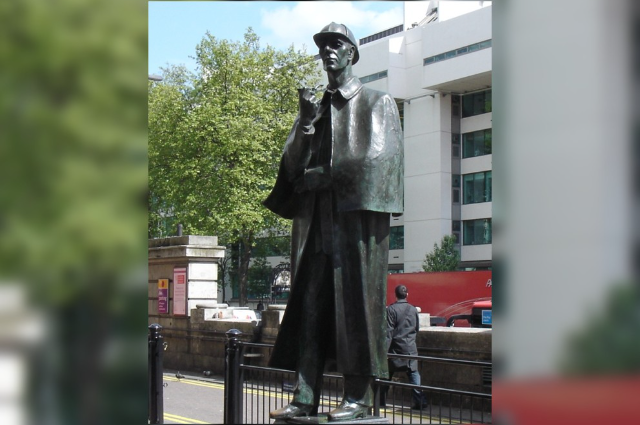
Some fictional characters stay just in one’s books, others become part of human culture. Sherlock Holmes is such a one. Sherlock Holmes remains all-the-time read and is still captivating more than a century after his birth. He is also a turnaround in psychology, sociology, philosophy, forensic science, the cinema and even in contemporary pop culture. Not many fictional characters have gained such popularity.
Sherlock Holmes is a fictional character created by the Scottish author Arthur Conan Doyle, and premiered in the novel A Study in Scarlet in 1887. However, Holmes appeared during the Victorian era when England was beginning to industrialise, discover and make new scientific advancements, to enrich through social changes, and to be a place of growing urban crime. The times were undergoing an incredible transformation, and many began to find science and logic more useful to deal with the intricacies of a modern world. Sherlock Holmes seemed less to be a detective, and more a mouthpiece for reason or order, in such a setting. He was a believer that anything mysterious and even complicated could be figured out only by observation and logical thinking.
But the brilliance of Sherlock Holmes isn't just from crime-solving. Holmes changed the definition of literature for the idea of intelligence. He wrote to readers to be aware of seemingly mundane details that can be of great significance. A footprint in the ground, the ashes of a cigar, the tone of a person's speech or the condition of a coat might be able to answer secrets which the rest of society may not be able to. Readers gained an appreciation of the roles of observation, patience and critical thinking through Holmes.
Meanwhile, Sherlock Holmes is anything but a mental steamroller. His world is accompanied by the sweetness of his personality. He is emotionally confused, in emotional isolation, and feels lonely and bored. An era of difficulties makes him relatable, despite his superhuman intellect. Dr Watson is Holmes's friend, showcasing his tender compassion and humanity. One of his key assets, and one of the keys to his everlasting popularity, is his combination of genius and vulnerability.
Sherlock Holmes' influence on the world is tremendous. Much of modern police fiction, serving as a method of crime investigation, psychological profiling and even many fictional detectives, is indebted to Holmes. His techniques are similar to those employed in scientific inquiry,y whereby the emotions and psychological and sociological backgrounds are being manifested in a wider pattern in society. Sherlock Holmes eventually changed from being a fictional character to becoming a symbol of intelligence, curiosity, and a quest for truth in fiction and everyday life.
Sherlock Holmes as the Symbol of Rational Thinking
Among the things that make Sherlock Holmes an enduring favourite is his ability to banish confusion, fear and superstition through rational thinking. Holmes is not just a detective operating within realms of cold criminal calculation; he's the very life of logic itself. A world fraught with fear and lies, Holmes would tell readers that truth is still accessible to crafty observation, analytical thinking, and mental pinpointing.
Holmes, created in the late 19th century, was a time when science and thought were in bloom. Medicine, chemistry, forensic science, and industrial technology were witnessing great advances in Victorian society. Traditional views and superstitions were coming under scrutiny. A growing faith in science and reason was emerging over myths or sentiment. It was becoming a new attitude,e and Sherlock Holmes was the quintessential agent of the change.
Holmes' intelligence always proves to be a deceptive charm. Science is the only way for Holmes to work; it's the instinct that's used by ordinary men and women. He notices things that are unnoticed by others and draws enlightening inferences from apparently insignificant observations. Through this quality, there is an understanding of the philosophical underpinning of Rationalism, which means that believing without supporting analysis and rationalising behaviour with proof or argument is unfruitful and unhelpful for the understanding of knowledge and truth.
Enlightenment philosophy also clearly has an impact on Holmes's character. This intellectual revolution in Europe stressed reason, science, doubt and the intelligence of man. Rational thinkers like René Descartes and John Locke championed their view that rational thinking would enable humanity to make progress and escape ignorance. The Enlightenment ideals continue in the fictional form of Sherlock Holmes. He has none of the superstitions and tries to rationalise as much as possible about every mystery, no matter how outlandish it may seem at first glance.
This struggle between science and superstition becomes evident when looking at such stories as The Hound of the Baskervilles. The novel's setting is shrouded in fear, and the supernatural as a haunting image is cast within an ancient and ghostly image of a hound. Many characters take supernatural and cursing for granted. But Holmes tries to solve the conundrum scientifically. He saw beyond the irrational explanations to the physical evidence, studied human motives and uncovered the truth behind the superstitions. Conan Doyle shows why it is better to seek the truth than to rely on fear-mongering imagination in the story.
The way Holmes investigates is similar to the Scientific Method-used in today's scientific research. The approach of his can be understood by following a systematic process, as follows:
- Development of concepts and ideas
- Formation of hypotheses
- Testing of evidence
- Discarding of inconvenient alternatives
- Coming to logical ends.
This is a structured approach, which is not what most detectives would do in this era. He isn't going to solve mysteries by chance or accident. Rather, he sees each case as more of an experiment in science. His techniques greatly affected not only the writing of detective fiction but the general attention and interest of the public in the science of forensic examination and criminal investigation.
Another factor of Holmes' importance as a thinker is that he used deductive and inductive logic. In many respects, Holmes' approach to solving the cases is described by the term “deduction,” yet scholars have contended that he uses both deductive and inductive reasoning in his approach. Deductive: starts with general ideas and works to specific ends; inductive: takes specific observations to create general patterns or theories.
For instance, Holmes might see the stains in the corners of a room and conclude the animals were cats due to the size, the appearance of mud tracks and his recognition of handwriting or posture, and draw a general conclusion about the animal's occupation, social class, or previous activities. This skill indicates outstanding analytical intelligence and the ability to pattern recognition. It is easy to see how Holmes processes and tests thoughts, and “selectively prints” on events of his day, but that is often how modern psychologists think. He sees things that the human brain would not have paid attention to at the subconscious level.
Holmes' oft-cited comment that “you see, but you do not observe” is a very telling insight into human perception. Most people look; most people look around, but Holmes analyses. This is one of the poles of his intellectuality. The basic point Holmes wants to convey to readers in many respects is that knowledge is not intelligence alone, but thinking intelligently and clearly.
At a more profound level, Sherlock Holmes is a representation of the ideals of humanity in its quest to tap into mental power. When the world was in danger of falling into chaos and disorder, Holmes comforted them by assuring them that logic and reason would yet prevail to reveal the truth. Across the generations, he seems to be welcomed by all, which seems to indicate that people still find value in rational thinkers in a chaotic world. In the age of misinformation and polarised attitudes, Holmes is as relevant as ever in his mission to educate society about the need to rely on evidence, question and take care not to jump to conclusions.
Thus, Sherlock Holmes is not merely a fictional detective. He is a cultural icon of logic, scientific studies, and reason. In his techniques, attitude and perspective, Holmes remains a source of inspiration to every reader to challenge their prejudgments and carefully sift the evidence, to believe in reason rather than in superstition and irrational fear.
Victorian England and the Birth of Sherlock Holmes
To grasp the ascent of Sherlock Holmes, a knowledge of the society in which he was born is necessary. Sherlock Holmes is a true Victorian-born, and the United Kingdom in the Victorian era was a world in rapid transformation. The Industrial Revolution has completely transformed society. The factories grew and mushroomed, the cities rapidly became overcrowded, and millions of people left the villages in search of employment in the cities. London developed into one of the world's biggest and busiest cities. Socio-economic development and science came from industrialisation, but with too many other drawbacks such as poverty, social inequality, crime and fear.
Life in Victorian London was a world of great contrasts. There was a great difference between rich and poor, with wealthy aristocrats living luxuriously and the working class residing in tightly populated slums with little sanitation and poor living conditions. This inequality in society fuelled increasing concerns about crime and public safety. Murders, thefts, fraud and crime from gangs were regularly documented in the newspapers, and raised the level of fear in the community. The public had to be comforted by the fact that things would be kept in order in an increasingly chaotic urban environment.
It can be seen in the light of the Historical Materialism of Karl Marx. This theory positions the economic and material factors as determinants of social institutions and human actions. The Industrial Revolution changed economic connections and social existence, and created new crimes and social unrest that are all recognised as "Urban" crimes. The Industrial Revolution changed the nature of economic connections and social existence, and created new crimes and social instability, which are all considered "Urban" crimes. Sherlock Holmes is a product of these new circumstances. He was a symbol of intellectual control in a rapidly changing society.
Holmes's character was also influenced by the development of forensic science, especially during the Nineteenth Century. Chemical analysis and handwriting examination, toxicology, and fingerprinting were becoming important methods used in criminal investigations through scientific methods. This belief in science and scientific thinking was embodied by Holmes. Unlike any other detectives, Holmes scientifically solved the cases, relying on the principles of chemistry and physics for investigations, whereas most investigators just relied on instinct. His methods of attacking the problem were very much like those used by society at that time, which was coming to trust reason and modern science.
Urban Sociology also makes contributions to the understanding of Holmes. Social scientists claim that big cities generate anonymity, isolation and social disintegration. During the turbulent times of Victorian London, it was more difficult to regulate crime because criminals would blend into the crowd of Londoners. Holmes was a character who established comprehension and order in this chaotic city-like environment. He knew the city better than anyone else, and he was more in tune with its ways than anyone.
Social Order Theory also views an important aspect of the theory and focuses on the role played by social institutions and social individuals in maintaining social stability in society. Holmes served as a "defender of the peace. If peace and morality were overthrown, Holmes re-established them with the aid of intelligence and justice. He was a favourite reader because he informed his readers that,t despite the uncertainties and fears of modern life, a place where things could still be done well, right and true.
“Sherlock Holmes” wasn't an accident, however. He's coming from the Victorian society itself. It was the Industrial Revolution, urban crime, scientific strides, and an aversion to social mores that led to the creation of a figure of logic, discipline, and stability-the detective. Holmes was the perfect figure for a time overwhelmed with a sense of chaos and confusion in the face of fast-changing times.
The Psychology of Sherlock Holmes
Sherlock Holmes's mind is an extremely interesting thing. Holmes is, is not just a detective with exceptional intelligence, he is a psychological study of observation, loneliness, obsession and cognitive brilliance. Despite the fact that his personality never fails to attract the interest of psychologists, literary scholars and neuroscientists as his methods and behaviour can be traced to several important psychological theories.
Holmes' main skill is his observational skills. He sees things that others don't even pay attention to. Either a small stain on clothing or a worn shoe, handwriting characteristics or posture will provide him with proof of an analysis. This is in line with the approach instilled in Cognitive Psychology – how humans process information, how they recognise patterns, and how they solve problems. Holmes thinking is similar to a cutting-edge analytical mechanism constantly gathering, screening and analysing information from his surroundings.
“The three words ‘you see, but you do not observe’ are a good way of summarising Selective Attention Theory.” Humans are constantly flooded with a lot of sensory information, of which most is unconsciously filtered out of the brain. Holmes develops his eyes to notice conscious observations that others aren't paying attention to. His intelligence is not merely knowledge but the mentality of trained attentiveness and observation.
Meanwhile, Holmes's genius makes him an outcast from society. Although able to solve complex mysteries, he still has a poor ability to deal with people and express his emotions. Often seems cold, distant and uninvolved. Dr Watson, his friend, plays an emotional balancing role and is a human companion. Holmes's isolation brings out the mental toll of the genius that can often be experienced by an exceptionally insightful person.
Another aspect of Holmes's psychology that's interesting is his battle with boredom. When not on a challenging case, Holmes characterises normal life as rather uninteresting and unimaginative. His drug use is highlighted in the stories, and his occasional use of drugs, especially cocaine, can be attributed to this psychological restlessness. Cocaine's ill effects were not well known in the Victorian era, but Holmes' most frequent use of the drug was for relieving mental emptiness. This could be a manifestation of ‘stimulation seeking behaviour' according to behavioural psychologists, and highly intelligent people are always looking for mental stimulation and novelty.
Some scholars today have also wondered if Holmes had exhibited traits of a high-functioning autistic or of exhibiting Asperger's syndrome. He tends to be more preoccupied with his work, forgets names easily, is not expressive physically or verbally, is more enhanced in his logical skills, and is less socially oriented than autistic people. Yet there is much debate regarding this because of the fact that in a lot of scenes, Holmes also has shown an understanding of his emotions and adaptability.
The genius of Holmes in the end was a reflection of the complexities of the human mind. He is a symbol of the strength and expense of great intelligence. He is extremely exceptional with his analytical skills, but also is separated from normal society by these skills. The equally thrilling and excruciating nature of Holmes's psychology remains highly engaging in the modern era. Not only is his mind captivating for readers, but also his struggle, even the most human struggling, that we cannot see from behind his rational façade.
The Holmes and the sociological approach to crime.
The adventures of Sherlock Holmes are not only suspenseful and mysterious, but also detective thrillers. They are also significant social documents that give insight into the world of Victorians at the time. The stories expose much more through crime itself and the criminals involved, as well as through investigations. The stories offer insights into broader issues of poverty, inequality, class divisions and social instability through crime, criminals, and investigations. Holmes's world reflects a society that is fast changing due to economic and social turmoil.
There are many themes that were explored in the Holmes stories, including one of the major sociological themes, which is crime and social inequality. During the Industrial Revolution, the wealth of Victorian England was rapidly increasing, but there was an uneven distribution. In the middle class were vast numbers of the working class, who were both impoverished and precarious. Numerous large groups of the working class lived in poverty and insecurity in the middle class as did the aristocrats and industrialists. The motives for the Holmes crimes in so many ways are related to greed, financial difficulty, inheritance and social rejection. This is based on the sociological understanding that crime more often than not has to do with various unfair social conditions as opposed to the individual.
The Conflict Theory is a perspective that can be explored and applied to this perspective, which happens to be the Marxist theory. Conflict theories suggest that inequalities in social class are a driving force of society and that power and wealth are held by a small number. In several Holmes stories, the tensions between the wealthy and the poor are revealed, as they offer a glimpse of how economic factors and social inequalities can lead to criminal activity. In many instances, crime can be seen as a result of other systemic inequities within a society.
The Holmes stories also give some insight into the boundaries between the classes in Victorian times. Holmes is at ease and integrates into various communities successfully. He talks to kings, professors, bankers, servants, labourers, beggars, as well as criminals. In these encounters, readers learn something about the harsh class division of the social structure of Victorian Britain. The point is that Holmes himself sometimes undermines the norms of his class. Not much does he care about one's social standing; instead, it's intelligence and evidence. In some tales, the little guy is good, and the rich are bad guys, or the rich are corrupt, as if being good and poor and poor but good weren't most important to the message.
Holmes is behaving as a social force of social good as well. The answer is Holmes restores stability when crime breeds fear and disorder or uncertainty, and brings forth truth and makes justice possible. This position is related to the concept of Functionalism, which is mostly the saying of Émile Durkheim. Social institutions and mechanisms play a role in guaranteeing a stable and ordered social system, according to functionalists. Holmes seems to be more like a social institution than an individual. He can solve crimes, which makes society more balanced and gives it more confidence in justice and the rationality of the situation.
Another sociological view is Symbolic Interactionism, which emphasises the meanings and symbols that are formed through social interaction. Eventually, Holmes' character extended beyond the confines of fiction. He has become a symbol around the world: his pipe, magnifying glass (microscope), violin, and investigative methods. “Sherlock Holmes” is still a well-known term for someone with an acute sense of observation or analysis, as they would perform today. In this example, it shows that a range of fictional characters can have a significant impact on social meanings and collective imagination.
The sociology of crime in Sherlock Holmes, therefore, extends beyond the role of detective, extending beyond the scope of solving mysteries. The stories tell about what happens when criminals are created by the conditions and constraints of society, how class divisions affect an individual's behaviour, and how society tries to maintain stability when facing uncertainties. Holmes' popularity was not only as a police procedural writer, but as a representation of, and hope to, society's idea of a world of change and order brought about by the force of intelligence and justice.
Sherlock Holmes and the Evolution of Detective Fiction
Sherlock Holmes is so much a part of literature that it is hard to conceive a detective story without him. There were stories of mystery long before Holmes, but Holmes was the genius who made detective fiction an intelligent, suspenseful and psychologically rich literature. He was not just entertaining to the reader; he irreversibly altered the form and perspectives of crime fiction worldwide.
The idea of the modern detective, one of Holmes' most important contributions, was his idea. He developed some of the elements of a detective story, which are standard in this genre. These included the sharp, but somewhat peculiar, detective, her faithful companion narrator, the hidden clues, the science investigation, the challenge of criminals through speculation and thought, and the gripping ending of the story itself. They were so influential that they are still followed today in crime novels, on television shows, and in movies.
Together with Dr Watson, Holmes revolutionised the story. Watson was the medium through which readers could partake in Holmes's genius. Although Watson was a clever man, he never came close to discovering anything as logically as Holmes did; readers followed him into his adventures, too. This narrative shape engendered anxiety as well as enhanced Holmes's reputation as an extraordinary person. Many subsequent crime stories would use a similar formula, that of a genius detective with another character as a partner or aide.
Holmes nurtured and expanded another literary notion of intelligence. In earlier times, heroes were often heroic because they were physically strong, brave or looked noble. But thanks to Holmes' mind, he became a hero. He proved that changes can be greater through observation, deduction and scientific study than through violence. This intellectual heroism had a great impact on twentieth-century fiction.
This is evident in the fingerprint of Holmes on subsequent fictional detectives. Hercule Poirot of Agatha Christie has several trappings to him that many associate with Holmes: He's incisive, mentally superior, and has a sharp mind. Despite their different characters and demeanour, the man of genius solving enigmas that no one can crack is a concept that derives much from Holmes.
Holmes also had a profound influence on today's superhero culture. Batman is known as “the world's greatest detective.” Batman uses observation, forensic analysis, disguise and psychological profiling like Holmes. Both of the characters have an astounding intelligence and don't always report to official institutions. Likewise, Dr Gregory House from the TV series House was indirectly influenced by the figure of Sherlock Holmes. As even the similarities in names, personality, addiction and analytical abilities demonstrate, this influence is very evident.
In the past few decades, modern crime stories, or investigative dramas, have also shown a strong resurgence of Holmesian motifs. Nineteenth-century ‘Holmes stories' are the beginning of the narrative model that is prevalent in modern exhibits on forensic science, criminal psychology and investigative deduction. The study of behaviour, decryption, and reconstructing scenes of crime, as well as profiling criminals, became popular and relatable through the excitement Holmes gave readers of the intellectual investigation.
The genius of Sherlock Holmes was that he really made detective fiction an interactive enterprise. Readers no longer just 'ate' a story. Before the detective gave their solution, they looked for clues, analysed evidence and did their best to try and solve the mystery. This approach made detective writing popular to a great extent and inspired many writers.
So Sherlock Holmes became not only a successful character in literature but one of success by name, as well. He reinvented a whole genre and established an archetype for contemporary detectives, investigators, and intellectual heroes throughout. What has remained is his legacy of realistic characters with intelligence and reason who can uncover hidden truths, in novels, movies, television and popular culture, with the persistence of that world.
The Human Side of Sherlock Holmes
Sherlock Holmes enjoys great popularity, but it is his humanity that makes him so popular, as well as his analytical brilliance and the fact that he is so smart. Holmes is not shown to be a logical problem-solving machine. The man he is behind is very complex, suffering from loneliness, emotional distances, boredom and internal turmoil. These traits are human characteristics that render him more accessible to readers despite being a brilliant genius and make him a truly psychological character of the novel.
Although Holmes is often one of the most intelligent characters, this is not the only aspect of his personality that should be remembered. Throughout the tales, he has emotional depth that emerges slowly. Holmes is often portrayed as being detached and chilling, but several occasions show him compassion, loyalty, and being morally sensitive. His humanity is most evident to Dr Watson.
Holmes and Dr Watson's friendship is a crucial emotional aspect of the tales. Watson is not only Holmes' assistant and narrator, but his closest friend; a lifeline during his extreme emotional stress. Watson can be cheerful and sympathetic; Holmes is the one with a genius for thinking. The relationship of the two is a mixture of reason and emotion. There is a high regard for Watson as regards his character by Holmes. Watson stays loyal and accompanying, though he rarely uses his emotions in public; his loyalty and company are equally important to Holmes.
This relationship can be understood using the concept of Humanistic Psychology, that isCarl Rogers's and Abraham Maslow's thoughts. Humanistic psychology focuses more on emotional development, human relationships, need for belonging. Even the most ratiocinating – on intellectual scales – among men needs companionship and understanding, as Holmes's attachment to Watson suggests. Watson helps to keep Holmes in touch with the normal human world.
Emotional-psychological weaknesses make Holmes psychologically realistic. Often suffers from boredom and mental emptiness when there are no challenging cases. His sporadic drug abuse is as much the symptom of addiction as it is the symptom of a lack of emotional health and an existential restlessness. Holmes seems, in many respects, to be always searching for meaning through mental stimulation.
This dimension relates to Existentialism as a philosophy, where issues of isolation, meaning and purpose in an uncertain world are discussed. In most times, Holmes will isolate himself from society, and life can prove boring for him. Mystery-solving is more than a career for him; it's a way to make his life make sense. He thrives when challenged, and becomes emotionally and mentally stuck when he's not.
Another important aspect of Holmes’s humanity is his moral complexity. He believes in the rule of law, but is not a law-abiding man. Holmes grants those who have done something wrong a pardon in several stories because he thinks they had a soldierly motive. Someone does something wrong, and Holmes grants him forgiveness because it is a soldierly motive in several stories. He acknowledges the limits of legal codes in referring to human morality.
This quality is related to one of the aspects of the Emotional Intelligence Theory, which distinguishes between intellectual and emotional intelligence elements of empathy and emotional intelligence and the moral awareness. Though Holmes seems cold on the outside, he is able to feel human pain on the inside. His actions make it clear that he cares as much as he cares about logical things!
So the humanity of Sherlock Holmes has been crucial to his greatness. People not only like his wit but also like his weaknesses, friendships and tribulations with his rectitude. Brilliance does not make a man human, reminds Holmes. Regardless of cognitive ability, the need for companionship, meaning and emotional connection is yearned for. This equilibrium of genius and humanity is what makes Sherlock Holmes ageless across the generations.
Lesser-known facts and smaller dimensions of Sherlock Holmes
Sherlock Holmes emerged as more than a fictional detective and grew to be a cultural icon worldwide. Housing that was near Baker Street responded to every one of these letters sent to the Baker Street address by Holmes, and many readers did take him seriously.
One well-known misconception is the line “Elementary, my dear Watson,” which wasn't exactly as it's written in Arthur Conan Doyle's stories. It gained popularity in films and adaptations, demonstrating the popularisation of Holmes' image.
In the First and Second World Wars, Holmes stories were used as psychological support to soldiers and civilians. His quiet wisdom, sound judgment and reason made him a stabilising influence in a time of crisis.
Holmes also advanced the techniques of forensic science, including the use of chemical analysis, handwriting evidence and careful examination of the crime scene before they became routinely used in the real world of investigation. His stories encouraged the prudent detective work relying on facts.
This popularity led to the formation of numerous groups dedicated to studying and commemorating his life and work, such as The Baker Street Irregulars and other Sherlock Holmes societies, which today are engaged in “Sherlockian scholarship.”
Holmes's fame resonated throughout the world, particularly in the fields of Japanese detective fiction and anime and manga, and many modern fictional detectives owe their methods and personalities to Holmes.
They are the hidden parameters that reveal not only that Holmes became a literary personality but also a strong, enduring intellectual and cultural icon whose impact is felt globally.
Sherlock Holmes in popular culture and media.
None of the fictional characters in entertainment has been adapted more than Sherlock Holmes. He is versatile as his stories have spread out in films, TV, radio, theatre, video games, anime, comics and even digital media – tons of films, TV, radio shows, video games, anime, comics and computer-based stories were produced with his stories used, so his stories shouldn't need much tidying up – let it be since they're timeless and adaptable.
Holmes is well-suited to satisfy the needs of every generation, which is why he is still popular today. Unlike most of the previous iterations that focused on the scientific method and science, contemporary media depict the psychology, genius and thought processes of Wilbur. Rather than the scientific method and science, today's renditions stress psychological complexity, genius and eccentric ideas of Wilbur.
His foray into the visual world started with silent movies of those days,s and different actors were assigned different roles, from cool and noble to eccentric and action-packed. The updating of Holmes to the modern era, such as Sherlock starring Benedict Cumberbatch, brought him a smartphone and a computer into the 21st century, but not much else, as his innate deductive skill remained intact. Likewise, "Sherlock Holmes" with Robert Downey Jr. gave one a more dynamic and action-based approach to the role.
The series Elementary again took place in modern New York, extending Holmes's adventures into themes such as emotional relationships, addiction and recovery. However, Holmes's impact extends beyond the realm of fiction, influencing the Japanese anime, manga, and gaming worlds as well, where fans engage with detective fiction.
It seems Holmes sticks with the younger generations these days through the medium of online fan communities, podcasts, memes and social media. His philosophy of observation, logic, and problem-solving is very appropriate for today's information age.
The fascination of Sherlock Holmes has stayed the same over time, era and tech, despite the many changes in setting, style and tech. Despite his death, people across the globe continue to fall for his intelligence, curiosity and pursuit of truth, making him one of the most influential figures in popular culture.
Philosophical and ethical basis of Holmes
Sherlock Holmes is a more than competent detective, but he also poses meaningful questions of philosophy and ethics in the areas of justice, morality, truth and human behaviour. In his tales, one might find that justice can often not be defined by rule; it's a broader concept.
The difference between law and justice is a primary subject in the Holmes stories. When he feels that someone acted in accordance with his suffering or unfair circumstances, Holmes lets that person off the hook, even when the person was morally correct. This is in keeping with the concept of moral philosophy, which values right and wrong outside of the rule of law.
Holmes's rulings are grounded in Utilitarianism, a doctrine of the French philosophers of the Enlightenment like John Stuart Mill or Jeremy Bentham. He fairly looks at whether the things are done according to the consequences of the action and the betterment of the entire society, and not just according to strict adherence to the law.
Furthermore, Holmes's devotion to truth and evidence is another key aspect of him. He does not believe that anything can be done on "assumptions" or "feelings" without facts, which is the baseline of ethical rational thinking. Holmes believes that logic and reasoning help him to explain the real actions of human beings.
Meanwhile, Holmes is dealing with the issue of logic versus emotion. He prizes intellectual separation, but he has feelings of loyalty, sympathy and grief, too. He is a friend of Dr Watson, representing the unity of rational and human-hearted.
Holmes knows the shades of moral ambiguity that the simple-minded hero does not know. In many of his tales, it is a question of desperation, betrayal, or suffering that causes the criminals to commit a crime, and Holmes refers to crime as both a legal and human issue.
These philosophical and ethical aspects rrenderSherlock Holmes an intellectually meaningful character even in present times. Is not just a detective solving a mystery, but a thinker who invites his readers to ponder upon justice, morality, truth and humanity itself.
Why the world's "most famous detective" is still popular today.
Sherlock Holmes is still very relevant in today's society, over 100 years since his creation. Holmes’ appeal hasn't waned, despite the changes in the world today and the fact that it's a different England than his own. Indeed, many of Holmes' attributes,s which were significant in the nineteenth century,ry are even more important in the twenty-first century. Holmes is a symbol of clear thinking, logic and clarity in an age of misinformation, digital overload and emotional polarisation.
Misinformation is one of the main factors contributing to Holmes' modern-day relevance. There is much information out there, and while social media and digital communication can be a great way to transmit information quickly, not all of it is accurate. Before facts are properly verified, rumours, manipulated narratives, and false claims influence people's opinions. The lessons that Holmes gives in the way he investigates are important for today's society. Never takes anything for granted. Rather, he is very careful to examine facts carefully, to question assumptions and to come to a conclusion after a rational analysis. His techniques make him sceptical, to check, and to be disciplined.
This relevance can be explained by what we call the Information Society Theory; in modern societies, the production of information, Communication Technologies and data exchange are increasingly shaping society. In these societies, it is critical to be able to analyse information critically. Holmes' character is fitting in this setting as he draws his most important strength from his ability to be objective and not jump to any emotional or irrational conclusions when interpreting information.
Additionally, Holmes represents the need for critical thinking in today's education and society. The world today demands people to solve complicated issues, read a lot of information and think of their own ideas. Holmes' ability to remember facts is not the only sign of intelligence; it is the ability to make logical connections between observations and question the superficial appearance. Students, researchers, investigators and intellectuals worldwide continue to be inspired by his famous knack for seeing things which everyone else missed.
Holmes is a popular young audience favourite, too. Today's youth are drawn to unusual characters who have a unique form of intellect, a complicated psyche, and a rebellious personality. This is a perfect description of Holmes. He's smart and not so smart, outgoing and withdrawn, rational and not so rational. His independent, original and uncompromising attitude towards society and its expectations can sometimes be admired by young readers and viewers.
Another factor is also accounted for by Media Theory, which explains Holmes's ongoing impact. The media continually portrays iconic characters for different audiences at different times. Holmes' existence has been maintained as he has been able to remain flexible in his identity, adjusting to different social settings. His defining attributes are the same, whether he's in Victorian London or the digital realm of smartphones and artificial intelligence: Observation, reasoning, curiosity and the search for truth.
Holmes, from a Cultural Studies point of view, has now become much more than a literary character. He's now a figure that is known to all cultures for intelligence and deduction. His image, phrases and investigative style are instantly recognised by readers all over the world, across countries and generations. Even those who don't know the original stories know what it means to be called “Sherlock Holmes-like. This illustrates the extent to which Holmes has become a cultural icon all around the world.
Holmes' continued relevance is due to a growing appreciation of analytical thinking in contemporary society. Whether in medical, criminal investigations, psychology, law or journalism, and even technology, a keen eye for observation and logical thinking are crucial. These are the professional and intellectual aspirations that are embodied in Holmes.
Sherlock Holmes is, after all, a symbol of all the things that are still deeply valued in human beings: intelligence, curiosity, rationality and the spirit to look for truth. While technologies can shift, societies can grow and change, and media forms can change, the urge to explore that which is mysterious and known is always here. Holmes lives on because he addresses the eternal human need to solve problems in a logical, sensible manner.
Conclusion
Sherlock Holmes is still one of the most significant and popular fictional characters of all time, over 100 years after he was invented. Holmes' popularity has endured over the passage of time and centuries, as well as new technologies and hobbies, because Holmes is more than a detective solving a crime. He represents the enduring trust in intelligence, observation, reason and the quest for truth among mankind.
As readers follow Holmes' adventures, they're presented with mystery and suspense-so much more. They experience the social circumstances of nineteenth-century England, the triumph of scientific ideas, the psychologies of the genius, and the dilemmas of morality and human activeness. Born in a time of industrial change and social turmoil, Holmes's techniques of scientific analysis seem very contemporary. The world is a more misinformed, polarised, and superficial place than ever before, and Holmes brings back the value of critical thinking, evidence and intellect.
Meanwhile, Holmes is still very much a flesh-and-blood character. There is loneliness, emotional turmoil, moral dilemmas and a sense of meaning under his extraordinary mind. Even the smartest mind needs company and friendship, as he finds out from his friendship with Dr Watson. This is the juxtaposition of wisdom and fragility that bestows Holmes with a perennially soft side.
Sherlock Holmes' impact has not only been felt in literature but has also permeated popular culture. His legacy still lives on in modern detective fiction, forensic science, crime thrillers, psychological profiling, films and television and even with superhero stories. Holmes is recreated in every generation because of his fundamental qualities, which are relevant to all generations. He can fit in with any time period, as the fascination with mystery, knowledge and truth has not gone the way of the dinosaur.
But what is possibly the best contribution of Sherlock Holmes is to have made thinking almost seem heroic in itself. He taught them that it is important to observe, learn the details, and sometimes the truth is found under what may seem like a perfectly ordinary surface. Holmes solved not just mysteries, but changed the way people looked at the world, in many ways.
Sherlock Holmes lives on, therefore, because of the strength and the intricacy of the human mind. He is rational but can be compassionate, detached but can be very human, and analytical but has a good sense of morality. Sherlock Holmes will live on in the minds of readers, in the pages of books, and in the hearts of those who delight in these qualities: curiosity, intelligence, and the search for truth.
References (APA 7th Edition)
- Conan Doyle, A. (2003). A study in scarlet. Penguin Classics. (Original work published 1887)
- Conan Doyle, A. (2001). The adventures of Sherlock Holmes. Wordsworth Editions. (Original work published 1892)
- Conan Doyle, A. (2008). The Hound of the Baskervilles. Oxford University Press. (Original work published 1902)
- Bentham, J. (1996). An introduction to the principles of morals and legislation. Oxford University Press. (Original work published 1789)
- Descartes, R. (1998). Discourse on method and meditations on first philosophy (D. A. Cress, Trans.). Hackett Publishing.
- Durkheim, E. (1982). The rules of sociological method (S. Lukes, Ed., W. D. Halls, Trans.). Free Press. (Original work published 1895)
- Locke, J. (1980). Second treatise of government. Hackett Publishing. (Original work published 1689)
- Marx, K., & Engels, F. (1978). The Marx-Engels Reader (R. C. Tucker, Ed.). W. W. Norton & Company.
- Maslow, A. H. (1954). Motivation and personality. Harper & Row.
- Mill, J. S. (2001). Utilitarianism. Batoche Books. (Original work published 1863)
- Porter, R. (1997). The greatest benefit to mankind: A medical history of humanity. W. W. Norton & Company.
- Rogers, C. R. (1961). On becoming a person: A therapist’s view of psychotherapy. Houghton Mifflin.
- Thomas, R. (1995). Detective fiction and the rise of forensic science. Cambridge University Press.
- Van Dover, J. K. (1994). We must have certainty: Four essays on the detective story. Susquehanna University Press.
- Weller, P. (2007). The Victorian city and the world of Sherlock Holmes. Greenwood Press.
- Wiltse, E. B. (1998). The Sherlock Holmes companion. Barnes & Noble Books.
- BBC. (2010). Sherlock [TV series]. Hartswood Films.
- Ritchie, G. (Director). (2009). Sherlock Holmes [Film]. Warner Bros. Pictures.
- Doherty, R. (Creator). (2012). Elementary [TV series]. CBS Television Studios.