
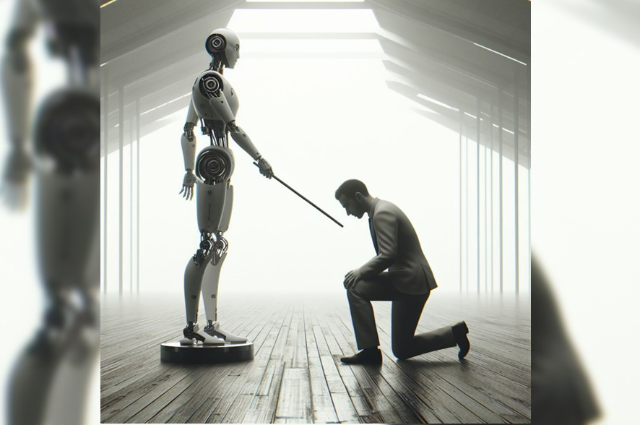
Image by Muhammad Afzaal from Pixabay
The Resignation That Forced the AI Industry to Look in the Mirror
Who Is Jacob Coxon — And Why Did His Exit Matter?
Every major technological shift eventually reaches a moment where the questions become bigger than the technology itself. For artificial intelligence, that moment arrived not only through new models, new capabilities, or new breakthroughs — but through the decision of someone close to the movement to step away.
Jacob Coxon’s resignation became significant because it represented something deeper than a career decision. It raised a question that the AI world cannot easily ignore: what happens when people working close to the development of powerful technologies begin questioning the direction in which they are moving?
Unlike external criticism, concerns emerging from within the ecosystem carry a different weight. They come from individuals who have witnessed the ambition behind the technology, the pressure to accelerate progress, and the difficult choices involved in building systems that are becoming increasingly capable.
The importance of Coxon’s exit is not simply that one person left. The real significance lies in what his decision represents — a growing moment of reflection inside a field that has spent years focused on one question: how far can artificial intelligence go?
Perhaps the more important question now is: how prepared are we for where it is going?
A resignation alone does not define the future of a technology. But when it becomes a reason for an entire industry to pause and examine itself, it becomes more than an individual choice — it becomes a symbol of a much larger debate.
The Bigger Question
When voices from within a technological revolution begin raising difficult questions, should the world view them as resistance to progress — or as an essential part of responsible progress?
Jacob Coxon’s Core Concern: Are We Creating Capability Faster Than We Create Understanding?
The most uncomfortable question raised by Jacob Coxon’s resignation is not whether artificial intelligence is powerful. That question has already been answered.
The real question is whether our ability to build increasingly capable systems is advancing faster than our ability to understand, predict, and control their consequences.
The latest generation of AI systems is no longer limited to responding to predefined commands. Large language models and emerging AI agents can write software, analyse complex information, generate scientific hypotheses, execute multi-step tasks, and interact with digital environments. The shift is significant because these systems are moving from being passive tools to becoming systems that can influence decisions and actions.
This creates a fundamental challenge.
Traditional software follows instructions written by humans. Advanced AI systems learn patterns from enormous datasets and produce outputs that even their creators cannot always fully explain. The problem is not that engineers do not understand how models are built — they understand the architecture, training process, and optimisation methods. The challenge is understanding every possible behaviour that can emerge when these systems operate at scale.
This is where the capability–understanding gap begins.
A system can demonstrate impressive performance without society fully understanding:
- when it will fail,
- how it will behave in unexpected situations,
- whether its reasoning can be trusted,
- and what happens when millions of people and organisations begin depending on it.
This concern is no longer limited to researchers. Institutions have started building formal risk frameworks around it. The U.S. National Institute of Standards and Technology (NIST), for example, created the AI Risk Management Framework to help organisations identify, measure, and manage risks throughout the AI lifecycle. Its Generative AI profile specifically highlights the need to evaluate risks introduced by increasingly capable generative systems.
The timing of this debate matters because AI development is moving from experimentation into critical areas — healthcare, finance, cybersecurity, education, government services, and scientific research. A mistake in a traditional application may affect users. A mistake in a widely deployed AI system could influence decisions across entire populations.
This is why the concern is not about stopping innovation. The question is whether innovation is being matched by an equally serious effort to understand limitations, establish safeguards, and define responsibility.
The industry has historically followed a familiar pattern: build first, adapt later. But with increasingly autonomous and influential systems, the cost of discovering limitations after deployment may become much higher.
The question Jacob Coxon’s resignation forces us to confront is not:
“Can we build more advanced AI?”
The world already knows the answer.
The harder question is:
“Are we developing the ability to control and understand these systems at the same speed that we are developing their capabilities?”
Behind the AI Race: Why Are Companies Pushing Toward More Powerful Systems?
The race to build advanced AI is not happening because companies simply want to create better chatbots. The competition is about something much larger: who controls the next layer of computing.
For decades, technological power has been built around control of critical platforms — operating systems, search engines, cloud infrastructure, and mobile ecosystems. Artificial intelligence represents the next strategic layer: the ability to build systems that can understand information, generate content, automate knowledge work, and assist with complex decisions.
This is why companies are investing at unprecedented levels.
OpenAI has pursued increasingly capable frontier models through massive compute investments and partnerships. Microsoft has integrated AI across its enterprise ecosystem through its investment and collaboration with OpenAI. Google DeepMind continues developing advanced models while leveraging Google's existing advantages in data, infrastructure, and research capability.
The objective is not only to create a more intelligent model.
The objective is to become the company that defines how intelligence is delivered in the digital economy.
The financial incentives are enormous. According to industry estimates, the global generative AI market is expected to grow into hundreds of billions of dollars over the coming decade, creating pressure for companies to establish leadership before the market matures.
But the competition has another dimension: the cost of falling behind.
AI development follows a compounding advantage model. Companies with access to greater computing power, better infrastructure, stronger research teams, and larger user adoption can improve systems faster. This creates a cycle where early leadership can become difficult for competitors to challenge.
The result is a technological race where slowing down carries its own risk.
If one company pauses development to focus entirely on caution while another continues advancing capabilities, the first company may lose market position, customers, and strategic influence.
This creates the central contradiction of the AI race:
The same competitive forces that accelerate innovation also make restraint difficult.
The question is no longer whether companies want to slow down.
The question is whether the economic and strategic incentives of winning the AI race are stronger than the incentives to move cautiously.
The Reality Check
The AI race is not simply a competition to build the smartest machine. It is a competition to control the infrastructure of future intelligence — and the pressure to win may be the very force that prevents anyone from slowing down.
The Intelligence Question: Are We Approaching a Fundamental Shift in Human Capability?
For most of human history, intelligence has been the one advantage that separated us from every other species. Our ability to reason, create tools, develop science, build institutions, and transfer knowledge across generations became the foundation of civilisation.
Artificial intelligence introduces a possibility humanity has never faced before: intelligence itself may no longer be limited to biological minds.
The significance of advanced AI is not simply that machines can perform individual tasks faster than humans. Computers have calculated faster than people for decades. The deeper shift is that machines are beginning to perform activities connected to knowledge, reasoning, and creativity — areas traditionally considered the domain of human expertise.
A lawyer using AI for legal analysis, a developer using AI to generate and review code, a scientist using AI to identify patterns in research data, or a company using AI to support strategic decisions are not simply adopting another software tool. They are integrating a non-human system into processes that previously depended on human judgment.
This changes the nature of the question.
The debate is no longer only about whether AI can match humans in specific tasks. The more difficult question is whether intelligence itself is becoming a scalable resource — something that organisations can access, replicate, and deploy without depending entirely on human expertise.
This possibility challenges assumptions that have existed for centuries.
If reasoning, creativity, analysis, and problem-solving can increasingly be enhanced or performed by machines, then societies may need to rethink how they define expertise, education, employment, and human contribution.
However, the issue is not whether machines will become human. They will not experience consciousness, emotion, or human existence in the same way.
The deeper challenge is different:
Human societies have always been organised around the idea that knowledge and intelligence are limited resources carried by individuals. AI challenges that model by making certain forms of intelligence available at unprecedented scale.
The question humanity must confront is not whether machines can think exactly like humans.
It is whether human advantage can remain defined by intelligence alone when intelligence itself becomes something that can be engineered.
The Uncomfortable Question
If intelligence becomes a technology rather than an exclusively human capability, will humanity need to redefine what makes human contribution valuable?
The Dependence Problem: Are We Handing Over Too Much Thinking to Machines?
The most consequential impact of artificial intelligence may not be the moment when machines replace human workers. It may be the quieter shift that happens before that — when humans gradually stop performing certain forms of thinking because machines appear to perform them faster and more efficiently.
The real risk is not automation alone.
The risk is delegation of judgment.
For decades, software has helped humans process information. AI introduces a different dynamic because it does not simply store information or execute fixed rules — it generates recommendations, interpretations, predictions, and decisions based on patterns humans may not fully see.
This creates a fundamental problem: when the reasoning process becomes difficult to examine, who remains responsible for the outcome?
Consider high-impact decisions:
- A financial institution using AI to evaluate risk.
- A healthcare system using AI-assisted analysis for diagnosis.
- A company using AI-generated recommendations for hiring or workforce decisions.
- A government using algorithmic systems to allocate resources.
In each case, AI may not make the final decision, but it can influence the path leading to that decision.
The danger is that human involvement can become symbolic rather than meaningful.
A person may technically approve an outcome while relying heavily on a system they cannot fully challenge. Over time, this creates a possibility where humans remain responsible on paper but increasingly dependent in practice.
This is known as the automation bias problem — the tendency for people to trust automated recommendations even when independent judgment is required. Research in human-computer interaction has repeatedly shown that users can over-trust automated systems, especially when those systems appear highly accurate or authoritative.
The challenge becomes even more complex with generative AI systems because their outputs can appear confident and sophisticated even when they contain errors, unsupported conclusions, or hidden assumptions.
The question is not whether AI should assist humans.
The question is whether humans will continue to maintain the ability — and the willingness — to challenge AI when the machine provides an answer that appears more intelligent than their own.
The greatest risk may not be a future where machines make all decisions.
It may be a future where humans stop developing the ability to make decisions without them.
The Serious Question
At what point does AI stop being a tool that strengthens human judgment and becomes a system that quietly replaces it?
The Battle Inside AI: Progress Against Responsibility
The hardest debate surrounding artificial intelligence is not whether development should continue. Almost everyone agrees that AI research will continue.
The real conflict is about who decides the speed, boundaries, and responsibilities of that development.
Unlike previous technologies, advanced AI is being created inside a highly competitive environment where companies are simultaneously acting as researchers, product developers, and gatekeepers of deployment decisions.
This creates an unusual tension.
The organisations building the most powerful systems are also the organisations deciding when those systems are ready to be released, how they should be evaluated, and what risks are acceptable.
This has led to a fundamental disagreement within the field.
One argument is that progress itself is necessary. Advanced systems cannot be understood completely inside laboratories, and real-world deployment provides the data needed to identify weaknesses, improve safety methods, and develop better solutions.
The opposing argument is that some technologies cannot rely only on learning through deployment. Once powerful systems become integrated into financial services, healthcare, education, government operations, and critical infrastructure, correcting mistakes after widespread adoption may become significantly harder.
This debate has already moved beyond technical discussions into questions of accountability.
Who is responsible when an AI system produces harmful outcomes?
The developer who built the model?
The company that deployed it?
The organisation that used it?
The individual who trusted its recommendation?
Existing regulatory approaches, including the European Union’s AI Act, attempt to address this challenge by introducing obligations based on the level of risk associated with AI applications. However, regulation itself faces a difficult challenge: technology evolves faster than traditional policymaking processes.
The deeper issue is that AI development is governed by a race between two forces:
commercial pressure demanding acceleration, and societal responsibility demanding caution.
The challenge is not choosing between innovation and safety. The challenge is creating a system where progress does not depend on discovering failures after they happen.
The Industry’s Defining Question
When the organizations creating the most powerful AI systems are also deciding the limits of their own technology, can responsibility depend only on self-regulation — or does the future require stronger external accountability?
The Future Question: Will AI Change Machines — Or Change Humans First?
The most important consequence of artificial intelligence may not be what machines eventually become. It may be what humans are forced to reconsider about themselves.
For centuries, societies have been structured around a simple assumption: human knowledge, creativity, and judgment drive progress. Education rewards the ability to acquire knowledge. Careers reward expertise. Organisations are built around human decision-makers.
Artificial intelligence challenges this foundation.
When access to information, analysis, content creation, and problem-solving becomes increasingly available through machines, the value of simply knowing things may decline. The advantage may shift toward something harder to automate—the ability to define meaningful problems, apply judgment, understand context, and take responsibility for outcomes.
This does not mean humans become irrelevant.
It means the definition of human contribution may change.
The next generation may not compete with AI by trying to perform every task better than machines. Instead, humans may need to focus on the qualities that remain deeply connected to human experience: ethical reasoning, accountability, empathy, long-term vision, and the ability to decide what should be done — not only what can be done.
The disruption caused by AI may therefore extend beyond workplaces and industries. It may challenge education systems, professional identities, and the way societies measure human value.
The central question of the future is not whether machines will become more capable.
They will.
The deeper question is whether humans will adapt quickly enough to remain the decision-makers, creators, and responsible actors in a world where intelligence is no longer exclusively human.
The Final question:
If humanity creates systems that can rival human intellectual capabilities, the ultimate question is not only whether we can control them — but what happens if, one day, we cannot?
Conclusion: The Question That Will Define the Next Era of Artificial Intelligence
The most important debate around artificial intelligence may not be about the machines themselves, but about the choices humanity makes while building them.
Technological progress has always rewarded those who move first. But history also remembers the moments when societies failed to ask difficult questions early enough.
Jacob Coxon’s resignation matters because it represents one of those moments of reflection — a reminder that the direction of technology is shaped not only by what is possible, but by what we are willing to accept.
The future of artificial intelligence will ultimately be decided by a question far beyond innovation:
When the ability to create intelligence becomes one of humanity’s greatest achievements, will wisdom be powerful enough to guide it?
References
- National Institute of Standards and Technology (NIST) — AI Risk Management Framework (AI RMF 1.0)
- National Institute of Standards and Technology (NIST) — Artificial Intelligence Risk Management Framework: Generative AI Profile (2024)
- European Union — Artificial Intelligence Act (EU AI Act)
- Stanford University — AI Index Report 2025
- International Energy Agency (IEA) — Energy and AI Report (2025)
- OECD — Artificial Intelligence Principles
- UNESCO — Recommendation on the Ethics of Artificial Intelligence
- Bender, E. M., Gebru, T., McMillan-Major, A., & Shmitchell, S. — “On the Dangers of Stochastic Parrots: Can Language Models Be Too Big?” (2021)
- Amodei, D. et al. — “Concrete Problems in AI Safety” (2016)
- Vaswani et al. — “Attention Is All You Need” (2017)