
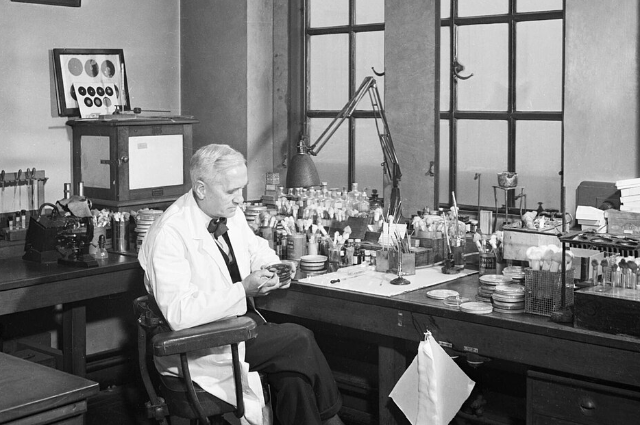
In the late summer of 1928, Alexander Fleming returned from a holiday to his cramped laboratory on the third floor of St Mary’s Hospital in London. Fleming was a Scottish bacteriologist of considerable skill but modest reputation, known by those who knew him as precise in his work yet famously untidy in his habits. Scattered across his bench were stacks of Petri dishes containing colonies of Staphylococcus bacteria, left incubating before his departure. Upon sorting through them, Fleming noticed something that would have caused a lesser researcher to toss the plate into the steriliser: one dish had been contaminated by a fuzzy, blue-green mould. But around the mould, the staphylococcal colonies had vanished. There was a clear zone—a halo of dissolved bacteria—where the mould had grown.
Fleming did not discard the plate. He paused, and according to the oft-repeated lore of the discovery, he remarked to a colleague: “That’s funny”. That moment of curiosity, rather than the accident itself, is where the story of penicillin truly begins. The mould was later identified as a strain of Penicillium notatum, and the active substance it produced was named " penicillin " by Fleming. He had discovered the first true antibiotic, a compound that could kill pathogenic bacteria without harming human tissue—a possibility that had eluded medical science for decades.
Yet the story of penicillin is not a simple tale of a lone genius and a lucky break. It is a story about the difference between noticing something and understanding it, between a discovery and a cure. Fleming’s contribution was indispensable, but it was also incomplete. The full realisation of penicillin’s power would require a second act, performed by a different cast of scientists, under the shadow of a world war.
What Fleming Actually Did, and Did Not Do
Popular narratives often depict Fleming as a passive beneficiary of serendipity, a man who stumbled upon a miracle and then let it languish for a decade. This caricature is unfair and historically inaccurate. Fleming did far more than simply notice the mould. He grew the Penicillium in pure culture and tested its effect on a range of bacteria, demonstrating that it inhibited many pathogens while leaving white blood cells unharmed. He injected penicillin into mice and rabbits to test its toxicity, finding it non-lethal. He even used a crude preparation of the mould broth to treat a colleague suffering from pneumococcal conjunctivitis, with dramatic success. He published his findings in 1929 in the British Journal of Experimental Pathology, a paper that, while modest in its claims, laid the groundwork for everything that followed.
What Fleming could not do was purify penicillin. The active compound was fragile, unstable, and present in the mould broth only in minute quantities. Fleming was a bacteriologist, not a biochemist. He lacked the chemical expertise to isolate and stabilise the substance, and he eventually concluded that penicillin’s instability made it impractical as a systemic therapeutic. He ended his active research on the compound around 1931, though he continued to follow its progress and freely distributed cultures of the mould to anyone who requested them. One of those cultures would eventually reach Oxford.
For nearly a decade, penicillin remained a laboratory curiosity. Fleming’s paper was cited but not pursued with urgency. The prevailing view in medicine was that bacterial infections were best treated with sulfa drugs, which had been developed in the 1930s and showed real promise. Penicillin, by contrast, seemed too difficult to produce in quantity and too unstable to be useful. The mould sat in culture collections, waiting.
Oxford, War, and the Chemistry of Survival
The second act of the penicillin story began in 1938 at the Sir William Dunn School of Pathology at Oxford University. Ernst Chain, a German-born biochemist who had fled the Nazi regime, came across Fleming’s 1929 paper while researching antibacterial enzymes. Intrigued, he proposed to his department head, Howard Florey, that they investigate penicillin systematically. Florey, an Australian pathologist with a reputation for rigour and a temperament that some found cold, agreed.
The Oxford team—Chain, Florey, and a young biochemist named Norman Heatley—faced a formidable challenge. To produce even a small amount of pure penicillin, they had to grow the mould in enormous quantities of broth, then extract and stabilise the active compound. Heatley, a practical and inventive scientist, devised the extraction methods and the assay techniques that made the work possible. By 1940, they had enough crude penicillin to test on mice. The results were astonishing. Mice infected with lethal doses of streptococci survived when treated with penicillin; untreated mice died.
The first human patient was treated in 1941: a policeman named Albert Alexander, who had developed a severe infection after scratching his face on a rose bush. His condition improved dramatically within days, but the Oxford team ran out of penicillin, and Alexander relapsed and died. The episode demonstrated both the drug’s power and the production bottleneck that stood between penicillin and the world.
By this time, Britain was at war, and the resources for large-scale pharmaceutical production were stretched thin. Florey and Heatley travelled to the United States in the summer of 1941, carrying precious cultures of the mould and seeking help from American drug companies. The American government, recognising the military necessity of an antibacterial drug, coordinated an unprecedented effort. The Northern Regional Research Laboratory in Peoria, Illinois, became a centre for fermentation research. There, in another moment of serendipity, a laboratory assistant named Mary Hunt found a mouldy cantaloupe at a local market. The mould, Penicillium chrysogenum, produced penicillin in far greater yields than Fleming’s original strain—roughly a thousand times more.
With the cantaloupe strain, American companies like Pfizer and Merck were able to scale up production using deep-tank fermentation, a technique adapted from the production of citric acid. By the time of the D-Day invasion in June 1944, enough penicillin was available to treat all severe casualties among the Allied forces. Howard Florey later acknowledged that without the American industrial effort, there would not have been sufficient penicillin for the Normandy campaign.
The Myth and the Man
In 1945, Fleming, Florey, and Chain were awarded the Nobel Prize in Physiology or Medicine. Fleming became a global celebrity, his face on magazine covers, his name synonymous with the miracle drug. Florey, who disliked publicity, largely retreated from the public eye, and Chain, who felt his contribution had been underappreciated, nursed a lifelong resentment. The popular narrative that emerged was one of British genius: Fleming the solitary discoverer, the modest Scot whose genius was recognised at last.
This narrative, while not entirely false, obscures the collaborative and contingent nature of the discovery. Fleming’s insight was essential—without his observation and his initial characterisation of the substance, the Oxford team would have had nothing to work with. But without Chain’s biochemical curiosity, Florey’s organisational drive, Heatley’s ingenuity, and the American industrial machine, penicillin would have remained a laboratory curiosity. The Nobel committee recognised this by awarding the prize to all three men, but the public imagination proved harder to correct.
Fleming himself was ambivalent about his fame. He was a shy man who, when knighted in 1944, reportedly insisted on pouring drinks for everyone present, including the tea lady. In his Nobel lecture, he warned presciently that the misuse of antibiotics could lead to the emergence of resistant bacteria—a warning that has proven tragically accurate. He noted that “the time may come when penicillin can be bought by anyone in the shops. Then there is the danger that the ignorant man may easily underdose himself and, by exposing his microbes to non-lethal quantities of the drug, make them resistant”. More than seventy years later, antibiotic resistance is one of the most urgent threats to global public health, and Fleming’s words read like a prophecy.
Why the Story Still Matters
The true story of penicillin is not a fairy tale of accidental genius. It is a story about the ecology of scientific discovery: how an observation made in one laboratory can lie dormant for a decade until a different set of skills, resources, and urgencies converge to turn it into a therapy. Fleming’s prepared mind allowed him to see something that others might have missed, but it took a biochemist, a pathologist, an industrial laboratory, and a world war to make that observation matter.
The story also carries a cautionary lesson about how we tell the history of science. The impulse to simplify—to credit a single hero and to treat the messy, collaborative, often frustrating work of science as a series of eureka moments—does a disservice to the truth and to the future. If we believe that discoveries happen by accident, we may fail to invest in the patient, unglamorous infrastructure of research that makes discovery possible. If we believe that one person’s insight is sufficient, we may undervalue the chemists, the technicians, and the production workers who translate a laboratory finding into a medicine that can reach a patient.
Fleming died in 1955, just a decade after penicillin became widely available. He lived long enough to see the drug transform medicine, to see previously fatal infections become routine, and to see the first signs of the resistance that would eventually erode its power. His legacy is not just the discovery itself, but the lesson he drew from it. “One sometimes finds what one is not looking for,” he said. “When I woke up just after dawn on September 28, 1928, I certainly didn’t plan to revolutionise all medicine by discovering the world’s first antibiotic, or bacteria killer. But I guess that was exactly what I did”.
The mould that drifted onto Fleming’s plate was an accident. The decision to look twice was not.
References:
- Wellcome Sanger Institute Blog. “Breaking the mould – the story of penicillin.” 2019.
- Science | AAAS. “Mould That Made History.” 2021.
- Brown, Kevin. Penicillin Man: Alexander Fleming and the Antibiotic Revolution. Review in PMC. 2005.
- Vellar ID, Hugh TB, Goldsworthy PD, McFarlane AC. “Howard Florey, Alexander Fleming and the fairy tale of penicillin.” Medical Journal of Australia. 2002;177(1):52-53.