
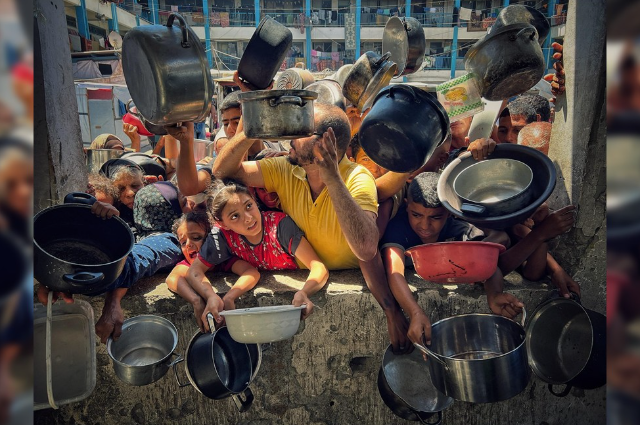
Image by hosny salah from Pixabay
A War Beyond Borders
As the world watches the unrelenting destruction in Gaza, the situation has moved beyond the confines of regional warfare and into the realm of international law, putting its viability, applicability, and—above all—humanity to the test. Tens of thousands of civilians have been killed, displaced, and vital civilian infrastructure has been destroyed in the ongoing Israel-Hamas conflict, which was rekindled by the October 7, 2023, bombings. In addition to the obvious human suffering, this struggle raises an existential query: Has the ability of international law to impose restrictions diminished?
The global debate on the legitimacy, applicability, and enforcement of international humanitarian law (IHL) has been reignited by the International Court of Justice (ICJ) proceedings that South Africa started against Israel in late 2023. One of the most important court cases in the years following World War II is the lawsuit, which alleges violations of the 1948 Convention on the Prevention and Punishment of the Crime of Genocide. However, it is questionable if the law is only a mute observer in the theatre of war as bombs drop and humanitarian channels collapse.
The Gaza Conflict's Legal Anatomy
The legal aspects of the Gaza issue stem from a number of important international agreements, all of which are intended to protect human dignity even during military conflicts. The cornerstone of humanitarian law controlling both international and non-international armed conflicts is found in the 1949 Geneva Conventions, namely Common Article 3 and Additional Protocol I. They forbid collective punishment, attacks on people, and targeting of medical facilities, educational institutions, and aid workers.
War crimes and crimes against humanity are further defined under the Rome Statute of the International Criminal Court (1998), which makes it illegal to intentionally target civilians, forcibly relocate people, or use famine as a weapon of mass destruction.
But the 1948 Genocide Convention sets a higher bar for the invocation of genocide, requiring not only proof of mass murder but also the deliberate destruction, in whole or in part, of a national, ethnic, racial, or religious group. Historically, cases of genocide have been uncommon and challenging to prove due to this aspect of dolus specialis, or specific intent.
According to South Africa's application to the ICJ, Israel has demonstrated genocidal intent against Palestinians in Gaza by its actions, which include systematic bombardment, starvation brought on by the siege, and statements made by state leaders. Israel, on the other hand, argues that its military operations are carried out in self-defence in accordance with Article 51 of the UN Charter and are only targeted against Hamas, a designated terrorist organisation.
The Self-Defence Principle and Its Definition
A state's inalienable right to self-defence against armed assault is acknowledged under Article 51. Although Israel's use of this authority is legally valid in theory—especially in light of the Hamas attack that killed over a thousand civilians—its implementation has brought up difficult issues with necessity and proportionality. The right to self-defence must satisfy two essential requirements: the necessity of using force and the proportionality of the reaction, according to the Caroline Doctrine (1837) and later case law, such as the Nicaragua Case (1986). Israel's ongoing air and ground operations, which have destroyed entire neighbourhoods, are criticised for going much beyond what is considered proportionate.
Article 33 of the Fourth Geneva Convention, which specifically prohibits collective penalties and retaliation against protected persons, may also be violated by the collective punishment of Gaza's 2.2 million inhabitants through blockades on food, fuel, and water supplies. Deliberately impeding humanitarian assistance could also be against Additional Protocol I's Article 54(1), which forbids starvation of civilians as a tactic of war. Therefore, even if self-defence is a right, its use in Gaza has become hazy, straddling the line between legal defence and illegal assault.
The Genocide Convention: A Reflection on Ethics
In its interim ruling on January 26, 2024, the ICJ acknowledged that the acts claimed by South Africa are "plausible" under the Genocide Convention, but it refrained from finding Israel guilty of genocide. The Court ordered Israel to guarantee humanitarian access, take all necessary precautions against acts of genocide, and provide regular reports on its compliance.
Despite being provisional, this decision was significant because it upheld the Court's duty to protect the moral conscience of the world. A troubling duality in international law, however, is highlighted by the ICJ's lack of enforcement authority: law without force and force without law. Despite the ICJ's judgment, Israel's acknowledged transgressions and ongoing military actions expose a structural flaw in the international legal system. Geopolitical alignments, especially the United States' frequent vetoes that protect Israel from criticism, continue to paralyse the UN Security Council, which is empowered by Article 94(2) of the UN Charter to execute ICJ rulings.
Many academics have questioned whether the "rules-based international order" is actually an order of exceptions, where the law is applied selectively, and impunity is the privilege of power, as a result of this political dysfunction.
The International Criminal Court's Function: Postponed Justice
The International Criminal Court (ICC) has jurisdiction over individual criminal culpability for war crimes and crimes against humanity, whereas the ICJ decides state responsibility. Karim Khan, the ICC Prosecutor, has previously stated that his office is looking into claims of crimes under the Rome Statute made by Israeli and Hamas officials. But the ICC has a lot of political and jurisdictional obstacles to overcome. Despite the State of Palestine's 2015 accession, which gives the Court jurisdiction over crimes committed in Palestinian territories, Israel is not a State Party to the Rome Statute. However, Israel contests Palestine's status as a state, resulting in a legal maze that could permanently delay accountability.
The failure to deliver timely justice erodes public faith in international criminal law. When law lags behind atrocity, it ceases to deter and instead becomes a postscript to human suffering.
Humanitarian Intervention versus State Sovereignty
The balance between state sovereignty and the duty to protect (R2P) is another long-standing debate in international law that is brought back to life by the Gaza conflict. Sovereignty carries the obligation of protecting populations from genocide, war crimes, and ethnic cleansing, as acknowledged in the United Nations' 2005 World Summit Outcome Document.
R2P operationalisation has remained selective, nevertheless. The world saw its paralysis in Syria, Yemen, and now Gaza, but it was invoked in Libya (2011). Even when the threshold of mass crimes is arguably reached, the lack of collective humanitarian involvement reveals the unequal distribution of moral outrage in global politics. If sovereignty continues to outweigh humanity, the R2P doctrine risks degenerating into a hollow promise — a relic of diplomatic idealism with no bearing on reality.
A Legal and Ethical Disaster: The Humanitarian Crisis
The moral consensus of civilisation is embodied in international law, which is more than just a collection of technical regulations. Human life is inviolable, according to the 1948 Universal Declaration of Human Rights, the 1966 International Covenant on Civil and Political Rights, and the 1989 Convention on the Rights of the Child. However, in Gaza, refugee settlements have become target areas, and hospitals have become graveyards. Conditions that shock humanity's collective conscience are described in reports from Médecins Sans Frontières and the UN Office for the Coordination of Humanitarian Affairs (OCHA). The legal tools designed to stop this kind of suffering are dormant; they are not enforced, ignored, or possibly unenforceable.
This humanitarian crisis highlights a sobering fact: political will, not universal adherence, is what sustains international law in its current form. And when that fails, the boom of missiles drowns out the law, which then becomes a whisper.
The Way Ahead: Restructuring the Accountability Architecture
The Gaza conflict ought to be a turning point for rethinking how international law is enforced. Specifically, three reforms are necessary:
- Enhancing ICJ Enforcement: In situations involving mass atrocities or genocide, the Security Council's political veto must be limited. Humanitarian justice could not be held captive by geopolitics if a plan similar to the "Responsibility Not to Veto" concept, which is supported by France and Mexico, were proposed.
- Universalising ICC Jurisdiction: Strong governments are able to avoid responsibility due to the ICC's jurisdictional flaws. No state or leader would be beyond the law if a worldwide treaty modification were to establish universal jurisdiction over fundamental international crimes.
- Empowering Regional Legal Mechanisms: Regional courts and human rights bodies — such as the European Court of Human Rights and the African Court on Human and Peoples’ Rights — should be equipped with expanded mandates to address cross-border conflicts. Justice should not be centralised in The Hague alone but decentralised across the world’s moral geography.
Conclusion
More than just a tragedy, the Gaza conflict serves as a window into the frailty of the global justice system. A crisis of credibility is indicated by the UN's inertia, the ICC's sluggish investigations, and the ICJ's temporary measures. Humanity's ability to overcome barbarism, which is the fundamental promise of international law, is currently being put to the test in real time. The post-war legal order runs the risk of becoming outdated if the international community does not maintain even the most basic norms of protection for people. The UN Charter and the Geneva Conventions' tenets are the moral foundation of the contemporary world, not just historical relics.
Therefore, Gaza's legal silence is not only a regional failing, but also a failure of civilisation as a whole. The world community must now determine whether to rehabilitate the law as a functional tool of justice or let it remain a relic of desire. For when the law stops protecting the weak, it stops binding the mighty, and in that quiet, humanity is lost.