
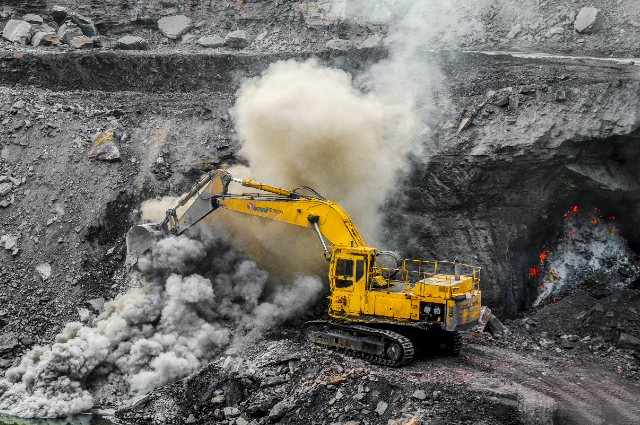
On the evening of 31 March 2026, the ground gave way in Baghmara, Dhanbad. Without warning, the earth cracked open beneath a residential settlement, and houses began to sink. Families ran out as floors split and walls collapsed, watching their homes disappear into deep fissures formed by fires burning far below the surface.
For the residents of the Jharia coalfield region, this was not an unprecedented shock but a feared reality finally unfolding. Beneath their homes, coal seams have been burning for decades, releasing heat and toxic gases while hollowing out the land above. What appears solid during the day can collapse overnight, turning ordinary lives into emergency evacuations.
This is not a disaster frozen in history or confined to reports.
It is present‑day India, where a city that fuels the nation’s growth continues to live on land that can fail at any moment.
Agenda
- To trace the historical origins of the Jharia coalfield fires and explain how unscientific mining led to a century‑long crisis.
- To document the human cost of underground fires, including land subsidence, displacement, and everyday risks faced by residents of Dhanbad.
- To examine policy responses and implementation gaps, with a focus on rehabilitation and fire‑control efforts.
- To analyse the ethical conflict between industrial growth and human safety, using recent subsidence incidents as evidence.
- To question how long a city critical to India’s energy needs can be allowed to burn while its people continue to live above the flames.
Dhanbad: Powering a Nation While Burning Itself
Often called India’s coal capital, Dhanbad occupies a critical place in the country’s industrial story. Located in Jharkhand, the district sits atop the Jharia coalfield, one of India’s oldest and most valuable reserves of prime coking coal—an essential raw material for steel production. For decades, coal extracted from this region has fuelled power plants, steel factories, railways, and urban growth far beyond its borders.
The economic importance of Jharia cannot be overstated. Its coal supports major public and private enterprises and plays a direct role in sustaining India’s energy security and industrial expansion. From infrastructure development to employment generation, Dhanbad has long been presented as a symbol of progress driven by natural resources.
Yet beneath this contribution lies a growing contradiction. The same underground seams that power industries have been burning uncontrollably for over a century. These fires weaken the land, release toxic gases, and make entire settlements structurally unsafe. While the nation benefits from the coal extracted here, local communities bear the cost—living on unstable ground, breathing polluted air, and facing the constant threat of land subsidence.
Dhanbad thus represents a stark imbalance: a city indispensable to national growth, yet forced to risk its own survival for it. The scale of India’s dependence on its coal stands in sharp contrast to the scale of danger faced daily by those who live above the burning earth.
How the Fire Started: A Century‑Old Mistake That Never Ended
The fires beneath Dhanbad did not begin as a natural disaster; they were the outcome of human decisions made over a century ago. Mining in the Jharia coalfield started in the late nineteenth century, long before environmental safeguards or scientific extraction methods were enforced. Private operators mined coal aggressively, prioritising output over stability, and left behind unfilled underground voids once seams were exhausted.
These abandoned cavities allowed oxygen to enter coal layers deep below the surface. Over time, spontaneous combustion began—slow, invisible, and unchecked. The first recorded coal fire in Jharia dates back to 1916, but the absence of regulation and coordinated response meant the flames were neither isolated nor extinguished. Instead, they spread laterally and vertically, travelling through interconnected seams beneath towns, roads, and settlements.
As mining expanded through the twentieth century, so did the fires. Nationalisation of coal mines in the 1970s brought oversight under public sector companies, but by then, the damage was extensive. Hundreds of fire zones had already formed, many burning at depths where direct firefighting was no longer feasible. What began as isolated ignition points evolved into a permanent underground inferno, fed continuously by exposed coal and fractured geology.
The consequences of these early failures are still unfolding. The fires weaken the earth from within, turning solid land into fragile crust. Over decades, this slow erosion manifests as surface cracks, sinking roads, collapsing houses, and sudden land subsidence. The crisis facing Dhanbad today is not the result of recent negligence alone—it is the accumulation of a hundred years of unplanned extraction, delayed accountability, and missed opportunities for containment.
In Jharia, the past has never stayed buried. It burns relentlessly beneath the present.
Living Above an Inferno
For thousands of families in and around the Jharia coalfield, danger is not an occasional disruption—it is part of everyday life. Underground fires continuously release toxic gases such as carbon monoxide and methane, making the air unsafe to breathe, especially in poorly ventilated homes. Residents report chronic respiratory problems, eye irritation, headaches, and skin ailments, while children and the elderly remain the most vulnerable.
The physical landscape itself offers no reassurance. Houses develop cracks that widen silently over weeks. Roads sink unevenly, electric poles tilt, and hand pumps release warm water—often a warning sign of fire beneath. In many neighbourhoods, residents sleep lightly, alert to unfamiliar sounds from the ground below, knowing that subsidence can occur without warning.
What makes life in Dhanbad uniquely precarious is the uncertainty. A structure that stands firm today may collapse tomorrow. Entire settlements exist on land officially marked as “unsafe,” yet relocation remains incomplete or delayed. Many families refuse to leave despite the risk—not out of denial, but necessity. Livelihoods, schools, and social ties are rooted here, and rehabilitation sites are often far from work opportunities.
Survival in these areas is shaped by constant compromise. People repeatedly rebuild cracked homes, avoid certain rooms believed to be unstable, and memorise escape routes rather than evacuation plans. Festivals, weddings, and ordinary moments of happiness unfold under the shadow of possible collapse. In Jharia, life continues not because it is safe, but because there is nowhere else to go.
The underground fires may be invisible to the outside world, but for those living above them, they define every aspect of existence—quietly turning ordinary life into a daily act of endurance.
When the Ground Finally Gave Way
What residents had feared for years became reality in the spring of 2026. On 31 March, land subsidence struck parts of Baghmara in Dhanbad, forcing families to flee as cracks tore through homes and the ground collapsed beneath residential structures. Houses tilted, walls split apart, and deep fissures appeared where streets had existed just hours earlier. The collapse was sudden, leaving little time for preparation—only escape.
Less than a month later, the danger escalated. On 24 April 2026, a far more severe subsidence event shook the same region. Twenty‑one houses were damaged or destroyed, entire families were displaced, and residents were injured while attempting to salvage belongings from structures already declared unsafe. What remained was a landscape of fractured earth, half‑standing walls, and settlements erased overnight.
These incidents were not isolated accidents but visible consequences of a crisis long documented by experts. The land in Baghmara lies above active underground fires, where burning coal weakens the soil layer by layer. Over time, the surface loses its ability to bear weight until collapse becomes inevitable. For years, warning signs—cracks, heat emissions, sinking roads—had been present. Yet habitation continued, largely because relocation remained slow and uncertain.
For those affected, the disaster was not just structural loss but emotional rupture. Homes built over generations disappeared within minutes. Livelihoods were disrupted, children were displaced from schools, and families were forced into temporary shelters with no clarity about permanent rehabilitation. What unfolded in Baghmara was not merely a local emergency—it was a reminder that in Jharia, survival depends as much on timing as it does on policy.
The question these collapses raised was unsettlingly simple: if the danger has been known for decades, why does action arrive only after the ground gives way?
Rehabilitation Delayed: Promises, Plans, and Ground Reality
Recognising the growing danger posed by the Jharia coalfield fires, the government introduced the Jharia Master Plan (JMP) in 2009, aimed at fire control, land stabilisation, and the phased relocation of affected populations. The plan identified dozens of settlements as unsafe and proposed rehabilitation through housing projects, infrastructure development, and alternative livelihood support.
However, progress on the ground has remained slow and uneven. While thousands of families have been relocated over the years, many more continue to live in high‑risk zones due to delays in land acquisition, limited housing availability, and resistance rooted in livelihood concerns. Rehabilitation sites are often located far from workplaces, making relocation economically unviable for daily wage earners and informal workers dependent on the coal economy.
In 2025, a revised Jharia Master Plan was approved to address earlier shortcomings, with increased financial allocation and renewed emphasis on time‑bound execution. Yet for residents of areas like Baghmara, these announcements offer little immediate reassurance. Fires continue to burn, land continues to weaken, and evacuations often occur only after visible collapse forces action.
The gap between policy and lived reality remains wide. Rehabilitation, when delayed, becomes reactive rather than preventive. Families are moved after homes are lost, not before danger becomes irreversible. As a result, trust between affected communities and implementing agencies has steadily eroded.
What the Jharia crisis reveals is not the absence of plans, but the cost of postponement. In a landscape where the ground itself is unstable, delay is not neutral—it is dangerous.
Growth vs Life: The Ethical Crossroads
Dhanbad stands at a moral junction that extends beyond geography. On one side lies India’s industrial ambition—steel production, energy generation, and economic growth driven in large part by coal extracted from the Jharia region. On the other side are communities that have spent generations living on land that is steadily becoming uninhabitable.
Coal from Jharia continues to support national development, even as the cost of that development is borne almost entirely by residents. The benefits are distributed far beyond the district, while the risks—fire, collapse, displacement, and illness—remain tightly concentrated. This imbalance raises a difficult ethical question: who pays the price of progress, and who gets to decide that price?
Policies often frame the issue in terms of compensation and relocation, but these measures address consequences rather than causes. For families forced to leave their homes, rehabilitation is not merely a logistical process; it involves the loss of social networks, access to work, and a sense of belonging. Yet staying behind carries its own risks, turning survival into a daily negotiation with danger.
The dilemma is not about choosing industry or people. It is about acknowledging that sustainable growth cannot rely on permanent human sacrifice. When economic output repeatedly outweighs human safety, development loses its moral foundation.
Dhanbad’s crisis forces the nation to confront an uncomfortable truth: progress measured only in tonnes of coal and megawatts of power is incomplete. Until human life is treated as a non‑negotiable priority, the ground beneath this city—and the values guiding its future—will remain dangerously unstable.
What Happens If the Fire Is Ignored
The danger posed by the Jharia coalfield fires extends far beyond collapsing houses and displaced families. If left unresolved, the crisis threatens to evolve into a broader environmental, social, and economic emergency. Underground fires continue to spread slowly, rendering more land uninhabitable each year and increasing the scale of displacement. What is now a regional problem risks becoming one of India’s largest climate‑linked internal migration challenges.
Environmentally, the fires contribute to long‑term air and soil degradation. Continuous emissions of greenhouse and toxic gases worsen local air quality and add to climate stress. Water sources become contaminated, vegetation struggles to survive, and land once used for habitation or agriculture is permanently lost. These impacts do not remain confined to Dhanbad—they ripple outward, affecting surrounding districts and ecosystems.
Socially, prolonged inaction deepens inequality. Communities living atop fire zones are often economically vulnerable, lacking the resources to relocate independently. Delays in rehabilitation trap generations in cycles of risk, illness, and insecurity. Over time, emergency responses replace planned development, making governance reactive rather than preventative.
Most critically, ignoring Jharia sets a precedent. It signals that environmental degradation and human displacement are acceptable costs of resource extraction. As India continues to rely on mining‑dependent regions, the failure to resolve Dhanbad’s crisis raises uncomfortable questions about how similar risks elsewhere will be addressed—or ignored.
Jharia is not merely a problem to be managed; it is a warning. The fires beneath Dhanbad illuminate what happens when economic urgency consistently outruns environmental responsibility and human safety. The longer the flames burn unchecked, the higher the cost—measured not just in land and resources, but in lives permanently uprooted.
The Question That India Must Answer
Dhanbad is not asking for sympathy; it is demanding acknowledgement. The fires beneath the Jharia coalfield have burned long enough to expose the limits of delayed action and selective attention. Every collapse, evacuation, and cracked home reinforces a truth that can no longer be ignored: this crisis is not sudden, and it is not unavoidable.
The city continues to supply coal essential to national growth, yet its people live with a level of risk few others are asked to accept. Development, when detached from human safety, becomes extraction without responsibility. The question, therefore, is no longer about identifying the problem—it is about deciding priorities.
How long can a nation benefit from a city while allowing it to remain unsafe?
How many warnings must surface before prevention replaces reaction?
And at what point does progress lose meaning if it is built over lives lived in fear?
Dhanbad is burning, slowly and persistently. Whether it continues to do so will depend not on the availability of plans, but on the urgency to act before the ground gives way again.
Disclaimer
This article is based on publicly available government reports, court records, verified news coverage, and institutional research. It does not intend to sensationalise tragedy, but to document and analyse an ongoing humanitarian and environmental crisis with journalistic responsibility.
References
- https://en.wikipedia.org
- https://www.downtoearth.org.in
- https://timesofindia.indiatimes.com
- https://ndtv.in/jharkhand-news
- https://pib.gov.in
- https://www.thehindu.com
- https://www.jrdadhanbad.in