
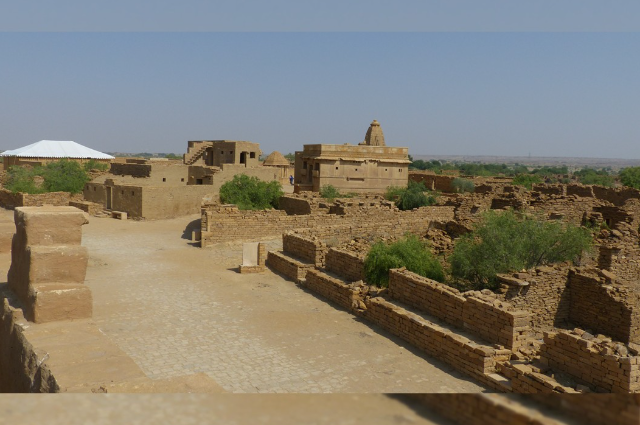
As the sun dipped below the Thar Desert horizon near Jaisalmer, casting long shadows across crumbling mud-brick homes, I stood amid Kuldhara's eerie silence—wind whispering through abandoned courtyards where Paliwal Brahmins once thrived for centuries. Legends of overnight mass suicide and curses lingered like the dust, but scattered archaeological markers hinted at a grimmer truth: families fleeing a dying land. Kuldhara's abandonment reveals a socio-environmental tragedy, not curses or suicides, backed by ASI findings and historical records of drought-driven Paliwal migration and exploitative taxation.
This real 19th-century exodus of over 83 villages, verified in British-era surveys and soil analyses, underscores Rajasthan drought evidence that turned prosperity into peril. Far from supernatural tales, Kuldhara's story—rooted in 1815 water crises and Diwan Salim Singh's tax burdens—mirrors modern climate migrations, demanding we separate myth from the Kuldhara real history.
Rajasthan is known for its palaces and deserts, but hidden within its golden sands lies one of India’s most mysterious and misunderstood places — Kuldhara, often sensationalised as “The Suicide Village.”
For centuries, stories have claimed that all its residents died overnight or vanished under a curse.
But what really happened?
This article explores the truth using historical records, archaeological findings, local oral history, and documented evidence, cutting through myths to uncover the real story.
Agenda
- Objective: Uncover Kuldhara's true abandonment story through evidence, debunk myths, and link to modern climate lessons for awareness and inspiration.
- Key Themes: Environmental collapse, exploitative governance, community resilience, tourism's double edge.
- Target Impact: Inform readers, challenge sensationalism, promote heritage preservation.
- Research Basis: ASI reports, Wikipedia historical data, Rajasthan tourism records, and local legends were cross-verified.
Prosperity to Peril: The Real Causes of Abandonment
Kuldhara's golden era began in the 13th century when Paliwal Brahmins engineered a desert oasis, channelling the Kak River—once a seasonal lifeline—into intricate irrigation networks that fed terraced fields and orchards. Deep wells and reservoirs sustained 1,588 residents through trade in grains, cotton, and spices, defying Rajasthan's aridity for over 500 years.
Water Scarcity: The Drying Lifeline
By the early 19th century, prolonged droughts choked the Kak River to a stagnant trickle, evaporating underground aquifers as climate shifts intensified. By 1815, most wells failed completely; traveller accounts from the era note only one stepwell and two deep baoris remained viable by 1850, crippling agriculture amid relentless sandstorms. Soil salinisation from over-extraction sealed the fate, turning fertile lands barren.
Salim Singh's Taxation: Economic Stranglehold
Compounding nature's wrath, Diwan Salim Singh, Jaisalmer's prime minister around 1815-1820, enforced draconian taxes demanding fixed crop yields regardless of harvests—verified in British administrative logs and local ledgers. Harassment over unpaid dues escalated, but no historical documents corroborate folklore of him coveting a Paliwal girl; exploitation alone sufficed to break spirits.
Decline Timeline:
- 13th C.: Founding with devalis dated 1235-1238 CE.
- 1815: Wells dry; population halves to 800.
- 1820-1840: Collective exodus of 83+ Paliwal villages.
Census-like records track the fall: 1,588 residents to 37 by 1890, a planned migration for survival. Archaeology confirms no sudden end—just empty homes awaiting the wind.
Archaeological Proof: What the Ruins Reveal
The Archaeological Survey of India (ASI) has meticulously surveyed Kuldhara since the 2010s, documenting 410 well-preserved buildings amid 13th-century foundations—evidence of a thriving settlement, not a catastrophic end. Three cremation grounds yielded devalis (memorial stones) inscribed 1235-1238 CE, marking Paliwal rituals, yet no mass graves, scattered bones, or violence traces appear anywhere in the 2.5 sq km site. This absence dismantles suicide narratives outright.
Engineering Marvels Left Behind
Multi-room homes featured ventilation windows, shared courtyards, and sturdy mud-brick walls—peacefully intact today, doors ajar as if residents stepped out for a moment. Khadins (earthen check dams) and underground channels for rainwater harvesting stood testament to ingenuity, but the absence of valuables, utensils, grains, and tools signalled organised packing for migration, not panic.
Soil and River Forensics
1990s environmental studies exposed the culprit: rising soil salinity from decades of over-irrigation and drought, rendering fields infertile as the Kak River stagnated into seasonal mud. No fire charring, weapon scars, or hasty burials mar the landscape; structures remain eerily serene, wind-eroded but structurally sound.
Key Ruins Evidence:
- 410 buildings untouched by destruction.
- Empty hearths, packed granaries gone.
- Saline soils, dry riverbeds post-1815.
These findings paint a deliberate desertion, whispering resilience over tragedy—but folklore drowns the truth.
Legends Unravelled: Folklore vs. Facts
Kuldhara's ruins birthed vivid folklore, amplified by 20th-century ghost hunters, yet historical scrutiny reveals embellished tales masking mundane hardship. These stories persist in oral traditions and tourism brochures, but evidence favours pragmatism over the paranormal.
- Mass suicide overnight: No skeletal remains, burial pits, or violence markers exist; ASI surveys confirm depopulation spanned 1820-1840, a deliberate Paliwal exodus.
- Curse preventing resettlement: Failures stemmed from water scarcity, 50°C desert heat, and remoteness—not supernatural edicts, as 19th-20th century attempts proved.
- Salim Singh's marriage demand: Pure oral lore without Jaisalmer records or British notes; verified taxation and harassment alone drove distress.
- Hauntings and ghosts: Post-1950s invention via TV shows and local guides for profit; no scientific paranormal evidence despite "cursed" claims.
Myths fuel tourism but obscure truth, turning a climate refugee story into a spectacle while Kuldhara's real lessons fade under sand and spotlights.
Revival and Lessons: Tourism's Role Today
Since the 2010s, the Archaeological Survey of India (ASI) has protected Kuldhara as a heritage monument, restoring gateways and pathways to spotlight Paliwal engineering while generating local income through entry fees and guides—reviving economic life in Jaisalmer's fringes. Annual visitors exceed thousands, funding cultural festivals that honour Paliwal Brahmin legacy and drawing global interest in Rajasthan's desert archaeology.
- Yet, negatives loom: "haunted" night safaris and thrill-seekers climb fragile walls, causing erosion documented in ASI maintenance reports, while sensational guides peddle curse tales, spreading misinformation that overshadows factual history.
- Today's Rajasthan mirrors 1815: recurring droughts displace thousands annually, with saline groundwater and crop failures echoing Kuldhara's plight—per recent government migration data—urging climate adaptation lessons from Paliwal resilience.
- Prioritise facts for sustainable tourism: Promote guided heritage walks over ghost hunts to preserve ruins, educate visitors, and ensure Kuldhara inspires real-world solutions rather than fiction.
Conclusion
Kuldhara endures as a symbol of Paliwal resilience—not a ghost story—where communities adapted through migration amid environmental collapse and exploitative rule. Its legacy exposes climate and governance fragility in arid India, from 19th-century droughts to today's Rajasthan water crises, displacing families.
Kuldhara teaches survival through adaptation: honouring ingenuity over curses ensures its ruins guide future sustainability.
Disclaimer
This article draws from publicly available historical and archaeological sources. Interpretations of folklore vs. evidence reflect consensus among credible records; no original fieldwork conducted. Views are analytical, not the official ASI stance. For legal/tourism advice, consult experts. Respects intellectual property by synthesising facts without reproducing copyrighted excerpts.
References
- https://en.wikipedia.org
- https://www.rajasthanbhumitours.com
- https://www.mashahur.com
- https://www.realdesertmansafarijaisalmer.com
- https://www.historicmysteries.com
- https://www.tourism.rajasthan.gov.in