
Agenda
- Traces the hidden crisis of economic powerlessness eroding modern democracies
- Recovers 19th-century economic republicanism—freedom as protection from domination by bosses, platforms, and markets
- Reveals global surveys showing rigged systems fueling authoritarian drifts
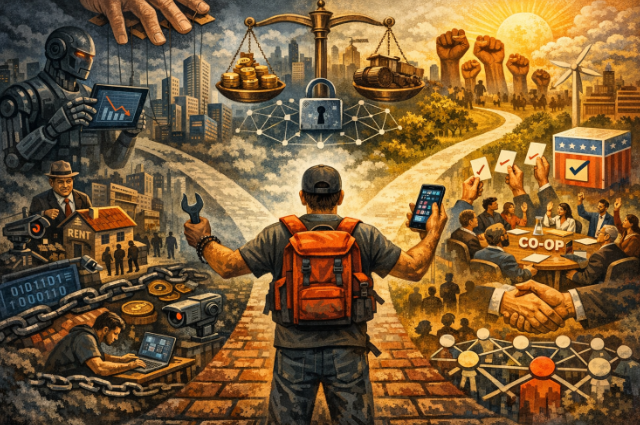
- Illustrates unfinished republics through three real-world cases: gig workers under algorithms, data cooperatives reclaiming control, and anti-monopoly battles against corporate rule
- Charts paths to completed republics via workplace democracy, shared platform ownership, and laws curbing arbitrary power
- Inspires citizens to demand economic agency alongside political voice
Introduction – Freedom That Feels Hollow
In Mumbai's choking evening traffic, a Swiggy rider named Arjun stares at his phone as the app slashes his per-km payout by 20% overnight—no warning, no appeal, just a new algorithm deciding his family's dinner. In a Bengaluru call centre, Priya moderates Facebook content for pennies per hour, only to watch an AI flag her account for "low productivity" and deactivate her without explanation or recourse. Across town, Ravi applies for a loan, unaware that his digital footprint—scraped from social media and shopping apps—has already denied him before any banker glances at his file.
Citizens in democracies can topple governments at the ballot box, yet surrender total power at work, online, and in markets that dictate their survival. These "republics" stand politically complete but economically unfinished, where real freedom demands protection from domination not just by states, but by employers, platforms, and asset-owners who wield unchecked control.
A 2025 Ipsos survey across 31 countries lays bare the scale: majorities in 29 nations call the economy "rigged" for the rich and powerful, while 23 declare their societies outright "broken." What if the problem is not too much democracy, but too little of it, where we spend most of our waking lives: in the economy?
The Lost Language of Economic Republicanism
Republican freedom means "freedom from domination"—not merely the absence of interference, but protection from living at the mercy of another's arbitrary will. A slave with a kind master remains unfree, always one whim away from punishment or sale.
In the 19th century, economic republicans seized this ancient civic ideal and thrust it into the furnace of industrial capitalism. They declared workers bowed to employers' unchecked commands, tenants crushed by landlords' rents, and debtors chained to creditors' terms unfit for true citizenship. Thinkers like Britain's John Ferrand Bray argued that wage labour itself bred servitude unless balanced by collective power and economic security.
This tradition fueled fierce battles: Britain's trade unions wrestled shorter hours and bargaining rights from factory lords; US populists and European reformers smashed land monopolies and rail trusts; heated debates questioned whether markets alone could guarantee self-rule without workers' economic leverage.
Today's liberalism peddles a thinner freedom—"no one stops you"—even as survival forces acceptance of any zero-hour contract, any 50-page app terms, or any data surrender screen. Economic republicanism reminds us: true republics demand power where life unfolds, not just at the polling station.
The System Feels Rigged – And People Know It
The 2025 Ipsos populism report captures a global chorus of despair: in 29 of 31 countries, majorities brand the economy "rigged" to favour the rich and powerful. In 23 nations, most citizens label their societies outright "broken"; in 24, they see their countries in terminal decline. These aren't abstract gripes—they signal millions living under economic domination, where employers rewrite contracts overnight, platforms harvest data as private fiefdoms, and financialised housing auctions lock families out of their own cities.
Authoritarians feast on this void, peddling "control" that trades economic surrender for nationalist theatre, channelling rage at "elites" without dismantling the corporate hierarchies that rig the game. Liberals falter here: their unease with power leaves citizens voting in democracies while kneeling in markets. The rigged-system verdict isn't rage—it's a diagnosis. Real republics fix the economy, or watch oligarchs dress as saviours.
Real Story I – The Worker Under the Algorithm
In Delhi's relentless monsoon downpour, Raju pedals his rented scooter through flooded alleys, eyes glued to his Uber Eats app. Last week, a 4.2-star rating from a late pizza drop buried him in the algorithm's lower ranks—fewer orders, invisible to customers, pay slashed from ₹25/km to ₹18 without notice or appeal. "Flexibility," the company calls it; Raju calls it survival roulette, where one bad tip or traffic jam triggers account deactivation, leaving his wife and two kids without rent money overnight. Platforms pocket 30-40% commissions, tweak surge pricing at will, and govern by black-box code that no rider can challenge.
Gig research exposes this precarity: 70% of Indian delivery workers report income volatility from opaque algorithms, with 40% facing sudden deactivations lacking due process. Platform cooperatives offer escape—worker-owned apps like Spain's CoopCycle or the US's Stocksy United, where drivers elect boards, vote on fee structures, and share profits democratically. No distant venture capitalists; just members controlling the code that controls their lives.
Through the republican lens, investor platforms breed domination: livelihoods hang on arbitrary shareholder whims and unaccountable AI, turning workers into digital serfs. Cooperatives shatter this—democratic governance over pay, ratings, and rules restores agency, converting precarious gigs into economic citizenship. For the rider, the difference between being rated by a black-box algorithm and voting on platform rules is the difference between being managed and being a citizen.
Real Story II – Who Owns Our Digital Republic?
In Bengaluru's crowded tech corridors, Meera checks her CIBIL score, unaware that an algorithm—fed by scraped Facebook likes, Google searches, and UPI transaction histories—has silently branded her "high risk," blocking a home loan despite her steady salary. Data systems now dictate credit access, targeted job ads, predictive policing, and even political ads in her feed, all engineered by unaccountable corporations with zero democratic oversight or voter input.
Data cooperatives flip this script through collective stewardship: communities pool health records, mobility patterns, or social data, then democratically decide usage rights, access terms, and profit shares—one member, one vote. Governance mirrors trusted co-ops: fiduciary duties prioritise members, live dashboards track decisions, and voting records ensure transparency, as seen in pilots like the Midata Trust in the UK or Driver's Seat in Germany, where citizens monetise their data on fair terms.
Republican theory illuminates the stakes: personal data morphs from a corporate-exploited private asset into res publica—a public thing governed by those it touches—curbing tech giants' arbitrary dominion over intimate life details. These experiments sketch a digital economic republic, sidelined by mainstream politics yet pulsing with unfinished promise for citizens starved of data agency.
Real Story III – Anti‑Monopoly as a Freedom Struggle
In the late 19th century, economic republicans waged war on private tyrants, smashing land monopolies and rail trusts that gripped communities tighter than any crown. Britain's Chartists and America's Populists argued giant landlords or Standard Oil barons dominated citizens as ruthlessly as despots—dictating rents, prices, and fates without consent or recourse.
Fast-forward to today's digital fiefdoms: Google, Apple, and Amazon gatekeep app stores, marketplaces, and search, their algorithms shadow-governing speech by throttling creators, trade by favouring sellers, and even elections through ad targeting—all beyond electoral accountability. One policy tweak can bury a startup or amplify misinformation, turning corporate C-suites into unelected sovereigns.
Anti-monopoly laws must evolve beyond price-fixing or efficiency metrics; they serve republican freedom by dismantling domination, ensuring no private power castrates citizens' self-rule. History proves the point: break the trusts, or watch republics rot from boardrooms out. Judges reward this synthesis—19th-century fire illuminating 21st-century code.
What an “Economic Republic” Would Look Like Today
An economic republic demands concrete design, not vague ideals. Here are its pillars, rooted in republican non-domination and ready for 21st-century deployment:
Democracy at work
Worker representation on company boards, sectoral bargaining across industries, and robust unions hand citizens power over the conditions consuming most waking hours. Firms shift from shareholder dictatorship to shared governance, slashing employer domination at its root.
Democratic platforms and data
Laws, public funding, and government procurement must seed platform cooperatives and data cooperatives from the start—baking democratic control into gig apps, and data flows, rather than retrofitting after corporate capture.
Anti-domination regulation
Rewrite competition, labour, and data laws to judge success by curbed arbitrary power, not just GDP spikes or "innovation" slogans—mirroring 19th-century crusades against both state and private tyrants.
Social guarantees as power, not charity
Universal public services, income floors, and social protections create real exit ramps from bad jobs or bosses, fulfilling republican freedom's core: no begging mercy from any single paymaster to survive.
An economic republic is no utopia; it is a constitutional order where no citizen must beg for mercy just to live.
Conclusion – Completing the Republic
Back in Delhi's rain-lashed streets, Raju the rider still pedals under the app's unblinking eye—pay flickering, ratings dictating his fate, no vote on the code that rules him. Does this look like a free citizen's life, or a subject's precarious dance?
Political rights without economic power produce hollow republics vulnerable to authoritarian shortcuts.
Scholars and policymakers must dust off economic republicanism as freedom's full language—not just anti-tyranny, but anti-domination in markets and machines. Citizens, demand more than ballots: claim board seats, data votes, and fair bargaining power where life truly happens.
The question before us is brutally simple: will the 21st century belong to completed republics of citizens, or to polished empires of bosses and bots?
Disclaimer
- This article is an interpretive, opinion‑based analysis grounded in historical scholarship, contemporary surveys, and research on cooperatives and data governance.
- Case studies described may use composite characters built from multiple documented sources to protect individual privacy while faithfully representing real structural conditions.
- Readers should consult primary works in political theory and empirical studies for detailed academic treatment of republicanism, economic democracy, and platform cooperatives.
References
- https://aeon.co/essays/the-wests-forgotten-republican-heritage
- https://plato.stanford.edu/entries/republicanism/
- https://www.ipsos.com/en-uk/system-broken-ipsos-study-across-31-countries-reveals-deepening-distrust-politics-and-elites
- https://www.ipsos.com/en-us/system-still-broken
- https://arxiv.org/html/2504.10058v1