
Agenda:
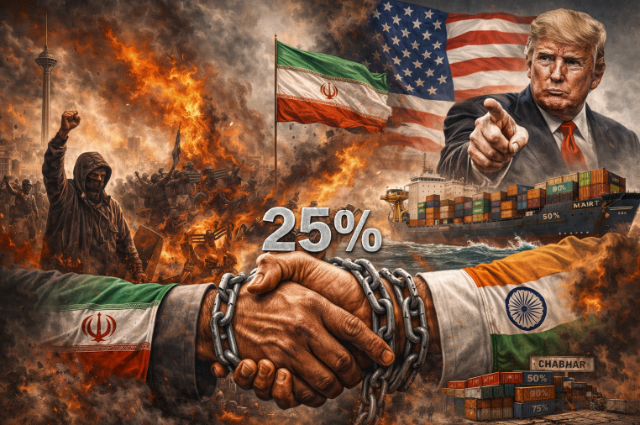
To analyze the humanitarian and geopolitical crisis in Iran as of January 2026 and evaluate the strategic and economic "double-bind" placed on India by the Trump administration’s aggressive new tariff policies.
The Streets of Tehran: A Winter of Discontent
By the second week of January 2026, the silence across Iran’s capital is no longer a sign of peace; it is a symptom of a nation being forcibly muted. A chilling "digital iron curtain" fell on January 8th, when authorities initiated a near-total nationwide internet blackout. In the void where social media feeds and news cycles once hummed, there is now only the rhythmic echo of security boots on asphalt and the muffled grief of families searching for the missing. What began in late December as localised strikes in the Grand Bazaar over a collapsing currency has, in mere weeks, metastasised into the most significant domestic threat to the Islamic Republic in half a century.
- The Human Toll: A Massacre in the Dark
While the initial reports you may have heard suggested 600 deaths, the reality emerging from behind the blackout is far grimmer. As of January 15th, human rights monitoring groups like HRANA and Iran Human Rights (IHR) have verified at least 2,600 fatalities, with some activist estimates soaring as high as 12,000. These are not just statistics; they represent a generation of youth—many under the age of 30—met with live ammunition in cities like Tehran, Shiraz, and Karaj. Hospitals are reportedly overwhelmed, and the judiciary has already signalled its intent to conduct "fast-track trials" for the 18,000 to 50,000 citizens currently detained, many under the dire charge of moharebeh (enmity against God). - The Spark: The Collapse of the Rial
The catalyst for this uprising was not a single political event, but the terminal breath of a dying economy. By early January, the Iranian Rial plummeted to a historic low, trading at an astronomical 1.4 million to 1.5 million per US dollar. This hyper-depreciation has rendered the purchasing power of the average citizen "virtually zero," making basic necessities like bread and medicine unaffordable. With inflation stubbornly lodged above 40%, the "shopkeeper strikes" of the bazaar evolved into a general uprising of the hungry—a desperate demand for dignity in the face of absolute economic ruin. - The Digital Iron Curtain: Choking the Narrative
The state’s use of a "sophisticated and selective" internet shutdown is a calculated tactic of war. By whitelisting only government propaganda channels while severing 99% of global connectivity, the regime has attempted to hide the scale of the crackdown from the world’s eyes. This communication void doesn't just hinder protest organisations; it serves as a shroud, allowing the most brutal elements of the state to operate with perceived impunity. As the world stares into this digital abyss, the "Real Story" of January 2026 is being written in blood on the streets of Tehran, long before the first bytes of data can confirm it.
The "Trump Doctrine" 2.0: Tariffs as Diplomacy
The internal Iranian crisis has been met with a swift, transactional response from Washington that shifts the paradigm of international sanctions. Moving beyond the traditional playbook of freezing assets or blacklisting banks, President Trump has introduced a more direct, aggressive mechanism: Secondary Tariffs. This strategy transforms trade access into a geopolitical weapon, turning allies into enforcers of American foreign policy.
- The 25% Ultimatum: Diplomacy via Truth Social
On January 13, 2026, the U.S. administration bypassed traditional diplomatic cables to announce an "effective immediately" 25% tariff on any nation "doing business" with the Islamic Republic of Iran. By framing the order as "final and conclusive," the White House has bypassed the lengthy negotiation periods typical of trade disputes, citing the violent crackdown in Tehran as a justification for immediate economic isolation. - Leverage over Dialogue: The Stark Choice
This policy places New Delhi in a profound strategic "double-bind." While India’s bilateral trade with Iran is valued at approximately $1.7 billion (less than 0.2% of its total trade), it is a vital outlet for India's agricultural and pharmaceutical sectors. However, this $1.7 billion must now be weighed against the $86.5 billion in exports India sends to the United States. The "Trump Doctrine" forces a choice between civilizational continuity in the Middle East and survival in the world’s largest consumer market. - The Escalation: The 75% Cumulative Wall Critically, this new levy does not exist in isolation. For Indian exporters, 2026 has already been a year of unprecedented friction. This 25% Iran-linked tariff stacks on top of an existing 50% burden already in place:
- 25% Reciprocal Tariff: Implemented in mid-2025 as part of the broader "America First" trade realignment.
- 25% Punitive Duty: Slapped on Indian goods specifically for New Delhi’s continued purchase of Russian energy despite U.S. warnings.
With this latest addition, certain Indian exports—ranging from textiles to auto parts—now face a staggering cumulative tariff of 75% at the U.S. border. This is no longer just a trade hurdle; it is a prohibitive wall that threatens to price "Made in India" out of the American dream entirely.
Strategic Assets vs. Economic Reality
While the total volume of India-Iran trade is statistically a drop in the ocean—accounting for roughly 0.15% of India’s global trade ($1.68 billion)—the strategic and humanitarian weight of this relationship is immense. For New Delhi, Iran is not just a trade partner; it is a geographic necessity. However, as of January 2026, the cost of maintaining this "necessary" link has never been higher.
- The Chabahar Anchor: A Gateway in Peril
The crown jewel of Indian diplomacy in West Asia, the Chabahar Port, now stands at a historic crossroads. Despite India signing a landmark 10-year contract in 2024 to operate the Shahid Beheshti Terminal, the project is under unprecedented siege.
- The Sanctions Trap: In late 2025, the U.S. revoked the long-standing sanctions waiver for the port. While a temporary six-month "winding down" exemption exists until April 26, 2026, the new 25% tariff threat effectively treats the port as a toxic asset.
- Strategic Exit? Reports from mid-January 2026 suggest that Indian officials have begun a quiet withdrawal, resigning en masse from the board of India Ports Global Ltd (IPGL) to insulate the Indian government from the "Trump Doctrine." Losing Chabahar would not only cede ground to China’s Belt and Road Initiative but would permanently sever India's direct sea-land access to Central Asia and Afghanistan.
- Sectoral Impact: The Basmati and Pharma Crisis
Beyond the high-level diplomacy, the "Real Story" is being felt by Indian farmers and pharmaceutical companies. Since India halted oil imports in 2019, the trade basket has shifted toward essential humanitarian goods.
- The Rice Shock: Iran is the second-largest buyer of Indian Basmati rice. Following the January 13 tariff announcement, prices in Indian mandis (markets) crashed from ₹85 to ₹80 per kg in just 48 hours. With over ₹2,000 crore worth of shipments currently stranded at Kandla and Mundra ports due to the unrest in Tehran, the livelihoods of thousands of farmers in Punjab and Haryana are hanging by a thread.
- Life-Saving Medicine: India remains a critical supplier of drugs and pharmaceuticals to the Iranian population. While industry leaders argue that "humanitarian trade" should be exempt, the current internet blackout and the collapse of the Iranian Rial (trading at 1.4 million to the dollar) have made secure payments nearly impossible.
- The "Shadow Trade" through Dubai. To survive, nearly one-third of Indian shipments are now being rerouted through the UAE to bypass direct scrutiny. However, with the U.S. monitoring "all business being done with Iran," even these shadow channels are tightening, leaving Indian exporters with a shrinking map of opportunities.
Conclusion: The Sovereignty Test
The silence across Iran’s capital is not merely a chronicle of a nation in revolt or a President’s social media decrees; it is the ultimate stress test for India’s strategic autonomy. As Washington converts trade into a blunt instrument of foreign policy, New Delhi finds itself at a historic crossroads where economic survival and geopolitical identity collide.
The High Cost of Non-Alignment: For decades, India has successfully "multi-aligned," balancing ties between Washington, Moscow, and Tehran. However, the "Trump Doctrine" has effectively raised the entry fee for this balancing act. With cumulative tariffs on Indian exports potentially hitting 75%, the fiscal cost of maintaining a "civilizational link" with Iran is no longer an abstract diplomatic concern—it is a direct tax on the Indian exporter and the Indian farmer.
A Fragile Balance in a BRICS Year: Ironically, this crisis unfolds as India prepares to chair BRICS 2026. Hosting the Iranian President for the upcoming summit in New Delhi while simultaneously negotiating a critical free trade deal with the U.S. creates a friction point that will define India's global standing for the next decade. Can India truly lead the Global South if its strategic projects, like the Chabahar Port, are subject to a "Trump Tax"?
The Final Verdict: Ultimately, January 2026 has taught us that in a world of transactional geopolitics, there are no "neutral" bystanders. India’s decision in the coming weeks will reveal its true priority: Will it safeguard the "Chabahar gateway" to preserve its regional influence, or will it pivot to protect its $86 billion American export dream? As the internet remains dark in Tehran and the tariff walls rise in Washington, New Delhi is discovering that the price of independence is higher than it has ever been.
Disclaimer
This article provides an independent analysis of the rapidly evolving diplomatic and economic landscape. The perspectives shared are based on synthesised reports from international human rights monitors, trade data from the Ministry of Commerce, and recent executive announcements from the U.S. administration.
Given the ongoing nationwide internet blackout in Iran and the shifting nature of "effective immediately" tariff policies, figures regarding death tolls (estimated between 2,600 and 12,000 as of mid-January) and trade impacts are subject to change as more verified data emerges from behind the digital curtain.
References
- https://www.thehindu.com
- https://www.washingtonpost.com
- https://visionias.in/blog
- https://www.amnesty.org