
The Golden Era We Forgot
In 1956, at the Melbourne Olympics, an Indian football team did something modern India has never repeated: it reached the semi-finals and finished fourth in the world. Against hosts Australia, India won 4–2 in the quarter-finals, with Neville D’Souza scoring a hat-trick—the first ever by an Asian footballer at the Olympics. India may have lost the bronze-medal match to Bulgaria, but the message was unmistakable: this country could compete with the best in world football.
Four years later, in Rome, P. K. Banerjee carried that belief forward. A blisteringly fast winger, he scored India’s equaliser against France in a 1–1 Olympic encounter—a moment that still feels almost unbelievable in a country that now struggles to qualify for major global tournaments. Then came the 1962 Asian Games, where Banerjee, Chuni Goswami, and Tulsidas Balaram helped India win gold. Later, as a coach, Banerjee guided Mohun Bagan in the celebrated 1977 clash against Pelé’s New York Cosmos, proving that Indian football once had both talent and global imagination.
Yet today, the same nation that produced these giants often watches the FIFA World Cup as distant spectators. We celebrate Messi, Mbappé, and Ronaldo, while our own stadiums fall silent and our own legends struggle to be remembered. This is not merely a story about poor rankings, empty stands, or cricket’s dominance. It is the story of a country that repeatedly discovered footballing greatness—and repeatedly failed to build the system needed to protect it.
From Kolkata’s historic clubs to P. K. Banerjee’s Olympic courage, and from Sunil Chhetri’s lonely appeal for supporters to the quiet rise of grassroots academies, Indian football’s real story is not that we never had a golden age. It is that we let one slip away—and must now decide whether to reclaim it.
The Kolkata Cradle: Where It All Began
Long before India had a professional football league, commercial sponsorships, or televised matches, Kolkata had already made football its own. Calcutta FC, regarded as India’s first football club, was established in 1872; Dalhousie Athletic Club followed in 1878, Aryan Club in 1884, Mohun Bagan in 1889, Mohammedan Sporting in 1891, and East Bengal in 1920. These were not merely sports clubs. In colonial Bengal, they became spaces where Indians learned organisation, competition, identity, and collective pride.
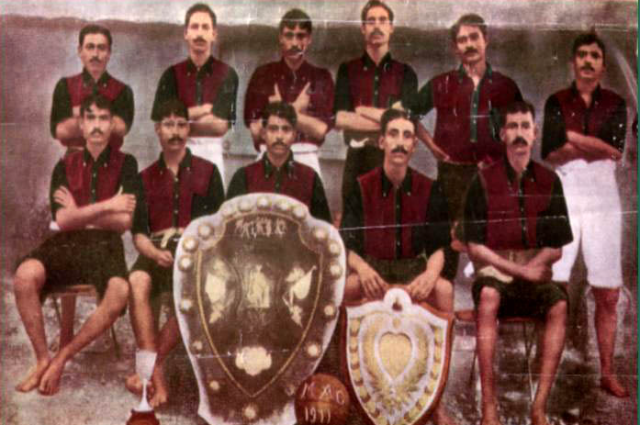
The defining moment came on 29 July 1911. Mohun Bagan, an Indian club whose players famously played barefoot, defeated the British East Yorkshire Regiment 2–1 to win the IFA Shield. It was the first time an all-Indian side lifted the trophy, breaking the dominance of British teams in one of colonial India’s most prestigious football competitions. For thousands of Indians, the victory was more than a sporting result; it was a symbolic assertion that Indians could defeat the rulers in the very game the empire had brought to India.
Kolkata’s football culture did not stop at one triumph. The city produced fierce rivalries, packed grounds, local heroes, and a football language that crossed class and community lines. Mohun Bagan and East Bengal turned the Kolkata Derby into one of Asian football’s most emotionally charged fixtures, while Mohammedan Sporting added another layer to the city’s rich footballing identity. Football was not an imported hobby here; it was woven into neighbourhoods, families, and everyday conversation.
This history destroys one common excuse: that India never had a football tradition. India had one of Asia’s earliest and most passionate football cultures. What it lacked was a national system that could carry Kolkata’s local passion into schools, villages, academies, and professional careers across the country. The cradle existed. The tragedy is that India never built enough hands to carry what was born in it.
The Contrast: When Cricket Became Religion, and Football Faded
India did not choose cricket over football in a single moment. Over decades, cricket received what football did not: money, media power, political stability, and a visible route from a small-town ground to national fame. The result is a sporting imbalance so deep that it now shapes what Indian parents, schools, and young athletes believe is possible.
Cricket’s advantage begins with accessibility. A child can play it in a narrow lane with a wooden plank, a tennis ball, and a wall for stumps. Football, by contrast, requires open space, goalposts, coaching, organised competition, and sustained physical development. That does not make football impossible in India—but it makes investment in grounds and grassroots structures essential. India never created that investment at scale.
The financial contrast is even sharper. The BCCI has become the world’s richest cricket board, with the Indian Premier League turning cricket into a year-round commercial spectacle. In FY 2024, the BCCI reportedly earned about ₹20,686 crore, while IPL broadcasting deals alone brought in roughly ₹9,678 crore. Cricket therefore offers young players not only fame but a believable economic future: contracts, endorsements, league opportunities, and financial security.
Football, meanwhile, has often been weakened at the very top. In August 2022, FIFA suspended the All India Football Federation because of “undue influence from third parties,” after a Supreme Court-appointed Committee of Administrators was involved in running its daily affairs. The suspension also put India’s hosting of the FIFA U-17 Women’s World Cup at risk. Whatever the legal complexities, the message to young footballers was damaging: the sport’s own governing structure could not guarantee stability.
The consequences are visible in the rankings. India’s men’s team currently sits 138th in the FIFA rankings—below nations with far smaller populations, economies, and sporting ecosystems. But the ranking is not the real failure. The real failure is that a country with India’s population, football history, and youth talent has not built enough reliable pathways for that talent to grow.
This is why the issue cannot be reduced to “Indians love cricket more.” Indians love success, visibility, and security. Cricket has learned to provide all three. Football, despite producing P. K. Banerjee, Kolkata’s great clubs, and Sunil Chhetri, has too often offered talent without protection, passion without infrastructure, and dreams without a future.
The Lone Warrior: Sunil Chhetri’s Appeal
If P. K. Banerjee represents the golden age India forgot, Sunil Chhetri represents the modern era India failed to fully embrace. Born in Secunderabad in 1984, Chhetri began his professional career with Mohun Bagan in 2002 and later rose to prominence at JCT, where his goals earned him national recognition. He went on to play abroad, captain India, and become the most important footballer the country has produced in the modern age.
His numbers demand attention. Before his initial international retirement in 2024, Chhetri had scored 94 goals in 151 appearances for India—making him India’s all-time leading scorer and most-capped player. Globally, only Cristiano Ronaldo, Lionel Messi, and Ali Daei had scored more international goals. In 2018, when Chhetri equalled Messi’s then tally of 64 international goals, the comparison briefly forced the country to confront an uncomfortable truth: one of football’s greatest scorers was Indian, yet most Indians barely watched him play.
The most painful moment came in June 2018. Ahead of India’s Intercontinental Cup match against Kenya, Chhetri released a video after only 2,569 spectators had attended India’s previous game. He did not ask for gifts, fame, or special treatment. He asked Indians to come to the stadium, support the team, criticise the players if needed—but simply to be present. “Football in India needs you,” he said.
The response was immediate. The stadium filled, India won the tournament, and Chhetri scored twice in the final. But the deeper question remained: why did the country’s greatest active footballer have to plead with his own people to watch the national team?
Chhetri’s appeal was not a story about one empty stadium. It was evidence of a broken relationship between Indian football and Indian society. A cricketer scoring a century becomes a national event; a footballer scoring for India often passes without notice. Chhetri carried the burden of that indifference for nearly two decades, scoring, leading, and representing the country while knowing that the stands might remain half-empty.
Even his retirement reflected the same imbalance. He stepped away in 2024 after a goalless draw against Kuwait at Kolkata’s Salt Lake Stadium, then returned in March 2025 and scored his 95th international goal against the Maldives. At 40, he was still doing what Indian football had long depended on him to do: carrying hope alone.
A New Dawn on the Horizon
The story of Indian football cannot end with empty stadiums, forgotten heroes, or a country watching the World Cup from the outside. It must end with responsibility. P. K. Banerjee proved that India could compete with the world; Kolkata proved that India could love the game deeply; Sunil Chhetri proved that even without support, one player could carry the hopes of a nation. What remains unfinished is India’s promise to its next generation.
That promise cannot begin with slogans. It must begin on the ground—literally. India needs more football fields in schools, qualified coaches in districts, regular age-group competitions, and academies that treat young players as athletes with futures, not as temporary talents. The AIFF’s grassroots programmes and FIFA-backed talent-development framework already recognise this need, aiming to build a structured pathway from local academies to youth national teams. But policy documents and accreditation lists will matter only when they translate into accessible grounds, trained coaches, and safe opportunities in places where football culture already lives.
There is proof that this can work. In July 2026, Minerva Academy became the first Indian team to win the Helsinki Cup, defeating defending champions HJK 1–0 in Finland after remaining unbeaten in a tournament featuring more than 1,700 teams from over 20 countries. The victory mattered not because it erased India’s problems, but because it showed what structured coaching, sustained youth development, and belief can produce. Indian children can compete with the world when they are given the same seriousness that the world gives its own.
The real tribute to Banerjee and Chhetri is not a statue, a documentary, or a nostalgic social-media post. It is a football ground in a Kolkata neighbourhood, a coached team in a Goa school, a girls’ league in Kerala, a scouting network in Manipur, and a young player in any Indian town who no longer has to choose between a football dream and a secure future.
India does not need to wait for another P. K. Banerjee or Sunil Chhetri. It needs to become a country worthy of producing them again—one that watches, funds, trains, protects, and believes. The next golden era of Indian football will not arrive because we remember the past. It will arrive when we finally build a future that our legends would recognise as their own.
References:
- Indian football team in Olympics: glories and lows: Covers India’s fourth-place finish at the 1956 Melbourne Olympics and Neville D’Souza’s historic hat-trick against Australia.
- Indian football records and statistics: Confirms Neville D’Souza’s Olympic hat-trick as the first by an Asian footballer.
- P. K. Banerjee profile: Details Banerjee’s Olympic appearances, international record, and role in India’s 1962 Asian Games gold medal.
- FIFA Museum — India go top in Asia: Notes P. K. Banerjee’s 1962 Asian Games contribution and his 2004 FIFA Centennial Order of Merit.