
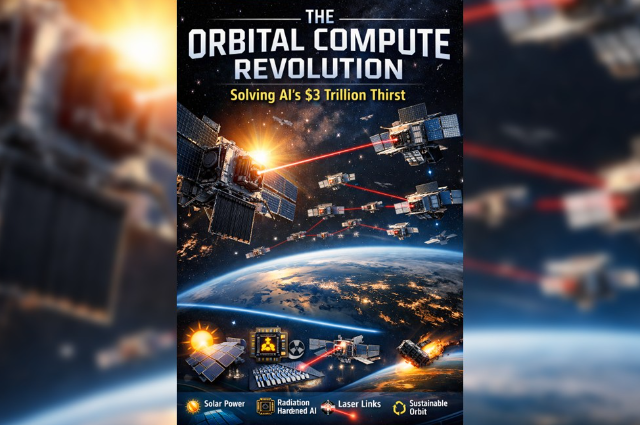
Agenda: The Blueprint for the "Celestial Cloud"
This article analyses the strategic shift of High-Performance Computing (HPC) from Earth to orbit, focused on three critical transitions:
- Solar Supremacy: Leveraging Low-Earth Orbit (LEO) to capture unfiltered solar flux ($1,361 \text{ W/m}^2$), providing 8x the energy yield of terrestrial systems and eliminating the carbon-heavy "night-gap" in AI training.
- Thermal & Hardware Resilience: Overcoming the vacuum through passive radiative cooling (using the $3\text{K}$ background of space as a heat sink) and validating Trillium TPU v6e hardware to survive 15 krad(Si) radiation levels.
- The Orbital Mesh Architecture: Deploying "Server-Sat" clusters—like the 80-satellite formation in Project Suncatcher—connected by 1.6 Tbps Laser Interconnects to create a unified supercomputer in the sky.
- India’s Sovereign Edge: Utilising ISRO’s SSLV (Small Satellite Launch Vehicle) for cost-effective deployment of on-board processing nodes, ensuring India's "Strategic Autonomy" by bypassing vulnerable undersea cables and land-based grids.
The Terrestrial Ceiling: AI’s Quiet Environmental Toll
The "Real Story" of AI is often told through code and chatbots, but its true cost is measured in hectares and Megawatts. While digital models feel weightless, they are anchored by a physical footprint that is rapidly outgrowing the planet's capacity to support it.
The Energy Surge: A $3 Trillion Infrastructure Thirst
The generative AI boom is essentially an industrial arms race.
- The Density Delta: Traditional server racks typically consume 5–12 kW of power. In contrast, modern AI-ready racks—packed with dense clusters of NVIDIA H200s or Google’s Trillium TPUs—are now crossing the 100–150 kW envelope. This is a 10x increase in power density per square foot.
- Global Grid Strain: As of January 2026, data centers consume approximately 2–3% of all global electricity. Goldman Sachs Research confirms that AI is the primary engine driving a 165% increase in demand by 2030. In specific hubs like Virginia (USA) or Ireland, data centres already guzzle over 25% of the total national power supply.
The Cooling Paradox: Trading Energy for Water
Maintaining the "health" of these massive digital brains has created a second, invisible crisis: Thermal Thirst.
- The Japan Benchmark: In 2024, the global data centre fleet used as much electricity as the entire nation of Japan. To keep these processors from melting, facilities rely on evaporative cooling.
- The "Bottle per Prompt" Metric: Recent research indicates that a simple conversation with a Large Language Model (approx. 20–50 exchanges) "drinks" about 500ml of water.
- The Resource Conflict: A mid-sized 100MW AI facility can consume up to 2.5 billion litres of water annually—equivalent to the needs of 80,000 people. This is leading to growing public backlash in water-stressed regions, where "Big Tech" is now in direct competition with local agriculture and communities.
The Carbon Lock-In
Despite massive investments in "Green AI," approximately 60% of the energy powering these centres still comes from fossil fuels. We are caught in a cycle where the very technology meant to solve climate change (AI) is one of the largest contributors to its acceleration.
Project Suncatcher: Google’s "Moonshot" for AI
In late 2024, Google Research unveiled Project Suncatcher, a visionary pivot from terrestrial expansion to orbital scaling. By January 2026, this "Moonshot" has matured into a series of technical milestones that prove the viability of a Celestial AI Stack.
The 8x Solar Advantage: Harvesting the Constant Sun
The primary driver for Suncatcher isn't just "green energy"—it is energy density.
- The Physics of Orbit: On Earth, solar panels are limited by the day-night cycle, weather, and atmospheric scattering. In a "Dawn-Dusk" Sun-Synchronous Orbit (SSO), satellites can achieve near-constant solar exposure.
- Unfiltered Flux: By operating above the atmosphere, these panels capture the full intensity of solar radiation ($1,361 \text{ W/m}^2$). Google’s research indicates this produces 8x more energy per year than an equivalent panel at mid-latitudes on Earth, effectively eliminating the need for the massive battery arrays that plague terrestrial renewable grids.
Breakthrough in Hardening: The Trillium "Stress Test"
A common critique of space-based computing is that cosmic radiation fries consumer-grade electronics. Google’s 2025 "Real Story" rebuts this through empirical testing.
- The Proton Beam Results: Google engineers blasted their latest Trillium TPU v6e chips with a 67 MeV proton beam at the UC Davis Crocker Nuclear Laboratory.
- 15 krad(Si) Resilience: The chips showed no "hard failures" up to 15 krad(Si) of total ionising dose. For context, a typical 5-year mission in Low-Earth Orbit (LEO) requires a tolerance of only 0.75 krad(Si). This confirms that Google’s off-the-shelf AI hardware is naturally "radiation-ready," drastically lowering the cost of entry.
The Orbital Mesh: 1.6 Tbps "Space Lasers"
To function as a single supercomputer, the satellites must communicate at the same speed as the fibre-optic cables in a traditional server rack.
- Free-Space Optical (FSO) Links: Suncatcher utilises Dense Wavelength Division Multiplexing (DWDM)—essentially "space lasers"—to connect an 81-satellite cluster.
- Bench-Scale Success: Google has already demonstrated 1.6 Tbps bidirectional speeds in lab environments. In orbit, these satellites will fly in tight formations (just 100–200 meters apart) to ensure the laser links remain stable, effectively creating a "Flying Data Centre" with the bandwidth of a terrestrial TPU pod.
ISRO’s Strategic Entry: The "Edge" of Sovereignty
India is not merely following a global trend; it is carving out a unique path for "Sovereign AI." As of January 2026, the Department of Space (DoS) and ISRO have transitioned from "what-if" brainstorming to active feasibility validation for a Celestial Cloud.
The ISRO Study (2025-26): From "Bent-Pipe" to On-Board Intel
Traditionally, satellites act as "bent-pipes"—they gather raw data and dump it all to ground stations. ISRO’s latest internal evaluations suggest this model is hitting a bandwidth ceiling.
- The Latency Breakthrough: By processing data at the source—Edge Computing in Space—India can bypass the delays caused by limited downlink windows. For time-critical applications like disaster management (e.g., tracking a fast-moving cyclone or flood), an AI-enabled satellite can process high-resolution imagery in orbit and transmit only the "Actionable Insight" (e.g., "Evacuate Zone A") rather than petabytes of raw pixels.
- Parliamentary Confirmation: In a landmark December 2025 response to a Parliament question, the DoS confirmed that a proof-of-concept for space-based edge infrastructure is already being conceived, focusing on radiation-hardened GPUs and autonomous reconfigurability.
Modular Infrastructure: The SSLV "Server-Sat" Model
India’s strategy differs from the West's massive monolithic structures. ISRO is leveraging its leadership in cost-effective, small-scale launches.
- The SSLV Advantage: The Small Satellite Launch Vehicle (SSLV) is the cornerstone of this plan. With a 72-hour turnaround time and the ability to launch "on-demand," the SSLV allows India to deploy Smallsat Constellations that act as modular "compute racks" in the sky.
- January 2026 Update: While the recent PSLV-C62 mission faced challenges in deploying some private-sector server prototypes (like the 6kW orbital data hub), it underscored the intensity of the race. ISRO continues to iterate on EOS-08 class micro-satellites, which now feature 12x more data storage and integrated avionics packages—the perfect "bus" for a space-based data centre.
The Vision of "Viksit Bharat" in Orbit
For India, space computing is a matter of Strategic Autonomy.
- Bypassing Vulnerabilities: By hosting critical AI workloads in orbit, India reduces reliance on undersea fibre-optic cables, which are physically vulnerable to sabotage or natural disasters.
- Economic Leadership: Moving toward the $200/kg launch cost goal with the upcoming NGLV (Next Gen Launch Vehicle) will turn India into the world's "utility company" for the cosmic economy, providing orbital power and compute to other nations.
The Engineering "Real Story": Challenges of the Vacuum
Winning this race requires more than just capital; it requires outsmarting the most hostile environment known to man. Space is not just a void—it is a brutal thermal and kinetic trap for high-performance GPUs.
1. The Radiator Problem: Life Without Convection
On Earth, fans move air to pull heat away from a chip (convection). In the vacuum of space, convection is non-existent.
- Thermal Choke-point: A single AI server rack generating 100 kW of heat would melt in seconds without a medium to carry that heat away.
- Metamaterial "Heat Mirrors": Researchers at Nanyang Technological University (NTU) and the University of Arizona (UA) are developing ceramic-based metamaterials that act as passive "heat mirrors." These materials are engineered to be "spectrally selective"—they reflect 99% of incoming solar radiation while simultaneously emitting internal heat into the $3\text{K}$ (-270°C) background of deep space via the Stefan-Boltzmann Law.
- Phase-Change Loops: Modern designs use two-phase cooling (liquid-to-vapour) to transport heat from the GPU core to massive deployable radiator wings that can span hundreds of square meters.
The $200/kg Threshold: The "Magic Number" of Economics
Space computing only becomes viable when the cost of "upmass" (launching weight) drops below the cost of terrestrial electricity and cooling over a 5-year period.
- The SpaceX Starship Disruptor: As of early 2026, Starship V3 is targeting a "fully reusable" payload cost of approximately $200 per kilogram. At this price point, launching a 500kg "Server-Sat" costs roughly $100,000—a figure easily offset by the 24/7 free solar energy it will harvest.
- India’s NGLV (Next Gen Launch Vehicle): ISRO is fast-tracking its NGLV, specifically designed for heavy-lift reusability. By targeting the same cost-efficiency window, ISRO aims to make India the world's "low-cost carrier" for orbital data centers.
The Kinetic Risk: Kessler Syndrome & Solar Storms
The "Real Story" of January 2026 includes a sobering warning.
- The 2.8-Day Warning: Recent January 2026 research indicates that with the current density of LEO satellites, a major solar storm could trigger a Kessler Syndrome (cascading collisions) in as little as 2.8 days if operators lose control.
- Autonomous De-orbiting: To win the "Sustainability" argument, orbital data centers must include "Graveyard Orbit" protocols—ensuring that once a server reaches its end-of-life, it autonomously burns up in the atmosphere, leaving no debris behind.
The Ethical Frontier: Space Debris vs. Green Computing
As we move the "Cloud" to the stars, the industry faces a profound moral dilemma. We are attempting to solve Earth’s climate crisis by potentially triggering an orbital one. The real winner of the "Celestial AI" race will not be the company with the fastest GPUs, but the nation that successfully couples Orbital Intelligence with Universal Sustainability.
The Kessler Dilemma: A Digital Collision Course
The Debris Bottleneck: Placing hundreds of "Server-Sats" in Low-Earth Orbit (LEO) increases the risk of Kessler Syndrome—a catastrophic chain reaction where satellite collisions create a permanent belt of debris, making space unusable for generations.
- Autonomous Disposal: To ensure a "Real Story" with a happy ending, firms like Google and ISRO are integrating Autonomous De-orbiting systems. These ensure that at the end of a server's 5-year life cycle, it uses its remaining fuel to burn up safely in Earth’s atmosphere, leaving the orbit clean for the next generation.
Life-Cycle CUE: The New Metric of Success
Carbon Usage Effectiveness (CUE): While terrestrial centres strive for a CUE of 0.0, they rarely account for the carbon cost of construction.
The "Net-Positive" Orbit: By using Life-cycle CUE, we measure the carbon emitted during a rocket launch against the carbon saved by running AI on 100% solar power for five years. Current projections for Project Suncatcher suggest that despite the launch emissions, an orbital TPU pod becomes carbon-negative within its first 14 months of operation.
The Water Victory: Saving Billions of Gallons
Hydrological Relief: By moving the 2030 AI compute load to space, we could save an estimated 2.5 trillion litres of freshwater annually—enough to sustain the daily needs of nearly 40 million people in water-stressed regions like North India and the American Southwest.
Disclaimer
This article is a synthesis of current aerospace engineering reports, corporate project announcements (Google Project Suncatcher), and preliminary feasibility studies from the Department of Space (India). While the technical milestones (radiation hardening, laser links) are verified, the large-scale deployment of orbital datacentres is subject to regulatory approval and evolving launch economics.