
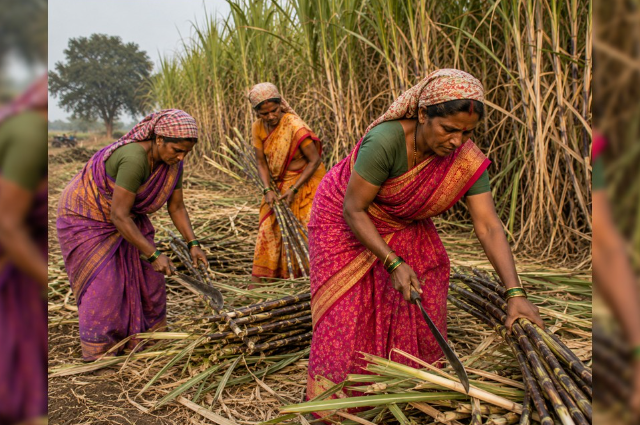
Before the sun breaks over the cracked fields of Beed, she is already awake. In the half‑light of dawn, she tightens the end of her sari around her waist, careful not to leave any loose fabric that might slow her down. Her sickle lies beside her, its metal dulled by seasons of cutting cane under a sky that offers no mercy. There is no time to stretch, no space to rest. Every minute counts.
Missing a day’s work is not an option. One absence can mean a fine, borrowed money, or an empty plate at night. Pain is swallowed quietly here—sharp cramps, exhaustion, dizziness—because stopping is costlier than enduring. By the time the fields begin to hum with labour, the heat has already settled into her bones.
When her body started failing her, she asked for help. No time off. Not lighter work. What she was offered instead was a final solution. A surgery, they said, that would free her from pain, from missed days, from the “monthly problem.” In these fields, rest is a luxury—but losing a part of yourself is sold as relief.
Agenda
This is not an isolated medical issue, but a recurring pattern affecting thousands of women.
- It represents a labour rights crisis, shaped by gender inequality and economic exploitation.
- Women are coerced by circumstances, not physically forced—poverty becomes the pressure.
- The practice continues despite investigations, reforms, and official promises.
- The story reveals how economic desperation can erase real consent without visible violence.
Life in the Sugarcane Fields
Sugarcane harvesting leaves little room for pause. The work is entirely manual—cutting thick stalks close to the ground, bundling them, lifting the weight onto shoulders, and loading them onto tractors and trucks. The day begins before sunrise and often stretches well past it, with bodies bent for hours under an unforgiving sun. No shade lasts, no task that eases with time; fatigue simply becomes part of the rhythm.
Most workers are hired as jodis—husband and wife treated as a single labour unit. Their productivity is measured together, their wages shared, and their penalties collective. If either falls ill, menstruates, becomes pregnant, or slows down, the entire unit is marked as failing to meet the day’s quota. What appears as a family arrangement is, in practice, a system that binds women’s bodies directly to output targets.
Missing a day of work is costly. Absence can lead to fines imposed by labour contractors, deductions from already meagre earnings, or added debt against advances taken before the season begins. Even partial workdays can carry penalties. In this structure, taking rest is not neutral—it actively pushes a family closer to hunger or deeper into loans they may spend years repaying.
The wages rarely justify the strain. Women in these fields typically earn the equivalent of three to four pounds a day, paid not daily, but at the end of the season—if deductions do not swallow the amount first. Against this backdrop, pain becomes negotiable, health secondary, and endurance a daily necessity. In the sugarcane fields, survival depends not on how much one can bear—but on how little one can afford to stop.
“Relief from the Monthly Problem”
In the sugarcane fields, a woman’s body is measured not by health, but by output. Menstruation and pregnancy—natural, recurring parts of life—are treated as disruptions to productivity. Bleeding, cramps, nausea, or the physical limits of pregnancy are framed not as reasons for care, but as obstacles to work. A day slowed by pain is counted as a loss. A day missed is treated as a breach.
The language used around women reflects this mindset. Contractors speak of “missed days” and “inefficiency,” while some medical professionals describe surgery as a practical fix rather than a last resort. Women report being told that removing the womb would “solve the problem,” that they would no longer be weakened by periods, no longer risk pregnancy, and therefore no longer lose wages. The procedure is presented not as extreme, but as sensible—almost inevitable.
On paper, the decision appears voluntary. No one signs under threat. No force is recorded. Yet the choice exists inside a narrow corridor: endure pain and lose income, or remove the source of that pain to keep working. For women already living season to season, burdened by debt and dependent on daily labour, the space to refuse barely exists. Consent, in this context, bends under economic weight.
Labour rights activist Manisha Vaijnath Tokle explains it bluntly: contractors may not physically force women into surgery, but they create conditions that push them toward it. Period pain or pregnancy means missed days, and missed days mean lost wages or fines. For many women who have already had children, a hysterectomy comes to feel less like a medical decision and more like the only way to remain employable.
Here, coercion does not arrive with chains. It arrives as an impossible choice—one where survival makes the decision long before the woman ever does.
The Numbers That Shocked Maharashtra
What surfaced from the Beed district was not a handful of cases, but a pattern too large to ignore. Surveys conducted by local non‑governmental organisations between 2018 and 2019 revealed that 36% of women sugarcane workers in Beed had undergone hysterectomies—a figure that stood in stark contrast to the national average of just 3%. The gap was not marginal; it was alarming.
Public pressure following these findings compelled the Maharashtra government to order an official investigation. What the inquiry uncovered deepened the concern. Over the previous decade, more than 13,000 women sugarcane workers in Beed district had their wombs removed, many without clear medical justification. Among them were women in their early twenties—some under the age of 25—an unusually young age for a surgery meant to be a last medical resort.
These were not isolated villages or a single contractor’s abuse. The data cut across multiple talukas, clinics, and labour chains, pointing to a system where extreme surgical intervention had become routine rather than exceptional. For activists and public health experts alike, the figures confirmed what women had been quietly indicating for years: this was not about individual health decisions, but about structural pressure.
The numbers stripped away any lingering doubt. When an entire district shows hysterectomy rates many times higher than the national norm—especially among working‑class, migrant women—the issue ceases to be anecdotal. It becomes evidence of a deep, systemic failure where economic vulnerability, informal labour, and inadequate oversight converge on women’s bodies.
Medicine or Marketplace?
In Beed, the boundary between healthcare and commerce often blurs. Many hysterectomies are performed not in public hospitals, but in private clinics, where regulation is weaker and accountability thinner. For women arriving with complaints of heavy bleeding, abdominal pain, or irregular periods—conditions that are often treatable—surgery is frequently presented as the fastest and final solution.
The medical advice offered is rarely framed as a choice among alternatives. Women describe being told that their uterus is “damaged,” that continued bleeding could become dangerous, or that surgery will permanently solve their problems. Critical information—about long‑term health impacts, non‑surgical treatments, or the permanence of the procedure—is often missing. Informed consent, while documented on paper, is compromised by language barriers, lack of medical literacy, and overwhelming pressure to return to work quickly.
For families that cannot afford the cost of surgery up front, loans become part of the treatment plan. Contractors or intermediaries help arrange borrowing, tying medical debt directly to future labour. The result is a cycle where women must keep working—often harder than before—to repay money spent on a procedure they may not have fully understood or genuinely needed.
Once the surgery is over, support rarely follows. Post‑operative care, long‑term monitoring, and management of complications are largely absent. Many women report chronic pain, weakness, or early onset health issues, but without access to follow‑up treatment, these become quietly borne consequences. The system that moved swiftly to remove the womb slows to a standstill when care is required afterwards.
This is not a story of individual doctors or desperate patients acting alone. It is the outcome of a system where profit, productivity, and survival intersect, turning medical decisions into transactions and women’s bodies into sites of economic adjustment. In such a marketplace, ethics struggle to survive where oversight is weak, and poverty speaks louder than pain.
Reforms Promised, Reality Unchanged
The scale of hysterectomies in Beed could no longer be ignored after the findings of the 2018–2019 NGO surveys, prompting the Maharashtra government to order an official inquiry in 2019. The investigation acknowledged the unusually high number of surgeries and recognised that many lacked clear medical justification. In response, authorities announced a set of corrective measures, including stricter monitoring of private clinics and mandatory health checkups for women sugarcane workers before seasonal migration.
On paper, the reforms signalled progress. Health screenings were meant to identify genuine medical needs, curb unnecessary surgeries, and ensure oversight. Committees were formed, permissions were required, and assurances were given that women’s health would no longer be sacrificed for labour demands.
Yet on the ground, activists argue that little has fundamentally shifted. The structure of sugarcane work remains unchanged—long hours, informal contracts, penalties for absence, and dependence on contractors. Medical checkups, when conducted, often function as administrative rituals rather than safeguards. They do little to challenge the economic pressures that make hysterectomy seem like the most viable option for continued employment.
Recent media investigations between 2024 and 2025 reignited concern when reports revealed hundreds of new hysterectomies among migrant sugarcane workers, many performed just before the harvest season. Some of the women were still in their early thirties, raising fresh questions about consent, necessity, and enforcement of earlier reforms. These revelations suggested that while scrutiny had increased, accountability had not.
Public outrage followed swiftly—across local protests, national headlines, and renewed demands for action. But for many women already coping with the irreversible consequences of surgery, the cycle feels painfully familiar. Each wave of attention brings promises, committees, and temporary outrage, while the conditions that push women toward these decisions remain firmly intact.
The persistence of the problem highlights a hard truth: without transforming the labour system itself, reforms risk becoming cosmetic. As long as survival depends on uninterrupted productivity, policies alone will struggle to protect women whose bodies are still treated as expendable tools of the harvest.
What Consent Means When Poverty Decides
Consent is often understood as a signature on a form—proof that a decision was made freely and legally. But legality is not the same as ethics. In Beed’s sugarcane fields, consent exists within a narrow frame, constrained by hunger, debt, and the fear of losing work. When survival is at stake, agreement can no longer be assumed to be a genuine choice.
For women labourers, economic vulnerability reshapes what “choice” means. The decision to undergo a hysterectomy is made against the threat of fines for missed work, unpaid days, mounting loans, and exclusion from future contracts. When the alternative to surgery is the inability to feed one’s family, refusal becomes a privilege few can afford. The pressure is quiet, systemic, and effective—leaving no need for force.
This burden is deeply gendered. Informal labour systems rely on women’s bodies for endurance while refusing to accommodate their biological realities. Menstruation and pregnancy are treated as inefficiencies, pushing women to absorb physical costs that the system itself creates. The expectation to work through pain is normalised, and the consequences—permanent loss of reproductive health—are borne almost entirely by women.
At its core, this is a women’s health justice issue. It exposes how access to dignified healthcare, bodily autonomy, and informed decision‑making are unevenly distributed along lines of class and gender. When poverty decides consent, health becomes transactional, and autonomy becomes negotiable. The story of hysterectomies in Beed is not just about surgery—it is about how inequality transforms choice into compliance, and medical decisions into acts of desperation rather than empowerment.
Why This Real Story Demands Attention
The consequences of hysterectomy do not end in the operating room. For many women, the surgery brings long‑term health challenges—chronic pain, early menopause, weakness, and increased risk of other complications—often without access to sustained medical care. In bodies already worn down by physical labour, these effects quietly shorten working lives and deepen dependence on the very systems that failed them.
The impact also stretches across generations. When women lose their health, families lose stability. Children grow up watching pain normalised and choice narrowed. Young girls inherit not only the burden of work, but the unspoken lesson that their bodies, too, may be negotiable in exchange for survival. What begins as a labour practice becomes a cycle that shapes expectations, futures, and freedoms.
This is why awareness alone is not enough. Policy must move beyond inquiry and paperwork to meaningful enforcement. Labour systems must acknowledge women’s biological realities instead of punishing them for it. Ethical healthcare must be insulated from profit and pressure, and work must not demand irreversible sacrifices as proof of commitment.
This story asks for reflection rather than outrage. It invites us to notice how easily exploitation learns to hide behind routine, how harm can persist without force, and how silence can make injustice appear ordinary. The women in the sugarcane fields did not lose their wombs because they lacked strength—but because strength, on its own, was never enough to protect them. Their story demands attention not for what was taken, but for what should never have been up for negotiation in the first place.
Disclaimer
This article is based on publicly available reports, investigative journalism, government records, and findings published by non‑governmental organisations. To protect privacy and dignity, individual names and identifying details have been withheld. Every effort has been made to ensure factual accuracy and responsible representation of events. The purpose of this piece is to inform, analyse, and raise awareness—not to sensationalise lived experiences or personal trauma.
References
- https://www.theguardian.com/global-development/2025/jun/12/outrage-as-sugar-cane-workers-in-india-still-being-pushed-into-having-hysterectomies
- https://atmos.earth/political-landscapes/the-forced-sterilization-of-indias-sugarcane-farmworkers/
- https://www.britsafe.in/safety-management-news/2025/a-bitter-harvest-female-sugarcane-workers-pushed-into-having-hysterectomies
- https://www.moretoherstory.com/stories/in-indias-sugarcane-belt-thousands-of-women-workers-undergo-forced-hysterectomies
- https://www.chinimandi.com/maharashtra-reforms-panel-to-examine-hysterectomy-surgeries-and-women-sugarcane-workers-health/