
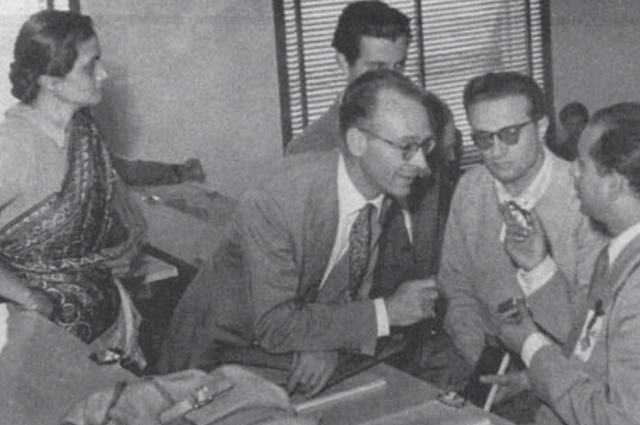
A woman carrying photographic emulsion plates to the hills of Darjeeling, waiting for invisible cosmic particles to leave their tracks. Then state the paradox: she helped make one of the earliest identifications of mesons, yet most Indians have never heard her name.
“History often remembers the prize; it forgets the person who first showed the way.”
When Science Sees the Invisible, but History Does Not
What happens when a woman helps science see particles arriving from deep space, but history fails to see her?
Dr. Bibha Chowdhuri (1913–1991) was an Indian cosmic-ray physicist whose early work, alongside Debendra Mohan Bose, used photographic nuclear-emulsion plates to investigate high-energy particles produced when cosmic rays enter Earth’s atmosphere. Their research contributed to early studies of mesons—unstable subatomic particles central to the development of particle physics.
Yet Chowdhuri’s name remains largely absent from school textbooks, popular science, and public memory. Her story is not only one of individual perseverance; it is also a question about how science decides whose discoveries deserve to be remembered.
She never married and described herself as “wedded to physics.” But perhaps the more accurate description is that physics never fully repaid her devotion.
A Mind Before Its Time
Bibha Chowdhuri was born in Kolkata in 1913 into a family connected with the Brahmo Samaj, a reformist movement associated with Raja Ram Mohan Roy that supported women’s education and social equality. That environment helped shape a woman who would refuse to accept that scientific ambition belonged only to men.
In 1934, she joined the MSc Physics programme at the University of Calcutta as the only woman in a batch of 24 students. She completed her postgraduate degree in 1936, entering a field where women were rare not because they lacked ability, but because institutions rarely made room for them.
Her first major obstacle came when she sought to work with Debendra Mohan Bose on cosmic-ray research. She was initially told that the work involved difficult expeditions to mountainous regions and was unsuitable for women. Chowdhuri persisted, and Bose eventually accepted her into his research group.
That refusal, followed by her persistence, became the first of many moments when she proved that talent does not require permission.
Reading the Sky Through Photographic Plates
Cosmic rays are high-energy particles from space that strike Earth’s atmosphere and create showers of secondary particles. In the late 1930s and early 1940s, Chowdhuri and Bose used photographic emulsion plates to record the tracks left by these particles.
The method was ingenious: instead of directly watching particles, which are invisible, they allowed the particles to leave permanent traces on specially prepared photographic plates. These tracks could then be analysed to estimate the particles’ properties.
Chowdhuri carried out fieldwork in the Darjeeling region, exposing plates at high altitude where cosmic-ray activity could be studied more effectively. Between 1940 and 1942, she and Bose published four rapid papers in Nature on their cosmic-ray findings, including work related to mesons.
Their contribution was not simply that they observed particles. They helped develop and apply a technique that made the invisible measurable.
War, Interruption, and Unequal Recognition
The Second World War disrupted the supply of specialised photographic emulsion plates, halting the momentum of Bose and Chowdhuri’s research. Science often advances not only through genius, but through access—to equipment, funding, institutions, and time.
Years later, British physicist Cecil F. Powell used and significantly developed photographic-emulsion methods in cosmic-ray research. He received the 1950 Nobel Prize in Physics for his development of the photographic method and discoveries concerning mesons. Powell acknowledged the earlier work of Bose and Chowdhuri, but their contribution did not receive comparable public recognition.
It would be inaccurate to claim that Chowdhuri was “denied” a Nobel Prize, because Nobel recognition depends on many factors and cannot be predicted retrospectively. But it is fair to ask a harder question: why did the early Indian work remain a footnote, while later work built on similar methods became globally celebrated?
The answer lies partly in wartime interruption, partly in unequal access to resources, and partly in a scientific culture that more easily remembered men with institutions, prizes, and global platforms.
From Manchester to the Depths of Kolar
Chowdhuri did not allow interrupted research to become the end of her career. She moved to the University of Manchester, joining the cosmic-ray laboratory of Nobel laureate Patrick M. S. Blackett, and earned her PhD in physics there.
After returning to India, she worked at the Tata Institute of Fundamental Research (TIFR) and later at the Physical Research Laboratory (PRL). Her research continued across cosmic-ray physics, high-energy particles, and underground detection experiments.
One of the most striking phases of her career came at the Kolar Gold Fields in Karnataka. There, scientists placed detectors deep underground to study particles that could penetrate the Earth. The Kolar experiments later became historically important for the first observation of atmospheric neutrinos.
This is where Chowdhuri’s legacy becomes especially relevant today. Deep-underground laboratories reduce interference from cosmic rays at the surface, allowing scientists to study rare particles and phenomena. The same basic principle now supports modern neutrino research and the search for dark matter. Chowdhuri did not single-handedly create dark-matter science, but her work belongs to the scientific lineage that made such research possible.
She had begun by chasing particles from the sky. Decades later, she was helping study particles from beneath the Earth.
The Cost of Being Forgotten
Chowdhuri continued working in physics for decades. A paper co-authored by her appeared in the Indian Journal of Physics in 1990, shortly before her death in 1991—a powerful rebuttal to any idea that her career ended with her early discoveries. Yet she did not receive major national scientific honours during her lifetime. In 2019, the International Astronomical Union named a star “Bibha” in her honour. It was a fitting tribute: a scientist who spent her life studying particles from space finally received a place among the stars.
But naming a star is not the same as teaching her story.
A nation honours its scientists not only through memorials, but by placing their work in classrooms, acknowledging their contributions in institutional histories, and asking why certain names were overlooked for so long.
More Than a Story of Prejudice
Dr. Bibha Chowdhuri’s life should not be reduced to a simple tale of a woman defeated by men. She was a rigorous experimental physicist, a pioneer of cosmic-ray research in India, and a scientist who continued working long after the world stopped paying attention.
Her story exposes a deeper truth: scientific history is not neutral. It remembers some discoveries loudly and allows others to fade quietly. It celebrates those who complete a journey, sometimes forgetting those who first showed that the journey was possible.
The particles Chowdhuri studied were invisible to the human eye. Her contribution, too, remained invisible to generations of Indians.
Science advances when we discover what the world cannot see. Justice advances when we refuse to overlook the people who made those discoveries possible.
It is time India remembered Dr. Bibha Chowdhuri—not merely as a woman who faced discrimination, but as one of the pioneers who helped teach us how to read the universe.
References:
- S. C. Roy and Rajinder Singh, “Bibha Chowdhuri—Her Cosmic Ray Studies in Manchester,” Indian Journal of History of Science, 2018.
- CTAO, “Building from Diversity: Bibha Chowdhuri,” 2024.
- Down To Earth, “Bibha Chowdhuri—celebrating a forgotten life in physics.”