
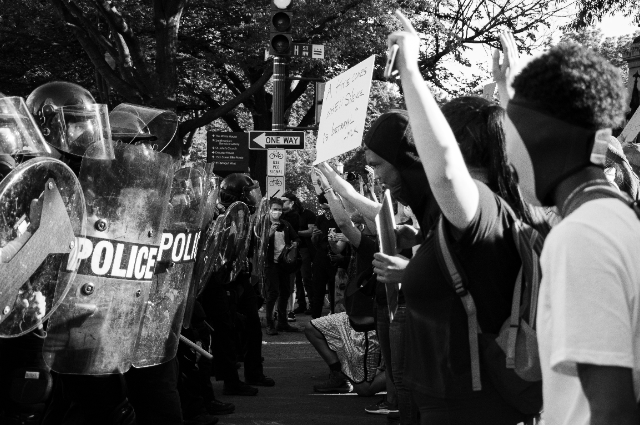
Photo by Koshu Kunii on Unsplash
Democracy does not collapse in a single moment. It erodes quietly—sometimes in the space between a raised slogan and a fired pellet. On December 7, 2020, during a protest march in North Bengal, Ulin Roy became a casualty of that fragile space between citizens and the state. His death demands more than sympathy; it demands scrutiny.
Agenda
1. Democratic Foundations
- Examine protest as a constitutional right under Article 19.
- Establish protest as a legitimate form of democratic dialogue.
- Introduce the tension between dissent and state authority.
2. Political Context of the Incident
- Analyse the political climate in West Bengal before the 2021 Assembly elections.
- Provide background on the “Uttarkanya Chalo” march.
- Situate the event within broader patterns of political polarisation.
3. Chronology of December 7, 2020
- Reconstruct the sequence of events during the protest.
- Document reported use of crowd-control measures (lathi charge, tear gas, rubber bullets).
- Present verified accounts of Ulin Roy’s death.
4. Forensic and Investigative Controversy
- Examine disputes regarding post-mortem procedures.
- Highlight allegations concerning pellet injuries.
- Analyse conflicting narratives between state authorities and opposition leaders.
- Raise questions about transparency in politically sensitive investigations.
5. Legal & Institutional Framework
- Review legal provisions governing crowd control (CrPC Sections 129–131).
- Discuss principles of proportionality and necessity in the use of force.
- Compare Indian practices with international standards on policing protests.
6. Structural Pattern of Political Violence
- Refer to data from the National Crime Records Bureau.
- Explore historical patterns of political clashes in West Bengal.
- Emphasise that the issue transcends party lines and reflects systemic challenges.
7. Human Impact & Personal Dimension
- Present the perspective of Malti Roy as a widow seeking justice.
- Shift focus from political narratives to human consequences.
- Illustrate how institutional decisions affect ordinary families.
8. Media Narratives & Public Perception
- Analyse how different media outlets frame protest-related deaths.
- Discuss the role of narrative polarisation.
- Highlight the importance of independent and credible reporting.
9. Democratic Risk Assessment
- Evaluate how excessive force may discourage civic participation.
- Explore the chilling effect on dissent.
- Question long-term implications for democratic trust.
10. Policy & Reform Recommendations
- Propose automatic judicial inquiries in protest-related deaths.
- Suggest mandatory video-recorded autopsies in politically sensitive cases.
- Recommend transparent audits of crowd-control protocols.
- Emphasise institutional reform over partisan blame.
11. Core Objective of the Article
- To transform a politically sensitive event into a case study on democratic accountability.
- To encourage evidence-based discussion rather than emotional polarisation.
- To promote institutional transparency as the foundation of public trust.
Protest as Democratic Dialogue
In any functioning democracy, protest is not rebellion—it is participation. From the farmers’ movements to anti-corruption marches, India’s streets have long been arenas of political dialogue. The Constitution under Article 19(1)(a) and 19(1)(b) guarantees freedom of speech and the right to assemble peacefully.
But what happens when that conversation between citizens and the state ends in force?
On December 7, 2020, during the “Uttarkanya Chalo” march in Siliguri, a 50-year-old political worker named Ulin Roy lost his life amid a police crackdown. His death became more than an individual tragedy; it raised fundamental questions about state accountability, use of force, and the shrinking space for dissent in parts of India.
This article does not aim to inflame. It aims to examine.
Political Context: Why “Uttarkanya Chalo” Happened
Uttarkanya Chalo: Opposition Leaders and Demands Against Political Violence
In late 2020, West Bengal was witnessing intense political polarisation ahead of the 2021 Assembly elections. The march toward Uttarkanya—the North Bengal branch secretariat of the state government—was organised by prominent opposition leaders, including BJP MPs Nisith Pramanik and Sukanta Majumdar, state BJP leader Meenakshi Banerjee, and local figures like Shyamaprasad Bandyopadhyay. They rallied hundreds to demand immediate action against alleged political violence, post-poll lawlessness, and attacks on opposition workers in North Bengal.
Such protest marches are common in Indian political culture. What distinguishes this one is how it ended.
The Day of the Incident: December 7, 2020
Timeline of the Uttarkanya Chalo Clash in Siliguri
Eyewitness accounts and media reports described a charged but organised rally by BJP supporters, starting from areas like Fulbari Bazar and proceeding toward Uttarkanya, amid pre-2021 election tensions. As protesters—led by figures like state BJP president Dilip Ghosh—attempted to advance toward restricted areas near Tinbatti intersection and Phoolbari Bazar, police reportedly used:
- Lathi charges (baton charges, as alleged by the BJP)
- Tear gas shells (confirmed in police dispersal)
- Water cannons (to control stone-throwing crowd)
- Rubber bullets (pellet-like injuries disputed in autopsy)
Key sequence: Protesters tried to breach barricades, hurling stones and bottles; police responded with non-lethal force around midday. Amid the chaos at Tinbatti, 50-year-old BJP worker Ulin Roy (also spelt Ulen Roy), from Gajoldoba, collapsed with injuries. He was rushed to a hospital but declared dead later that evening.
BJP leader Dilip Ghosh, on site, stated: "One of our party workers was injured in the baton charge, and he died in hospital," alleging police brutality.
Official statements initially framed the police response as necessary crowd control, claiming only water cannons and tear gas were used—no firearms or lathis. However, the postmortem (conducted post-midnight) revealed "shotgun injuries" from close range, with police asserting: “Police do not use shotguns. It’s obvious that... armed persons were brought and they fired from firearms,” sparking public dispute—BJP demanded CBI probe, family sought second autopsy (court-ordered December 8).
The Forensic Controversy
According to reports from outlets such as The Indian Express and NDTV, the post-mortem findings mentioned pellet-like injuries consistent with shotgun pellets fired from close range on Ulin (Ulen) Roy's body.
The controversy deepened over:
| Issue | Details |
| Allegations that the autopsy was conducted without family consent | First post-mortem done late night Dec 7 without family present; widow petitioned court, BJP refused findings. |
| Demands for a second post-mortem | Jalpaiguri CJM court ordered a fresh autopsy on Dec 8 by three doctors under videography; compliance by Dec 11. |
| Conflicting narratives about whether police used shotguns | Police: "Police do not use shotguns... armed persons [protesters] fired." BJP: Pellet wounds on front, not back—if police, would be from rear. |
| Claims suggesting protesters may have carried weapons | Police alleged "malicious intention" with firearms in the rally; unprecedented violence was incited. |
BJP state president Dilip Ghosh accused: "If Roy was shot by one of us, the pellet wounds would have been found on his back," noting similar injuries on other workers. Family demanded a CBI probe, alleging a cover-up.
The state administration denied wrongdoing, while opposition leaders accused the police of excessive force. The truth, caught between political narratives, became contested terrain.
The Legal Framework: Use of Force in Crowd Control
CrPC Provisions and Supreme Court Safeguards on Police Action
Indian law permits police to use force for dispersing unlawful assemblies under the Criminal Procedure Code (CrPC Sections 129–131), which empowers magistrates or officers to command dispersal and apply graduated force if ignored, from verbal warnings to physical measures. However, Supreme Court guidelines in landmark cases like DK Basu vs State of West Bengal (1997) and Prakash Singh vs Union of India (2006) emphasise proportionality, minimal force, and mandatory safeguards such as prior warnings, medical aid post-action, and judicial oversight to prevent custodial or crowd-related excesses.
International Standards: UN Principles in Context
International standards such as the UN Basic Principles on the Use of Force and Firearms by Law Enforcement Officials (1990) require:
- Necessity: Force only when strictly unavoidable to protect life or prevent serious crime.
- Proportionality: Level of force must match the threat; lethal options as an absolute last resort.
- Accountability: Full reporting, investigation of injuries/deaths, and compensation for victims.
These align with India's obligations under treaties like the ICCPR, ratified in 1979, which courts have invoked in cases like People's Union for Civil Liberties vs State of Maharashtra.
Force Gradation Table: Legal vs. Uttarkanya Chalo Application
| Force Level (CrPC/UN) | Description | Uttarkanya Context Questioned |
| Verbal/Warning (Tier 1) | Commands to disperse [CrPC 129] | Rally organised; barriers pre-set—warnings given? |
| Physical/Non-Lethal (Tier 2) | Lathi, tear gas, water cannons | Used amid stone-throwing, but chaos led to collapse. |
| Lethal Potential (Tier 3) | Firearms (only if imminent threat) | Shotgun pellets disputed—police deny; BJP alleges. |
| Post-Action Duties | Medical aid, inquiry [SC Guidelines] | Autopsy controversy; delayed family consent. |
Applying the Framework: Proportionality Gap in Siliguri
The critical question is not whether force can be used. It is whether it was proportionate and transparently investigated, especially when a death occurs amid non-lethal dispersal tools, raising echoes of Extra Judicial Execution Victim Families Association vs Union of India (2016), where the SC mandated probes into suspicious police encounters. In Uttarkanya Chalo, water cannons and tear gas were standard, but pellet-like wounds shifted scrutiny to accountability lapses, fueling demands for independent probes like the CBI.
A Pattern Beyond One Incident
West Bengal's History of Political Violence: NCRB Insights
Political clashes are not new to West Bengal. Data from the National Crime Records Bureau (NCRB) has periodically recorded incidents categorised under political violence, with West Bengal consistently ranking high in rioting, murder, and assault cases linked to political rivalries—e.g., over 1,000 political murder cases in some years pre-2021, per NCRB reports from 2015–2020.
Recurring Patterns Across Regimes
Regardless of party in power, West Bengal has historically witnessed:
- Cadre-based clashes: Party workers from CPI(M) (Naxalite era), TMC, and BJP engaging in turf wars, often over local control, as seen in 1970s–80s Left Front violence and post-2011 TMC-BJP escalations.
- Pre-election violence: Spikes ahead of polls like 2016, 2019 Lok Sabha, and 2021 Assembly elections, with NCRB noting hundreds of poll-related murders and injuries.
- Street-level confrontations: Marches turning violent, from Singur-Nandigram farmer protests (2006–08) to recent BJP-TMC face-offs in North Bengal, mirroring Uttarkanya Chalo.
Structural Roots: Beyond Partisan Blame
| Pattern | Examples Across Eras | Impact |
| Cadre Clashes | Naxalite (1967–71), TMC vs BJP (2019–21) | Dozens are killed yearly; it erodes grassroots democracy. |
| Pre-Election Violence | 2011, 2016, 2021 polls | Voter intimidation; NCRB: 200+ deaths in 2020 alone. |
| Street Confrontations | Post-poll riots (2021), anti-CAA marches | Police interventions: questions on force proportionality. |
The Human Dimension: Malti Roy’s Pursuit of Justice
A Widow's Voice Amid Political Noise
Beyond the data and legalities lies a family. For Malti Roy, Ulin Roy was not a headline. He was a husband and provider—a 50-year-old BJP karyakarta from Gajoldoba, Siliguri, who supported their family through local political work and small-scale trading.
In interviews with media outlets like The Indian Express and local channels post-December 7, 2020, Malti Roy broke down the public clamour: "My husband was a simple worker... They took him away in an ambulance, but no one told us the truth. I want a CBI inquiry, not this tamasha of post-mortems without us." She refused to accept the initial autopsy report, petitioning the Jalpaiguri CJM court alongside BJP leaders for a second examination, alleging procedural lapses and police complicity.
Family Struggle: From Denial to Court Battle
Malti's demands highlighted the human toll:
- Immediate aftermath: Family barred from the first post-mortem (conducted after midnight Dec 7); she learned of shotgun pellets only via leaks.
- Public appeals: "If police didn't fire, who did? Give us answers, not blame," she told reporters, rejecting police claims of protester-fired weapons.
- Ongoing fight: Joined BJP protests for CBI probe; by early 2021, case transferred to WB CID, but no convictions reported, leaving the family in limbo amid election rhetoric.
Judging Democracies by the Powerless
Democracies are judged not by how they treat the powerful—but by how they respond to the powerless seeking answers. Malti Roy's unresolved quest—five years on—mirrors countless families in West Bengal's clash cycles, underscoring failures in transparent justice over partisan spin.
Media Narratives and the Politics of Blame
Polarised Framing in West Bengal's Political Theatre
In polarised environments like West Bengal ahead of the 2021 elections, narratives solidify quickly. One side—primarily BJP leaders and aligned media—frames Ulin Roy's death as martyrdom, portraying him as a victim of state-sponsored police brutality during the Uttarkanya Chalo march, with calls echoing "shaheed karyakarta" and demands for Central probes.
The other side, led by TMC and state police statements, frames it as a law enforcement necessity, alleging Roy died from friendly fire amid protester stone-pelting and smuggled weapons, justifying water cannons and tear gas as measured responses to an unruly mob.
The Erosion of Trust in Facts
Between these narratives lies the role of independent investigation. When trust in institutions erodes—as seen in the rushed first autopsy without family consent and contested CID handover—even facts become partisan, with media outlets like TV9 Bangla and social trends amplifying echo chambers over evidence.
The larger concern is institutional credibility: Are investigations insulated from political influence? In Uttarkanya's case, the lack of transparent second post-mortem disclosures or video footage only deepened the divide, mirroring broader patterns in India's protest policing where truth bends to power.
Silence After the Smoke Clears
Institutional Memory Outlasts the Chaos
Tear gas eventually disperses crowds. But what lingers is institutional memory—the scars on families like Malti Roy's, the unresolved CBI demands, and the chilling precedent set by Uttarkanya Chalo, where a routine march ended in death amid disputed force.
The Shrinking Space for Dissent
If citizens begin to fear protest as a life-threatening act, democratic participation narrows. Silence becomes safer than dissent, as seen in West Bengal's cycle of cadre clashes where workers like Ulin Roy weigh loyalty against survival, echoing patterns from Nandigram to Sandeshkhali.
Arendt's Warning: Force as a Sign of Weakness
Political theorist Hannah Arendt once wrote that power thrives on legitimacy. Force, when used excessively, signals weakness rather than strength—turning streets from dialogue arenas into battlegrounds, eroding the Article 19 guarantees that define India's democracy.
The Larger Question: What Does Democracy Demand?
Non-Partisan Reforms for Protest Accountability
The death of Ulin Roy raises three non-partisan questions that transcend West Bengal's BJP-TMC rivalry:
- Should all protest-related deaths trigger an automatic judicial inquiry? Uttarkanya's CID handover, mired in delays and disputes, highlights gaps where magisterial probes under CrPC Section 176 could preempt politicisation.
- Should autopsies in politically sensitive cases be video-recorded by default? The family's absence during Roy's first post-mortem fueled cover-up claims; Supreme Court precedents like People's Union for Civil Liberties vs State of Maharashtra advocate videography for transparency.
- Should crowd-control protocols be publicly audited? From lathi charges to tear gas in Siliguri, periodic NHRC-style reviews could enforce UN proportionality, preventing escalations seen in farmers' protests or anti-CAA marches.
Listening Over Loudspeaker: Democracy's True Measure
Democracy is not measured by how loudly governments speak, but by how carefully they listen—ensuring streets remain arenas of dialogue, not graves for dissenters like Ulin Roy.
Conclusion: Remembering Without Weaponising
It is easy to turn tragedy into a political slogan. It is harder—but more necessary—to turn it into institutional reform.
Whether one supports the ruling party or the opposition, one principle must remain constant: No citizen should lose their life while exercising a constitutional right.
When the state and citizens meet in the streets, it should be a conversation—not a confrontation.
If we forget cases like Ulin Roy’s, silence wins. If we examine them honestly, democracy learns.
Disclaimer
- This article is a research-based analytical case study intended for academic and public discussion purposes.
- The narrative is constructed using publicly available reports, legal provisions, and secondary sources.
- The objective is to examine issues of democratic accountability, policing standards, and institutional transparency—not to promote any political party or ideology.
- Where narratives differ, the article acknowledges the existence of conflicting claims and does not present unverified allegations as fact.
- Readers are encouraged to consult primary documents, court records, and official statements for independent verification.