
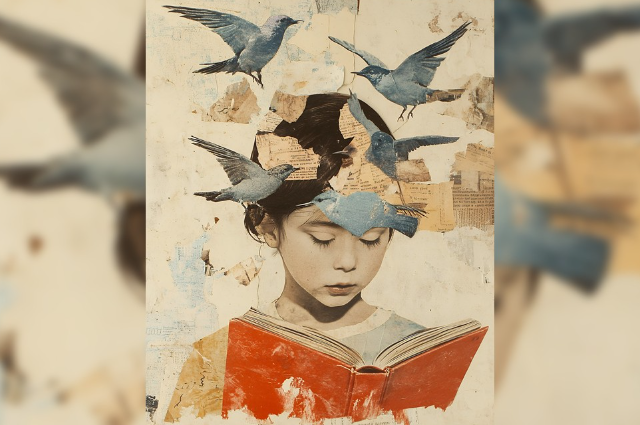
Image by Tyli Jura from Pixabay
They Came to Read
On a Thursday evening in Ahmedabad, a group of people gathered at AUDA Garden in Vastrapur with an unusual form of protest in mind: they came to read.
There were no loud slogans to begin with, no stage and no political speeches. Instead, books were opened. Among them were, I Am Malala by Malala Yousafzai and The Diary of a Young Girl by Anne Frank—the two books at the centre of a growing controversy at Anand Niketan School. Other readers brought works associated with Mahatma Gandhi, Jawaharlal Nehru and other writers.
The choice of protest was deliberate. If books could become controversial enough to be removed from a school's reading programme, the protesters appeared to be saying, then perhaps the most fitting response was not another argument, but reading itself.
What happened next transformed that quiet gathering into something far more serious.
According to the complaint and accounts from organisers, the readers were confronted by people allegedly associated with the Bajrang Dal and Vishwa Hindu Parishad. The confrontation reportedly escalated into an altercation in which some participants alleged that they were assaulted with wooden sticks and threatened. Organisers also alleged that women were intimidated and that some participants were questioned about their religious identity. Police subsequently registered an FIR naming two people and several unidentified individuals, while later reports said three suspects had been detained or arrested as investigators examined CCTV footage.
The allegations are now part of a police investigation, and they must be treated as allegations until established through due process. But the incident raises a question larger than what happened in one Ahmedabad garden.
How did two books move from a school reading programme into the centre of a public confrontation?
The answer begins at Anand Niketan School, where objections from some parents and right-wing groups turned a question about reading material into a dispute over education, identity and ideology. The school subsequently made the books optional and ended its association with consultant Munazza Shums, who had been involved in the school's curriculum and reading programme.
But by then, the books had acquired a significance beyond their pages.
I Am Malala is the story of a young Pakistani girl who became an international advocate for girls' education after surviving a Taliban attack. The Diary of a Young Girl is the wartime diary of Anne Frank, a Jewish teenager who documented her life while hiding from Nazi persecution before her death in the Holocaust.
Neither book was written as a response to the Ahmedabad controversy. Yet both found themselves at the centre of one.
That is what makes this story worth examining.
The question is not simply whether a school should include a particular book in its reading list. Schools and parents can—and should—debate what children read. The more difficult question is what happens when disagreement over a book moves beyond criticism of its content and begins to involve the identity, politics or beliefs associated with its author.
And there is an even more uncomfortable question.
When a person sits down in a public garden and opens a book, at what point does that act of reading become a political act?
In Ahmedabad, that question stopped being theoretical.
The Two Books at the Centre of the Storm
At first glance, I Am Malala and The Diary of a Young Girl have little in common.
One is the memoir of a Pakistani girl who became a global advocate for girls' education. The other is the wartime diary of a Jewish teenager who spent more than two years hiding from the Nazis during the Holocaust. They belong to different countries, different generations and entirely different historical circumstances.
Yet both books share something fundamental: they allow young readers to encounter history through the eyes of someone their own age.
That is what makes them more than ordinary titles on a bookshelf.
Malala: Education as a Right
In I Am Malala, Malala Yousafzai recounts her childhood in Pakistan's Swat Valley, her family's support for education and the growing restrictions imposed by the Pakistani Taliban. Her advocacy for girls' education eventually made her a target. In October 2012, she was shot by a Taliban gunman while travelling home from school. She survived and continued her campaign for the right of girls to receive an education.
Her story subsequently became international. In 2014, she became the youngest recipient of the Nobel Peace Prize.
For a student encountering her memoir, the book can therefore be read as a story about much more than one person. It raises questions about education, gender, violence, extremism, courage and the price some children are forced to pay simply for wanting to attend school.
But Malala is also a public figure with political opinions. That distinction matters in the Ahmedabad controversy because objections to her book were not limited to questions about literary or educational suitability. Critics also pointed to her views on political issues, including Kashmir.
This creates a difficult boundary for schools: should a student's access to an author's work depend on whether the author is politically agreeable?
Anne Frank: A Child's View of History
Anne Frank's story is different, but its educational power comes from a similar place.
Between 1942 and 1944, Anne wrote about her family, friendships, fears, arguments and dreams while hiding with others from Nazi persecution in Amsterdam. Her diary was never intended to become one of the world's most widely read accounts of the Holocaust. Anne wanted to become a writer, and she revised parts of her diary with the hope that it might one day be published.
She did not survive the Holocaust.
Her diary became a historical document of extraordinary human significance precisely because it did not describe history from the distant perspective of a politician or military leader. It showed what persecution looked like inside the everyday life of a teenager.
For a young reader, that difference can be powerful. History is no longer only a collection of dates, governments and casualty figures. It becomes a human experience.
And that is why The Diary of a Young Girl belongs to a category of books that can make students uncomfortable in a productive way: books that ask them to understand experiences they did not live through themselves.
Two Books, One Educational Question
The significance of the Ahmedabad controversy therefore lies partly in the contrast between these two works.
Malala's memoir asks readers to think about the struggle for education in the present.
Anne Frank's diary asks them to confront one of the darkest chapters of the twentieth century.
Neither requires a student to agree with every opinion expressed by its author. Reading a memoir is not a political oath. Reading a diary is not an endorsement of everything associated with its writer.
That distinction is central to education.
A student can read Malala and disagree with her political views. A student can read Anne Frank and still question, investigate or debate the historical context surrounding her story. A student can read Gandhi without becoming a Gandhian, Nehru without becoming a Nehruvian, or Orwell without accepting every idea in 1984.
The purpose of reading is not always to produce agreement. Sometimes it is to produce understanding.
That is where the Anand Niketan controversy becomes larger than the fate of two books.
If a school removes a book because it considers the material inappropriate for a particular age group, that is an educational judgment open to debate. If parents believe a book should not be included, they have a legitimate right to raise that concern.
But when objections begin to centre on the author's nationality, religion, political positions or identity, the question changes.
It becomes a question about whether we judge an idea by examining it—or whether we reject it before a reader has even had the opportunity to encounter it.
And perhaps that is the most important reason these two books matter in this story.
They were written by people whose lives were shaped by forces much larger than themselves. Yet both ultimately ask readers to do something remarkably simple: listen to another person's experience before deciding what to think about it.
It Didn't Start With a Book
The Anand Niketan controversy did not begin with a debate over Malala Yousafzai or Anne Frank.
It began with something far more ordinary—and, at first, entirely unrelated to literature.
A controversy emerged at the school's Shilaj campus after concerns were raised over food served to students. According to reports, a parent complained after an alleged piece of glass was found in food provided at the school. What might ordinarily have remained a question of food safety soon developed into a wider dispute involving the school's management, parents and its educational practices.
Then the focus shifted.
Questions were raised about books being made available to students through the school's reading programme. Among the titles that came under scrutiny were I Am Malala and The Diary of a Young Girl. What had begun as a concern over something as tangible as food had now entered a completely different territory: what children should be allowed to encounter in books.
The shift is important because it shows how controversies rarely remain confined to the issue that first triggered them.
A complaint can create distrust. Distrust can produce wider scrutiny. Wider scrutiny can bring previously unnoticed decisions under examination. And once political or ideological groups enter the conversation, an institutional dispute can quickly acquire a meaning far beyond its original subject.
That appears to be what happened at Anand Niketan.
The school defended the books as part of an optional reading initiative rather than compulsory academic material. Following the controversy, however, the two titles were made optional and were no longer part of the mandatory reading list. The school also ended its association with consultant Munazza Shums, who had been involved in curriculum-related work.
The distinction between "banned" and "made optional" matters.
Calling the books banned suggests that students were completely prohibited from accessing them. The school's position was different: it described the titles as part of an optional Book Club/Library initiative. But from an educational perspective, the change was still significant because books that had previously been promoted within the school's reading programme were no longer being given the same place.
That distinction also reveals why language matters in a controversy like this.
A school can decide what it recommends.
Parents can question those decisions.
Teachers can defend or criticise particular texts.
But once a dispute becomes public, a much larger question emerges: who has the authority to determine which ideas deserve a place in a child's educational environment?
The answer cannot be reduced to one side simply winning an argument.
Schools have a responsibility to consider age, context and educational value. Parents have a legitimate interest in what their children are taught. Educators must be able to explain why particular books are selected. And students, especially as they grow older, need opportunities to encounter perspectives that are different from their own.
The Anand Niketan episode became unusual because these different responsibilities collided at the same time.
The original dispute was no longer just about food.
The books were no longer just books.
And the disagreement was no longer confined to the school.
What followed would take the controversy out of the classroom altogether—into a public garden, where supporters of keeping the books available would attempt to make their argument without a classroom, a timetable or a lecture.
They would simply sit down and read.
What the School Actually Did
In a controversy driven by strong reactions, one word began to carry enormous weight: “ban.”
But the reality was more complicated.
Anand Niketan School did not officially describe I Am Malala and The Diary of a Young Girl as completely prohibited books. The school maintained that the titles were part of an optional Book Club and Library initiative rather than compulsory classroom texts. Following the controversy, however, the books were made optional and removed from the mandatory reading programme.
That distinction may sound technical. It is not.
There is a significant difference between telling students that a book is prohibited and deciding that a book will no longer be part of the reading material promoted by a school. The first is an outright restriction on access. The second is a change in institutional recommendation. But in both cases, the underlying question remains relevant: what influenced the decision?
The school was operating in a difficult space.
On one side were parents who believed that the institution had crossed a line in its choice of reading material. On the other were those who believed that removing the books in response to public pressure compromised the independence of educational decision-making.
Neither side can simply be dismissed.
Parents are not outsiders to their children's education. They have a legitimate right to ask why a particular book has been selected, what age group it is intended for and how potentially sensitive material will be discussed. Schools, meanwhile, have the responsibility to make educational choices based on curriculum, age-appropriateness and pedagogical value rather than simply on which books are least likely to generate controversy.
The problem arises when those two responsibilities collide without a transparent process.
A school library is not merely a storage room for books. The titles a school chooses to recommend tell students, indirectly, what kinds of stories and perspectives are considered worth encountering. Removing a book therefore does not necessarily erase it from the world—but it changes the institutional message surrounding it.
The Anand Niketan episode also had consequences beyond the books themselves. The school ended its association with consultant Munazza Shums, whose work included curriculum-related responsibilities and teacher training. Her involvement became another part of the controversy surrounding the school's educational choices.
This is where the story moves beyond the simple question of whether two books should be on a reading list.
It becomes a question of institutional independence.
If an educational institution chooses a controversial book after considering its educational value, it should be able to explain that decision. If it later removes that book, it should be able to explain that decision just as clearly.
Otherwise, students are left with a lesson that was never intended to be taught:
that the safest book is the one nobody objects to.
That would be a particularly unfortunate lesson for a library to teach.
Education inevitably involves disagreement. History contains violence. Literature contains uncomfortable ideas. Biographies contain political opinions. Social science challenges assumptions. Even the most respected writers and historical figures have been criticised, contradicted and reinterpreted.
The answer cannot be to eliminate every contested voice.
It should be to provide students with enough context to understand why a voice is contested in the first place.
That is particularly important in the case of I Am Malala. The controversy surrounding the book was not simply about whether students should encounter Malala's life story. Her political views, including her positions on Kashmir, became part of the objections raised against her inclusion.
And that introduced a new question into the debate:
When we disagree with an author, do we also have to remove the author's story from the shelf?
When the Author Becomes the Controversy
The debate over I Am Malala was not confined to the contents of the book.
It increasingly became a debate about Malala herself.
That distinction matters because a person's public identity can sometimes overshadow the work they have written. In Malala's case, her story as an education activist is inseparable from the political attention that followed her rise to global prominence.
Supporters of the book see her primarily as a young woman who stood up for girls' education under extraordinary circumstances. Her survival after being attacked by the Taliban and her continued advocacy made her an internationally recognised voice for education.
Critics, however, have pointed to her public statements on political issues, particularly Kashmir, to argue that she should not be presented to Indian students as an uncomplicated role model.
That criticism deserves to be acknowledged rather than caricatured.
A school is not required to present every author as morally or politically beyond criticism. In fact, students should be encouraged to question public figures—including celebrated ones. If an author has made controversial political statements, discussing those statements can itself become an educational exercise.
But there is an important difference between examining an author's ideas and deciding that the author should therefore not be read.
That difference is at the heart of the Anand Niketan controversy.
Imagine a classroom where students are given a controversial political speech. The educational value does not necessarily lie in agreeing with it. It may lie in asking:
Who said it?
Why did they say it?
What evidence supports their position?
What are the opposing arguments?
What historical circumstances shaped their view?
What might be missing from their account?
The same approach can be applied to a memoir.
A book does not have to be treated as unquestionable truth simply because it appears in a school library. A memoir is one person's account of events. It can be read alongside other sources, challenged, contextualised and discussed.
In fact, that is precisely how critical reading works.
The danger begins when disagreement with an author becomes a reason to prevent students from encountering the author's work altogether. At that point, the student is denied the opportunity to form an informed opinion before the opinion is formed for them.
There is another complication.
Malala's nationality became an important part of the public debate. She is Pakistani, and India-Pakistan relations are burdened by decades of conflict, political distrust and disputes over territory. In such an environment, the nationality of an author can easily become politically charged.
But nationality and the value of a text are not the same thing.
A student's understanding of a Pakistani writer does not require political loyalty to Pakistan. Reading a German account of the Second World War does not make an Indian student sympathetic to Nazi Germany. Reading an American critic of India does not require agreement with that critic.
A reader can encounter an idea without surrendering their ability to disagree with it.
That is one of the most important skills education can provide.
And it is why the Malala controversy raises a question that extends far beyond one school.
If schools begin judging books primarily by whether their authors have taken positions that somebody finds objectionable, where does that principle end?
Almost every significant historical figure has opinions that someone considers unacceptable. Writers change their minds. Activists make controversial statements. Scientists have political beliefs. Artists have personal histories. Leaders have legacies that remain contested.
If every disagreement becomes grounds for removing the person's work, a library can gradually become less a place of discovery and more a collection of only those voices considered safe.
The alternative is not to protect controversial authors from criticism.
It is to teach students how to criticise them intelligently.
That is a harder task than removing a book.
But education is supposed to be difficult.
And perhaps the real test of a school library is not whether every book on its shelves is agreeable to every parent.
It is whether students are given the tools to open a difficult book, encounter an unfamiliar argument, and still have the freedom—and the intellectual ability—to say:
“I have read it. Now let me decide what I think.”
Why Anne Frank Makes This Story Even More Complicated
If the controversy surrounding Malala can be understood through the politics surrounding a living public figure, Anne Frank presents a very different problem.
Anne Frank was not a politician. She was not a political campaigner. She was a teenager who wrote about her life while hiding from Nazi persecution during the Second World War.
Her diary begins with the ordinary concerns of adolescence: friendships, family tensions, school, loneliness and the desire to become a writer. But surrounding those ordinary experiences was an extraordinary reality. Anne and her family were forced into hiding because they were Jewish at a time when Nazi Germany and its collaborators were systematically persecuting and murdering European Jews.
Anne did not survive the Holocaust.
Her diary survived.
That distinction is central to understanding why The Diary of a Young Girl has remained an important educational text across generations. It does not explain the Holocaust through military strategy or political theory. Instead, it gives readers access to the thoughts of a teenager living through it.
That is precisely what makes the book powerful for younger readers.
History can become distant when it is reduced to dates, names and numbers. Anne's writing makes it personal. It allows a student to encounter persecution not merely as something that happened in a textbook, but as something that affected a person who had hopes, fears, ambitions and an everyday life remarkably similar to that of many young people today.
That educational purpose is different from asking students to adopt a political position.
A student reading Anne Frank is not being asked to endorse a government, movement or ideology. The book offers an opportunity to understand what happens when prejudice, discrimination and state-sponsored persecution are allowed to grow.
That makes the presence of Anne Frank in the Anand Niketan controversy particularly striking.
Her diary entered a debate that was increasingly being framed around questions of identity and political acceptability. Yet the historical lesson of Anne's life is, in part, a warning about what can happen when human beings are reduced to labels before they are seen as individuals.
There is an important caution here.
It would be simplistic to suggest that every objection to Anne Frank's diary is automatically comparable to the persecution she experienced. They are not the same thing, and such a comparison would diminish the historical reality of the Holocaust.
The more useful question is narrower:
What should a school do when a book carries historical, cultural or political sensitivities?
The answer does not have to be either unquestioning promotion or complete removal.
A school can provide context.
Teachers can explain the historical circumstances.
Students can discuss difficult questions.
Parents can raise concerns.
Different interpretations can be compared.
And if there are legitimate age-appropriateness concerns, educators can address them openly.
That approach treats students as learners rather than as people who must be protected from every uncomfortable idea.
There is another lesson hidden in Anne's diary.
She wrote because she wanted her experiences to be heard.
The power of her writing today comes from the fact that readers decades later are still willing to listen to a voice from a different country, a different religion, a different generation and a completely different historical period.
That is one of the defining purposes of literature: to allow people who could never meet to encounter one another through words.
A school library makes that encounter possible.
A teenager in Ahmedabad can read the thoughts of a teenager who lived in Amsterdam more than eighty years ago. A student can enter a world shaped by circumstances they have never experienced and leave with a deeper understanding of someone else's life.
That does not require agreement.
It requires curiosity.
And that may be the most uncomfortable lesson in the entire controversy: the value of a book is sometimes greatest precisely because it takes a reader somewhere unfamiliar.
The question, therefore, is not whether every student must like Anne Frank, Malala Yousafzai or any other author.
It is whether students should be given the opportunity to encounter them, understand the context, ask questions and form their own conclusions.
Because once a library begins removing difficult voices simply because they are difficult, students lose more than a particular title.
They lose an opportunity to discover why the world became difficult in the first place.
The Silent Answer
There are many ways to protest the removal of a book.
People can write letters, organise demonstrations, demand meetings with school authorities or take their disagreement to social media. In Ahmedabad, however, the response took a quieter form.
The protesters chose to read.
At AUDA Garden in Vastrapur, people gathered with books in their hands after the controversy surrounding Anand Niketan's reading programme. The choice of location was significant: this was no longer a discussion confined to a school campus. A question about what belonged on a school's reading list had entered a public space.
And the choice of activity was even more significant.
They did not need to explain what a book was supposed to do. They demonstrated it.
Among the titles brought to the gathering were I Am Malala and The Diary of a Young Girl. Other books included works associated with figures such as Mahatma Gandhi and Jawaharlal Nehru, while reports also noted titles such as George Orwell's 1984 and Bhagat Singh's Why I Am an Atheist.
The selection turned the gathering into something broader than a defence of two disputed titles.
These were books representing different periods, ideologies and experiences. Some dealt with freedom and political power; others with education, history, religion, resistance or individual conscience.
Together, they conveyed a simple idea:
A library is valuable because it contains more than one voice.
That idea is easy to accept in theory. It becomes harder when the voice in question belongs to someone whose identity or opinions are politically contentious.
That is why the protesters' decision to read in public mattered.
They were not attempting to prove that Malala was right about every political issue. They were not claiming that every opinion expressed in a book must be accepted. They were making a narrower argument: that disagreement with an author should not automatically prevent a reader from encountering the author's work.
There is an important distinction between reading and agreeing.
A student can read a controversial argument and reject it. They can read a historical account and compare it with another source. They can encounter an author's political position and decide that the argument is flawed.
But none of those intellectual responses are possible if the encounter never happens.
This is why silent reading can sometimes be more powerful than a loud demonstration. A slogan tells an audience what to think. A book asks the reader to think for themselves.
The gathering therefore carried an unusual form of protest.
Its message was not simply:
“Put these books back.”
It was closer to:
“Let readers decide.”
That distinction matters in a democracy.
The freedom to disagree has little meaning if people are allowed to encounter only ideas that have already been approved by everyone around them. Intellectual freedom does not mean that every idea is correct. It means that people have the opportunity to examine ideas, challenge them and reach their own conclusions.
For students, that opportunity is especially important.
Children eventually enter a world in which they will encounter political arguments, religious disagreements, conflicting historical narratives and opinions that may deeply challenge what they have learned at home. A school cannot permanently shield them from disagreement.
Its more useful responsibility is to teach them how to navigate it.
That is why the image of people sitting with books in a public garden carries more significance than it might initially appear to.
The books were not weapons.
They were not demands.
They were not even speeches.
They were simply open.
And for a brief moment, the protesters were attempting to answer a controversy about what people should read by doing the most basic thing a reader can do:
opening a book.
But the evening did not remain silent for long.
When Silence Broke
The reading session was intended to remain peaceful. But as the evening progressed, the atmosphere at AUDA Garden changed.
According to the complaint filed after the incident, a group of people arrived at the gathering and objected to the protesters reading I Am Malala. Organisers alleged that the confrontation escalated into heckling and physical violence, with some participants claiming they were attacked with wooden sticks.
The allegations went beyond a dispute over the books.
Participants and organisers claimed that some women were threatened and that protesters were questioned about their religious identity. One participant reportedly alleged that she was threatened with being made to “disappear” if she continued recording the confrontation.
There were also conflicting accounts about what happened when the police became involved. Organisers alleged that some protesters themselves were taken away in a police vehicle and brought to Vastrapur Police Station.
These claims form part of the complaint and accounts given by participants; they should not be treated as judicially established facts. The investigation is expected to determine what happened, who participated and whether the competing accounts are supported by available evidence.
What is significant, however, is how quickly the nature of the gathering changed.
The original disagreement was about books.
The response, according to the allegations, was no longer taking place through books or arguments about their contents. It had moved into the physical space occupied by the readers themselves.
That shift is the point at which the story stops being simply a debate about educational choices.
People can disagree about whether I Am Malala belongs in a school reading programme. They can challenge Malala's political views. They can argue that parents should have a greater say in what their children encounter at school.
All of those disagreements can exist within a democratic society.
But a disagreement over an idea and an attempt to intimidate the person expressing or discussing that idea are fundamentally different things.
That distinction becomes even more important when the subject is reading.
A book can be criticised.
An author can be challenged.
A school policy can be protested.
A parent can demand an explanation.
But once physical confrontation or threats enter the picture, the original question—whether a particular book should be read—risks being replaced by a much more serious one:
Who gets to decide what another person is allowed to read, and by what means?
By the end of the evening, the answer would no longer be debated only in a garden.
It would move into a police station, an FIR and an investigation based partly on CCTV footage.
The books had begun the journey as objects of disagreement.
Now, the incident surrounding them had become a matter for the law.
From Garden to FIR
By the time the evening ended, the controversy had crossed a line that had little to do with a school reading list.
Ahmedabad Police registered a First Information Report in connection with the Vastrapur incident. The case named two accused and also included several unidentified people. Police invoked multiple provisions of the Bharatiya Nyaya Sanhita in relation to the alleged violence and unlawful conduct.
Investigators subsequently detained or arrested three suspects after examining CCTV footage, according to police reports. Further investigation was underway to establish the sequence of events and the roles of those involved.
This is an important stage in the story because a police FIR is not a finding of guilt.
An FIR records information about an alleged offence and sets an investigation in motion. Whether the accused actually committed the offences alleged is a matter that must ultimately be established through investigation and, where applicable, judicial proceedings.
That distinction is particularly important in a case surrounded by competing narratives.
The protesters have described themselves as participants in a peaceful reading gathering who were confronted and assaulted. Those accused of attacking them have their own version of events. Police must therefore establish what happened rather than simply adopt the account of either side.
CCTV footage, eyewitness statements, medical records and other available evidence can become crucial in reconstructing the evening.
Who arrived first?
Who confronted whom?
Did the confrontation become physical, and if so, who initiated it?
Who participated in the alleged assault?
Were threats made?
Were people unlawfully prevented from leaving?
And what exactly happened when the police arrived?
These are no longer questions that can be settled by social-media posts or competing political claims. They are questions for evidence.
Yet the legal dimension also reveals how dramatically the original dispute had changed.
At the beginning, the disagreement concerned educational material.
Then it became a public argument about the books.
Then a protest.
And now, a criminal investigation.
That progression matters because it demonstrates how quickly a disagreement over ideas can become a dispute over conduct.
The law does not decide whether I Am Malala is a good book. It does not decide whether Malala's political views are correct. It does not decide whether parents were justified in objecting to the school's reading choices.
Those are matters of public discussion and educational judgment.
The legal system has a different task: to determine whether specific actions constituted offences and, if so, who was responsible.
Keeping those questions separate is essential.
Otherwise, the entire episode risks being reduced to a political battle in which every allegation is treated as fact and every fact is interpreted as political propaganda.
The FIR provides an opportunity to establish something much simpler and more important:
what actually happened that evening.
And once that question is separated from the larger argument over the books, another question comes into focus—one that cannot be answered by the police.
What is a school library actually supposed to do?
What Is a School Library For?
A school library is not meant to be a collection of books that everyone already agrees with.
Its purpose is to expose students to different experiences, histories and viewpoints—and to teach them how to evaluate those ideas.
That does not mean every book belongs in every classroom. Age, context, educational value and content all matter. Parents also have a legitimate right to question what schools recommend.
But there is a crucial difference between questioning a book and preventing students from encountering it because of who wrote it or what the author believes.
The better educational response to a controversial book is often context, discussion and comparison—not silence.
A student should be able to read an argument without being required to accept it.
Reading is not agreement.
When Identity Becomes the Test
The Anand Niketan controversy exposes a more difficult problem: whether a book can be separated from the identity and politics of its author.
Malala is Pakistani. She has expressed political views that some Indians strongly disagree with, including views on Kashmir. Those disagreements are legitimate subjects for public debate.
But nationality or political disagreement alone cannot tell a student whether a book is worth reading.
Otherwise, the principle becomes dangerously broad.
A writer's nationality, religion, politics or ideology could become a reason to reject their work before the work itself is examined.
Education should teach students to ask:
What does this author say? Why do they say it? What evidence supports it? What are the opposing views?
That is critical thinking.
Rejecting an idea without encountering it is not.
The Lesson Hidden Inside Anne Frank
Anne Frank's diary offers another reason for caution.
Anne's story demonstrates what happens when people are reduced to an identity and judged because of it. Her Jewish identity became, under Nazi persecution, a reason for exclusion, persecution and ultimately murder.
The Ahmedabad controversy is obviously not comparable to the Holocaust. But the educational lesson of Anne Frank remains relevant.
Her diary reminds readers why understanding another person's experience matters.
That is precisely what books can do: they allow a student to encounter a life they have never lived and a world they have never seen.
Removing difficult perspectives may make education more comfortable.
It does not necessarily make it better.
Criticism Is Not Censorship
There is nothing undemocratic about disliking a book.
Parents can object.
Teachers can disagree.
Students can criticise.
Schools can reconsider their choices.
But these forms of disagreement depend on argument.
The boundary is crossed when disagreement becomes intimidation or violence.
The distinction is simple:
“I disagree with this book” is criticism.
“You cannot read this book” is censorship.
“You cannot read this book, and there will be consequences if you do” is intimidation.
A democratic society must leave room for the first. It should be deeply cautious about allowing the second and third to become normal.
What Students Actually Need
Students do not need a world where every idea is comfortable.
They need the ability to encounter uncomfortable ideas without being overwhelmed by them.
Schools can achieve that through context and discussion.
If a book contains controversial political positions, explain them.
If an author has been criticised, discuss the criticism.
If parents object, create a transparent mechanism for dialogue.
If an alternative text is appropriate, provide one.
But the objective should remain the same:
teach students how to think, rather than deciding everything they should think.
That is a much harder responsibility than simply removing a controversial title.
It is also a more meaningful one.
The Question Beyond Anand Niketan
The Ahmedabad episode should therefore not be reduced to a fight between one school and one group of protesters.
The larger question concerns the future of intellectual space in educational institutions.
Today the disagreement may involve Malala.
Tomorrow it could involve a historian, novelist, scientist, activist or political thinker whose views offend a different group.
If every controversial author becomes unacceptable to someone, eventually the definition of an “acceptable” book becomes narrower and narrower.
A library built around avoiding controversy would contain fewer disagreements.
But it would also contain fewer opportunities for students to learn how to handle disagreement.
What the Incident Should Teach Us
There are lessons here for everyone involved.
- For schools: educational decisions should be transparent and based on clear academic reasoning.
- For parents: questioning a school's choices is a legitimate right, but disagreement should remain peaceful and evidence-based.
- For political and social organisations: criticism of ideas should not turn into intimidation of people.
- For students: reading a book does not require agreeing with its author.
And for society as a whole:
A healthy democracy does not require everyone to read the same books. It requires people to remain free to read, question and disagree.
The Books Were Never the Real Issue
Perhaps that is why this episode deserves attention beyond Ahmedabad.
The two books became symbols.
Malala came to represent questions about education, identity and political disagreement.
Anne Frank came to represent memory, persecution and the importance of hearing individual voices from history.
The protesters turned reading itself into their response.
And the confrontation that followed, according to the allegations now under investigation, turned a debate about books into a question of public safety and law.
But beneath all of it lies a simpler issue:
Who gets to decide what another person is allowed to read?
Let the Reader Decide
A book does not become dangerous simply because it contains an idea we dislike.
Nor does it become correct simply because it sits on a school library shelf.
Its ideas can be questioned. Its author can be criticised. Its historical context can be examined. Its limitations can be exposed.
But the most powerful response to an idea is not necessarily to remove it.
Sometimes it is to read it carefully, understand it completely—and then decide that you disagree.
That is the habit education should create.
The people who gathered in Ahmedabad came together because two books had become symbols of a much larger dispute. What began with a school reading programme eventually reached a public garden and a police investigation.
The irony is that the simplest act in the entire story was also the most important one.
They opened books.
And perhaps that is where this story should ultimately leave us—not with the question of whether everyone should agree about Malala, Anne Frank or any other author, but with a more fundamental question:
Can we still allow one another to read something we disagree with?
Because a society does not demonstrate its commitment to intellectual freedom by protecting only the books everyone loves.
It demonstrates it by protecting the reader's freedom to turn the page.