
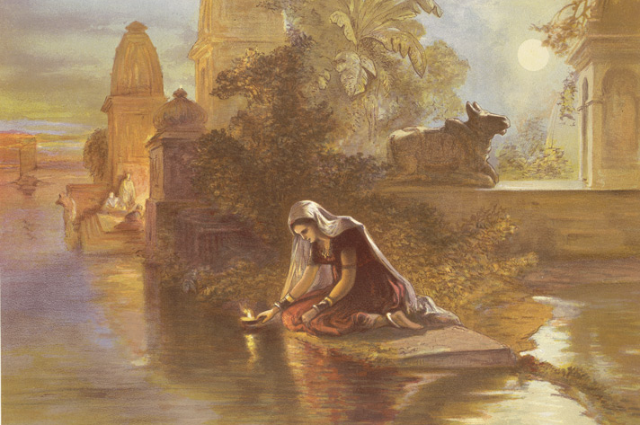
There are rivers, and then there is the Ganga. Most rivers are happy flowing from one place to another, carrying water, fish and the occasional leaf. The Ganga, however, seems to have a much bigger job description. It is a river, a source of water, a cultural symbol, a place of pilgrimage, a home for wildlife and, according to millions of people, something much more sacred. It has been praised in ancient texts, worshipped for centuries and has supported huge populations along its banks. In other words, the Ganga has been famous for so long that if rivers had social media accounts, the Ganga would probably have millions of followers and a very complicated biography.
The Ganga stretches about 2525 km and flows through India and Bangladesh and meets the Bay of Bengal. But here is the interesting thing- the river doesn’t originally start with the name Ganga. At its source in Uttarakhand, the river is known as Bhagirathi. The Bhagirathi begins at Guamurk, melting from the Gangotri Glacier in the Himalayas. It then travels from the mountains and reaches Devprayag. This is where something important happens. The Bhagirathi meets another major river called the Alaknanda. When the two rivers join, the river is officially known as the Ganga. So, if we imagine the river having a school identity card, this is basically the moment when its name changes from “Bhagirathi” to “Ganga.”
The name Ganga is deeply connected with Indian culture and tradition. In Hinduism, Ganga is personified as Goddess Ganga, and the river is considered sacred. According to Hindu tradition, the Ganga originally flowed in the heavens. One of the most famous stories about her descent to Earth is the story of King Bhagiratha. Bhagiratha is said to have performed intense penance to bring Ganga down to Earth so that she could help liberate the souls of his ancestors. However, there was one tiny problem: Ganga was believed to be so powerful that her force could have devastated the Earth when she descended from heaven. Fortunately, Lord Shiva came to the rescue. According to the traditional story, Shiva caught Ganga in his matted hair, controlling her force before allowing her to flow gently onto the Earth. This is why the river is also associated with Shiva. Imagine having enough power to cause chaos across the Earth and then being told, “Please calm down, you're flowing through Shiva's hair first.” That is quite an introduction!
The story of Bhagiratha is also connected to the word “Bhagirathi.” In tradition, the river is associated with Bhagiratha's efforts to bring Ganga to Earth. This is why the name Bhagirathi is not simply a geographical label; it carries an important cultural story with it. After meeting the Alaknanda at Devprayag, the river becomes the Ganga and continues its enormous journey towards the plains.
So, why exactly is the Ganga considered holy? There are several reasons. First, Hindu tradition regards the river as divine and as a manifestation of Goddess Ganga. Second, the river has been closely connected with religious ceremonies and pilgrimage for thousands of years. Places along the Ganga, such as Haridwar, Prayagraj and Varanasi, are extremely important pilgrimage centres. People visit the river to pray, perform rituals and take part in religious festivals. The belief that bathing in the Ganga can spiritually cleanse a person is particularly important in Hindu tradition. Of course, the Ganga doesn't exactly hand out certificates saying, “Congratulations! You are now 100% purified.” The belief is spiritual rather than something that can be measured with a science experiment.
The river is also closely connected with important Hindu ceremonies. Its water, known as Gangajal, is traditionally kept in homes and used during religious rituals. Many people consider Gangajal especially sacred and preserve it carefully. It may be used during prayers, ceremonies, and other important occasions. For generations, the river has therefore been much more than a source of drinking or irrigation water—it has been part of people's spiritual and family traditions.
There is also a fascinating connection between the Ganga and death. In Hindu tradition, the river is considered sacred even at the end of life. Varanasi, located on the banks of the Ganga, is one of the most important spiritual cities in India. Many Hindus believe that having one's final rites performed there has special religious significance. The river therefore becomes part of the journey of life from beginning to end. That is quite a responsibility for one river!
But the Ganga is not famous only because of mythology and religion. It is also incredibly important geographically and economically. The Ganga basin supports hundreds of millions of people. Its water is used for agriculture, drinking water, industry, and many other activities. The fertile plains created by the river and its tributaries have supported farming and settlements for centuries. Crops such as rice, wheat, sugarcane, and many other crops are grown in the region. In simple words, the Ganga does not just flow past farms—it helps make farming possible on a massive scale.
And now we reach one of the most interesting questions: What is special about Ganga water?
Ganga water is, of course, water—it is made primarily of H₂O, just like other natural freshwater. So there is no secret “Ganga ingredient” that scientists can pour into a laboratory bottle. However, researchers have found some interesting characteristics in Ganga water and in the river's ecosystem.
One of the most famous scientific facts associated with the Ganga is the presence of bacteriophages, which are viruses that infect bacteria. Some studies have suggested that these bacteriophages may contribute to the river's ability to naturally reduce certain bacterial populations. The Ganga has also historically been reported to have relatively interesting self-purifying characteristics compared with some other rivers. However, this does not mean that all Ganga water is automatically safe to drink. Modern pollution, sewage, industrial waste and other contaminants can make sections of the river unsafe. So please don't read “self-purifying” and immediately think, “Excellent, free water bottle!” Science does not give us permission for that.
Another interesting feature is the amount of dissolved oxygen in parts of the river. Healthy rivers generally need sufficient dissolved oxygen to support aquatic organisms. However, oxygen levels vary depending on location, season, temperature, flow, and pollution. The river's health is therefore constantly changing.
The Ganga is also home to an amazing variety of wildlife. One of its most famous inhabitants is the Ganges river dolphin, a rare freshwater dolphin that uses sound to navigate through the muddy waters. Unlike dolphins in the sea, these dolphins live in freshwater rivers. They are a fascinating reminder that the Ganga is not just a giant water highway for humans—it is also an ecosystem.
As the river continues downstream, it eventually reaches Bangladesh, where the main channel is known as the Padma. The Ganga joins other great rivers, including the Brahmaputra system, and together they create an enormous delta. This region includes the Sundarbans, famous for its mangrove forests and wildlife. The Sundarbans is the world's largest mangrove forest region and is shared by India and Bangladesh. So the Ganga's final destination is not simply “the sea.” It helps create one of the most remarkable ecosystems on Earth.
Unfortunately, the Ganga also has a serious problem: pollution. A river can be holy in people's beliefs and still be polluted in physical reality. Large quantities of sewage, plastic waste, industrial pollution, and other materials enter parts of the river. This creates serious challenges for people, animals and ecosystems. Cleaning and protecting the Ganga is therefore not only an environmental issue but also a cultural responsibility.
Over the years, many efforts have been made to clean and rejuvenate the river. Projects have focused on sewage treatment, reducing pollution, improving riverfront areas and protecting aquatic life. But cleaning a river that runs for more than 2,500 kilometres is obviously not like cleaning a swimming pool. You cannot simply walk along the bank with a giant mop and say, “There, finished!” It requires treatment plants, better waste management, scientific monitoring, responsible industries, and cooperation between communities and governments.
Reference: