
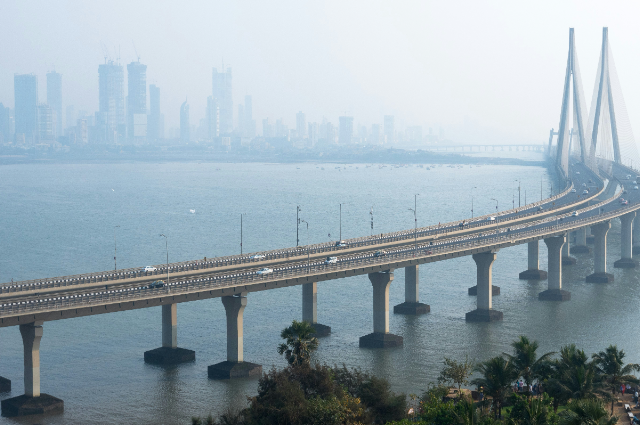
Photo by Previn Samuel on Unsplash
The time when Mumbai was just water!
A long time ago - before traffic, before vada pav, and before local trains that run faster than your thoughts - the place now called Mumbai, the city of dreams, was called Bombay, the city of water, because that time Mumbai was mostly water!
If you could travel back in time a thousands of years ago, you won't see tall buildings or the Marine Drive. You would see the Arabian Sea happily moving and the seven small islands quietly sitting like some shy students on the bench.
No gateway, No Bandra-Worli sea link, No bridges, No Bollywood. Only seven islands floating in peace.
Meet the Seven Islands
Mumbai was not always a huge city it was separated into seven different islands. Colaba Known for the Gateway of India, Taj Hotel, and Colaba Causeway, little Colaba which was also known as Old Women's Island, Bombay Island Contained Walkeshwar Temple and Malabar Hill, Mazagaon island contains the only Chinese temple in Mumbai, Parel island contains the Lalbaugcha Raja Ganpati Temple and old textile mills, Worli island is commonly known for the Bandra-Worli sea link, and Mahim island is a crucial northern island connecting the city to Salsette Island.
They were not connected, so if you had to visit someone on another island you would have to take a boat. Image reaching to school late and giving the excuse of a high tide.
The first people to arrive
The first people who lived here way before us were the fishing communities known as the Koli people.
They loved the sea. They did fishing in the sea, the sea gave them fish. The fish gave them food and money and that gave them the energy to complain about the fish and the weather- just like we do when it rains and our phone battery is drained.
They build small villages and temples which slowly formed our Mumbai. Life was simple then. No honking, no traffic and no network problem. Honestly they were really lucky.
How did the islands even form?
Now let’s go even further back in time — before humans.Millions of years ago, volcanic activity happened in this region. Lava came out, cooled down, and slowly formed land.
This land later became part of a region called the Deccan plateau.
Over time, sea levels changed. Water rose and covered some parts. The higher land stayed above water — and that’s how we got the seven islands.
So technically, Mumbai exists because of volcanoes.
Which explains the heat.
Who ruled the islands?
1. Ancient and early medieval
Before anything, in the prehistoric moments of Mumbai, the first people to ever rule Mumbai were the Mauyras in the 3rd century BCE. They helped with trade development and administration, especially under Ashoka.
After them different rulers controlled Mumbai, including the Shilahara dynasty, who governed the Konkan coast until 1343 CE and supported temples, trade and local culture.
2. The late Medieval
After the Shilahara dynasty, Mumbai came under the rule of the Seuna Yadava dynasty, which ruled parts of Deccan and Konkan areas. Later the Gujarat Sultanate ruled the area from 1348 to 1534, strengthening Mumbai’s trade along the western coast and connecting it with important ports in the Arabian sea.
3. Enter the Portuguese
Fast forward to the 1500s.The Portuguese arrived. They looked at the islands and said, “Nice place. We’ll take it.”They called it “Bom Bahia,” which means “Good Bay.” Later this became “Bombay.”
They built churches, forts, and houses. They ruled for many years.One day, the Portuguese princess Catherine of Braganza got married to Charles II of England.
And guess what? As part of the wedding gift, the Portuguese gave the islands of Bombay to England.
Yes. Mumbai was once a wedding gift. Imagine getting seven islands instead of a toaster.
4. The British took over
Now the British had Bombay. But they didn’t want to manage it directly.
So in 1668, they gave it to the East India Company for a small yearly rent. Just £10 per year!
That’s less than the price of a fancy coffee today. The East India Company saw potential. They thought, “This could be a great port.” And they were right.
So, the Mumbai that you live in is not just any normal city. It is a city with a history vaster than your math tuition. But there is more…
One big problem-water
There was one small problem, the islands were separated. So floods were as common as the amount of the times your mother shouts at you. During a high tide, the water would overflow onto the lower parts of the islands. People had to wait for a long time for the water to settle. Mosquitoes were happy, but humans were not.
But every problem has a solution. Because of the high tides and the overflowing of water, the British thought to… join all the seven islands and make it one huge island. And that is when the real transformation began.
The British did this so that the water doesn't harm a many parts of the land it harm a specific place and cause less destruction.
The great joining project
Throughout the 1700s and the 1800s, the British started the reclamation project. Reclamation means taking land from the sea. They filled the gaps between the islands with rock, soil and mud. Slowly, the water areas became land.
One of the famous projects was the Hornby Vellard, completed in 1784. It blocked the water from flooding the low-lying parts of land between Worli and Mahalaxn. And after that, the islands became one large landmass.
Mumbai was no longer seven lonely island. It was one large united city.
The port that changed everything
Because of its location on the Arabian sea, Bombay became a major port city. Ships came from many parts of Europe, Africa and Asia. Trade increased and money flowed like water.
Cotton became important, especiallyduring the American Civil War, when Britain needed cotton from India. Bombay became rich. Buildings grew like mushrooms after rain. Everything was perfect. This was Mumbai’s dream coming true.
Railways arrive, and so does chaos
In 1853, after all the islands in Mumbai were one large landmass, India’s first passenger train ran between Bombay and Thane! It was started by the Great Indian Peninsula Railway.
People were amazed. A giant moving machine carrying people! Felt like a dream. Little did they know that one day, local trains would become so crowded that personal space would become a myth.
The birth of the city of dreams
As industries grew, people from all over India came to Mumbai for jobs. Textile mills opened, Dockyards expanded, and the market grew. The city became crowded- but full of life. Bombay became known as the city of dreams.
Different languages, different cultures, different foods- all mixed together. In Bombay, if you worked hard, you could succeed. But if you didn't work hard, you won’t succeed.
The Bollywood enters
In the early 1900s, something very magical happened in Mumbai- the film industry started to grow in Mumbai, which we now call Bollywood! Lights, camera, songs in the rain- this was the point where Mumbai… changed.
Mumbai became the city where people came with one suitcase and a big sack of dreams. Some became superstars, some became background dancers, and some were just tired.
From Bombay to Mumbai
In 1995 the city officially changed its name from Bombay to Mumbai. The name comes from the local goddess Mumbadevi worshipped by the Koli community. The temple of Mumbadevi still stands in the city.
So technically the city is named after a goddess. Which explains how the city survives on everything- floods, traffic, and cricket losses.
How the sea was pushed back
Even after the islands were joined, Mumbai kept growing. New areas like the back bay were reclaimed. Later, Nariman Point was built by filling land into the sea. Marine drive? Also reclaimed land.
So when you go near the sea in Mumbai, remember the sea is thinking, “that used to be mine.”
Nature vs City
Mumbai’s story is all about nature and humans working- but sometimes fighting- see, nature made islands-humans blocked them, nature brought flood-humans stopped them, nature gave fish- humans are them, nature brought trees- humans cut them.
If you see, it has always been our fault, we have always been harming the nature in many possible ways without even noticing it. But always in the end… nature wins.
Mumbai today
Today, Mumbai is known as India’s financial capital and one of the most energetic cities in the country. It is the home of Bollywood, where movies, music, and big dreams are created every day. Often called the city that never sleeps, Mumbai is always moving — whether it is early morning local trains, busy offices, or late-night food stalls. Space is rare and houses are small, yet the city’s ambitions are huge. Tall skyscrapers rise beside tiny homes, billionaires live not far from street vendors, and luxury cars share the road with auto-rickshaws. There are moments of calm by the sea, but also constant traffic and endless honking. In every corner, there is hard work, hope, and the strong belief that dreams can come true.
Imagine if Mumbai were still 7 islands
If Mumbai were still seven separate islands, life would be completely different and much funnier. You would need a boat just to visit Bandra, and food deliveries might take two days because the rider would be waiting for the tide to go down. The Bandra-Worli Sea Link would not be a bridge at all — it would just be “Sea.” And instead of blaming traffic for being late, you could simply say, “High tide, bro.” Truly, the city would look and feel nothing like it does today.
Why is Mumbai’s story special
Mumbai is not just a city build on land…it is a city built on water, from the sea. It is a giant proof that shows that humans are capable of changing geography. But it also reminds us to respect nature. Because every monsoon the sea gently says, “Remember who was here first.”
The formation of Mumbai is a mix of volcanoes, sea levels, fishermen, Portuguese weddings, British engineering, railways, trade, films and hard work. Mumbai’s history shows that because of hard work of people whom we don't even know, we are able to stay peacefully.
From seven small islands to India’s busiest city- Mumbai’s journey is amazing. So the next time you are stuck in traffic in the Western Express Highway, you should be glad that you are at least not waiting for a low tide.