
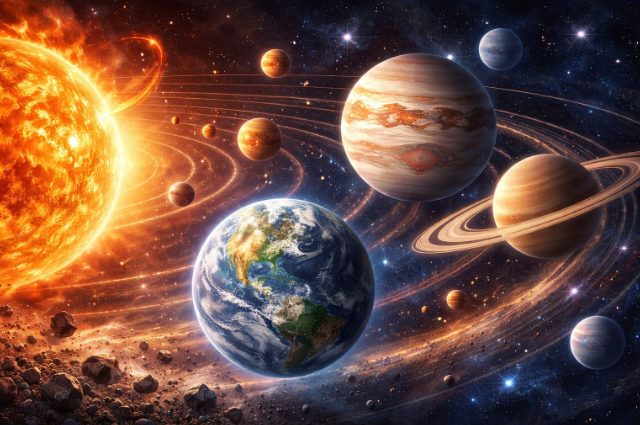
Part 1: When Earth Decided to Spin Faster (2020 and Beyond)
So, remember how some people in the 2020s said, “Time feels like it’s flying by!”? Well, turns out, somehow, they weren’t just being dramatic or trying to be cool — Earth itself literally started spinning faster.
Usually, the Earth takes exactly 23 hours 53 minutes and 0.4 seconds to complete a rotation; it is just too detailed to remember, so just count 24 hours. Well, that’s enough, a neat day for us humans to eat, sleep, scroll through memes, and complain about schools and offices. But since 2020, scientists noticed something odd — Earth’s rotation was a few milliseconds faster than usual.
Milliseconds! That’s like the time my classmates study each day.
Now, that doesn’t sound like a lot, but when it comes to the planet that’s carrying billions of people-you know, every millisecond counts. Imagine a massive spinning ball suddenly deciding, “You know what? Let’s speed things up a bit.” That’s what Earth did — and scientists are still scratching their heads trying to figure out why.
They’ve got some suspects:
Changes in Earth’s core: Deep down, our planet has a liquid metal core that moves around like soup in a pot. If it shifts, it can slightly change how fast Earth spins
Melting ice: Thanks to global warming, glaciers are melting like our ice creams and sending water toward the equator, messing with Earth’s weight distribution — like putting all your fat on one side of your stomach.
The Moon’s position: Our friendly neighbourhood Spider-Man, I mean, Moon pulls on us with its small gravity. Its position can cause small speed-ups or slow-downs in our spin, kind of like a dance partner who occasionally steps on your toes.
So, yes — since 2020, the Earth’s been spinning kind of faster than usual, which technically means our days are getting kind of shorter by a few milliseconds. Scientists are even thinking they might have to remove a leap second from our official clocks around 2029, just to keep up.
But don’t worry — this won’t make you age faster or lose your sleep. It just means our planet is having a midlife crisis, and instead of buying a sports car, it’s acting like Usain Bolt.
Part 2: The Math Toppers of 3500 BC — How 60 Took Over Time
Long before people complained about not having enough time or having too much time, the Sumerians (ancestors of the kid who always gets A+ in maths) — around 3500 BC — decided to invent it.
Okay, they didn’t invent time itself (that’s been around since like the Big Bang), but they invented how we measure it — and they did it in a way that still confuses schoolchildren today.
Instead of counting by 10s like we usually do, they used a base-60 system. Why 60, there are so many numbers like 72, 9, 11, 67, 69, well, because apparently, they loved fractions. The number 60 can be divided evenly by 1, 2, 3, 4, 5, 6, 10, 12, 15, 20, and 30 — making it the most cooperative number in math history.
So, thanks to the Sumerians, we got:
- 60 seconds in a minute
- 60 minutes in an hour
- 360 degrees in a circle
The Babylonians (their successors) thought, “Hey, this works!” and carried it on. Thousands of years later, when mechanical clocks were invented in the Middle Ages, people stuck with the 60-based system because — well, changing it would’ve been way too much paperwork or say maths.
So next time you’re staring at the clock in math class, watching those seconds crawl by, waiting for the class to end, remember — you’re counting just like someone did 5,500 years ago in Mesopotamia. That’s both cool and slightly depressing.
Part 3: The Week That Took Seven Days (Babylonians to 321 CE)
Let’s move on to the seven-day week — that not-so-magical stretch of time where everyone hates Monday and worships Friday.
This idea started with the Babylonians around 600 BC, who praised astronomy almost as much as the Sumerians loved math. They looked up at the night sky and noticed seven important celestial bodies: 🌞 the Sun, 🌙 the Moon, and five visible planets — Mercury, Venus, Mars, Jupiter, and Saturn.
They decided to honour them by giving each one a day. So, eureka — a seven-day week.
Well, the Romans later stole the idea (because Romans stole a lot of great ideas) and renamed the days after their own sweet gods:
- Sunday – Sun’s day ☀️
- Monday – Moon’s day 🌙
- Tuesday – Mars’ day (dies Martis) 🔥
- Wednesday – Mercury’s day (dies Mercurii) 🕊
- Thursday – Jupiter’s day (dies Jovis) ⚡
- Friday – Venus’ day (dies Veneris) 💕
- Saturday – Saturn’s day 🪐
Then in 321 CE, Roman Emperor Constantine the Great (kind of), made it official: the seven-day week was now the law across the whole Roman Empire — and Sunday was declared the first day (and later the day of rest).
And just like that, our modern week was born. So, every time you dread Monday, you can thank a bunch of ancient sky-watchers who thought it was a good idea to split time according to planets, and just curse them.
Part 4: When the Romans Messed Up the Calendar (753 BCE to 45 BCE)
Now let’s talk about the calendar, because oh boy, the Romans really couldn’t get it right at first, and never did.
Back in 753 BCE, Rome’s founder, Romulus (yes, the wolf-raised guy, the jungle book of rome) created the first Roman calendar. It had only 10 months and started in March, because apparently, winter didn’t deserve any months. The calendar looked like this:
March (Martius)
April (Aprilis)
May (Maius)
June (Iunius)
Quintilis (July later)
Sextilis (August later)
September
October
November
December
That’s right — December was originally the 10th month, not the 12th. The name comes from decem, Latin for ten. There were no January or February, because winter was just considered “the off-season.” Farmers didn’t work, soldiers didn’t fight — so who needed a calendar?
Then came King Numa Pompilius around 713 BCE. He looked at the sky, scratched his head, and said, “Guys, this doesn’t match the Moon at all.” So he added two new months: January and February — bringing the total to 12 months and making the year roughly 355 days.
Unfortunately, 355 days isn’t quite long enough for a solar year (which is about 365.25 days). Over time, festivals and seasons started drifting — winter happened in July, and nobody knew when to plant crops anymore.
By 46 BCE, things were such a mess that Julius Caesar said, “Enough!” He introduced a brand-new system: the Julian calendar. His astronomers explained that the year needed to be 365 days, with an extra day every 4 years — the leap year — to make up for that pesky quarter-day in Earth’s orbit.
This new system began in 45 BCE, and guess what? We’re still basically using it today (well, with a few tweaks).
Part 5: February — The Month That Got Scammed
Ah, February, the underdog of the months. The short, awkward, sometimes romantic, sometimes miserable 28-day wonder month. But how did it get so unlucky?
Let’s rewind again to Numa Pompilius in 713 BCE — the same guy who added January and February. Back then, even numbers were considered unlucky by the Romans, even though they are the most numerous in world history. Most months had 29 or 31 days (all odd). But someone had to get stuck with an even number, so the total would balance out to 355 days.
And Numa, in his infinite wisdom, said, “Let’s dump all the pure bad luck into February!” That’s because February was already associated with purification rituals and honouring the dead (from the festival Februa). So, why not make it the shortest and “unluckiest” month too?
Over time, as the Julian calendar was introduced, all other months got their lengths adjusted — but February stayed way short. Then, to keep things fair, Caesar added one extra day every four years — the leap day — so February could feel a bit special for a change, as if it's a birthday.
Even now, leap years happen every four years (except in the Gregorian fix of 1582, where centuries must be divisible by 400 to count, whatever). So, 2000 was a leap year, but 1900 wasn’t, whatever. It’s really complicated — just like everything else about time.
Part 6: From 1582 to Now — The Gregorian Glow-Up
By the 1500s, the Julian calendar had drifted about 10 days off track. That’s like celebrating Christmas in autumn and Diwali in summer. So in 1582, Pope Gregory XIII said, “Okay, we’re fixing this once and for all.” He introduced the Gregorian calendar, which fine-tuned the leap-year rule so our seasons stayed in sync and won't mess up, probably.
That’s the calendar we still use today. The Gregorian calendar keeps us aligned with the solar year (365.2422 days), and it’s been holding up pretty well — though February still hasn’t forgiven anyone.
Part 7: Time, Tradition, and a Planet That Can’t Sit Still
So now we’re back in 2020–2025, and our planet — after thousands of years of humans trying to control time — decides to mess with us again by spinning faster (Earth won't forgive us)
It’s kind of poetic, isn’t it? The Sumerians gave us 60 seconds. The Babylonians gave us 7 days. The Romans gave us 12 months. Julius Caesar gave us leap years. Pope Gregory gave us the modern calendar. And now, Earth is like, “Cool story, but I’m going to rotate however I want.”
If this keeps up, around 2029, scientists might actually remove a leap second — the first time in history we’d have to make days shorter instead of longer, finally maths classes will be shorter, by a leap second.
But don’t panic. You won’t lose sleep, your phone will still tell the right time, and February will still feel unfairly short.
Time will keep moving — fast or slow — and humans will keep trying to measure, name, and organise it… while the universe just laughs in milliseconds.
Final Thoughts: Time Is a Human Joke That the Universe Plays Along With
From 3500 BC to 2025, we’ve been obsessed with tracking something we can’t even touch. We made hours, minutes, weeks, and months — all to give structure to the chaos. But in the end, time is just Earth spinning around and the Sun doing its thing, while we stress over deadlines and birthdays.
So next time you check the clock and sigh, remember:
The Sumerians are the reason you’re counting to 60.
The Babylonians are why weekends exist.
The Romans are why your calendar has 12 months.
And February? It’s short because the ancient Romans decided it should suffer for everyone else’s sins.
Meanwhile, Earth is spinning just a tiny bit faster, like it’s in a hurry to get to the weekend too.