
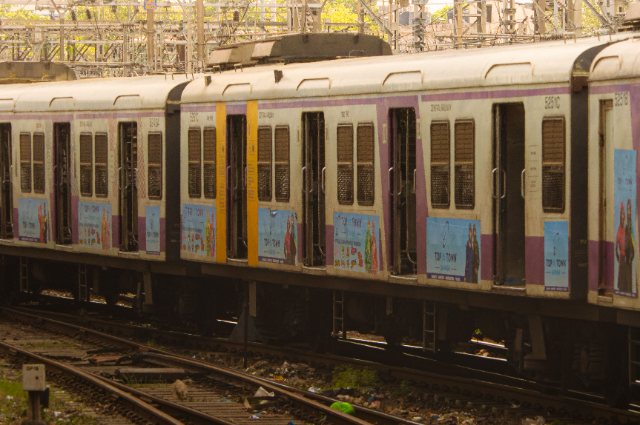
Mumbai is known for its heavy monsoon showers, which cause flooding, delays, traffic congestion, and general frustration amongst the crowd. Amidst this heavy downpour, some residents still have to go about their daily lives: work, commute, and perform as they usually would. Often, people are forced to endure such extreme weather conditions while juggling other chores and while commuting via local trains.
One such train was heading towards Virar. Mayank Lohar, a young commuter, boarded the train numbered 90663 after finishing his work in Andheri. This is the Churchgate–Nallasopara Fast Local, which departed Churchgate at 10:05 PM. As the rainfall grew heavier, he simply asked a fellow passenger by the compartment door of the first-class cabin to close it.
What sounded like an ordinary commuter story- a simple request, a polite reply, and a problem being solved- turned into something gory. Instead of having a simple conversation, a request to close the doors turned into a murder investigation.
Despite his polite request, the other passenger disagreed. The situation quickly escalated; a knife was pulled, and Mayank was stabbed in the abdomen. Soon after this, the accused jumped off the train at Borivali station before it could even come to a halt.
This tragedy has forced many people to think about the uncomfortable realities of why ordinary disagreements often lead to such extraordinary acts of violence. Is it the lack of public safety? Or is it the normalisation of such crimes that has led to a rise in incidents like this?
When the City’s Lifeline Becomes a Crime Scene
Mumbai's suburban railway network is described as one of the busiest in the world. It is considered Mumbai's lifeline, carrying around 7-8 million passengers every day.
The Western Railway suburban corridor alone connects several major commercial and residential hubs across the city, such as Churchgate, Borivali, Andheri, Virar, and Nallasopara. It serves millions and millions of daily commuters.
For many people, trains are more than just a way to get around; they are a vital part of daily life. Whether going to work, heading home, or shopping, these trains reach every part of the city.
This is why coaches are packed with passengers, especially during peak hours and in inclement weather. Picture this scenario. There are millions of commuters with long working hours who are physically exhausted and mentally drained, and want to get home as quickly as possible. Then, they face monsoon delays, limited personal space, overcrowded compartments, and the general stress of balancing work, getting home on time, and managing their family responsibilities.
All these conditions intensify the emotions among these millions of commuters, making even minor disagreements seem disproportionate and significant. However, while there might be a lot of pressure, which explains the frustration, it can never justify any acts of violence. The issue with the case regarding Mayank’s request is that the train door was never the actual cause. It was simply the spark that ignited many emotions in the passenger, who was already fueled by impatience, stress, and poor emotional regulation.
The Growing Normalisation of Everyday Aggression
This is just one incident. However, if we look beyond the train tracks, we can notice how aggression has become visible, how everyday violence is being normalised. It isn't just limited to Mayank's case.
Whether it be through road rage, arguments in queues, conflicts in marketplaces, parking disputes, neighbourhood disagreements, or brawls on buses and trains, acts of violence, even small acts of harm, have become a normal part of social life. And this trend is worrying because it is quickly escalating, and disagreements are turning into physical violence within a matter of mere seconds.
There are multiple reasons why such acts have been occurring more frequently. Nowadays, the stress level amongst people is increasing, and they lack awareness regarding emotional regulation or impulse control. People often feel there are no proper channels for discussing these emotional issues. Sometimes, viewing disagreements can also become a personal challenge to one's dignity.
This case of fatal death is recorded as the second stabbing that was reported on Mumbai's Western Railway suburban network in 2026. There was an earlier incident recorded as well that took place in February 2026, wherein a 23-year-old college lecturer was stabbed on a train from Vile Parle while attempting to get off the local train. The police later arrested the accused in the case, Omkar Shinde.
We must understand that ordinary disagreements are now increasingly turning into acts of fatal violence. Law enforcement is actively participating, but they must understand that there is an emotional angle that needs to be analysed as well. Is this going to be a culture that develops within public spaces? Do people need to be more careful when making small requests? Or are we just normalising the act of rage that should never turn into such heinous acts?
Safety That Goes Beyond Security
In one of the busiest cities in the world, public transport doesn't depend solely on its infrastructure. But also on public trust. Small disagreements and quarrels are a part of human nature. However, passengers expect strangers to disagree without becoming violent. They expect a mutual understanding of public space and that arguments, even if they arise, must remain verbal, not physical. Most importantly, everyone who commutes expects to get home safely.
When violence occurs inside closed spaces that are being used by millions of people every single day, that trust begins to fade. Even a small act of harm can have far-reaching consequences. People who travel from the office late at night, women who are commuting alone, students who are simply travelling from schools and colleges, senior citizens, family members, young children- all of them are affected by such incidents and heinous acts.
The Borivali Government Railway Police (GRP) have registered a murder case and are examining the evidence that has come to light. They have taken into account witness statements, forensic evidence, and even CCTV footage available at the time. The railway authorities are also cooperating with the investigators, providing them with full support in obtaining whatever evidence they need. Even though investigations have taken place, preventing violence and crime requires a lot of attention beforehand.
There needs to be visible policing, stronger surveillance, and better emergency response systems so that the public has more trust in the system and the people. Public awareness about how to de-escalate conflict is also a must.
After completing an ordinary workday, Mayank Lohar boarded the train.
His final interaction was a simple request to close the compartment door due to the heavy downpour. That request should have either ended with an action or silence. Instead, it ended with tragedy.
The Mumbai local is celebrated as the city's lifeline. It connects millions of people every day. However, a lifeline should never become a place where ordinary disagreements turn into crime.
Perhaps the lesson we can learn from Mayank Lohar’s death is that public safety is not just about monitoring actions but also about rebuilding trust and empathy amongst the people who share everyday spaces with millions of others.
References:
- The Indian Express. (2026). Virar man stabbed to death after argument over train door in Mumbai local. (Primary report for the incident and investigation.)
- The Times of India. (2026). Man stabbed to death inside first-class coach of Mumbai local train. (Case details and police investigation.)
- Hindustan Times. (2026). Borivali GRP probes fatal stabbing on Western Railway local train. (Witness accounts and investigation updates.)
- Western Railway, Indian Railways. Mumbai Suburban Railway: Passenger Statistics. https://wr.indianrailways.gov.in/
- Ministry of Railways, Government of India. Railway Safety and Security Initiatives. https://indianrailways.gov.in/
- National Crime Records Bureau (NCRB). Crime in India Report. https://www.ncrb.gov.in/