
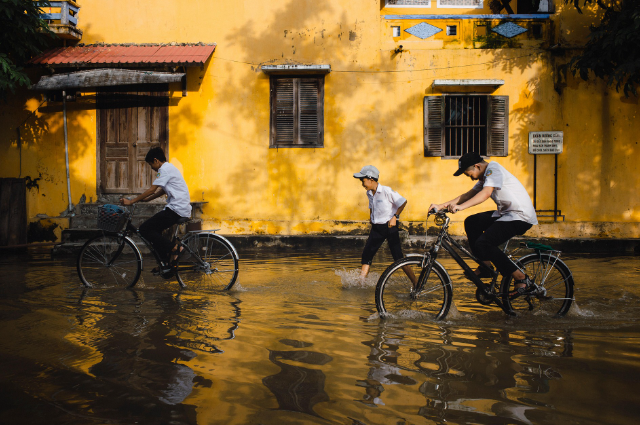
Children require uninterrupted access to education, especially during their formative years. However, for many Assamese students, that access is often restricted due to floods, climate change, and repeated uncertainty.
Residents of Upper Assam have gotten accustomed to floodwaters, as these drastic climate changes have become a repetitive phenomenon. Locals regularly witness the loss of livelihoods and necessities during such fluctuating weather conditions and are forced to start from scratch each year.
The children of Assam also notice a similar pattern, yet in their scenario, their only source of learning and knowledge vanishes. Assam’s flash floods have turned well-established schools into rubble, destroying any desk, chair or other infrastructure that comes in their path. This curbs a student’s right to education and plays a major role in derailing their learning process.
This year’s flood records showcase vast damage to people and property. During July’s monsoon spell, Upper Assam witnessed extreme flooding, and around 78 people lost their lives. These erratic rains affected several districts such as Golaghat, Sivasagar, Jorhat and Nagaon. With its vast spread, the floods affected nearly 3,00,031 citizens.
These high water levels also affected the residents of around 551 Assamese villages and damaged their crop yields. With insufficient infrastructure, village folk lost agricultural stability.
The floodwaters also flowed towards colonies and schools. The unprecedented rainfall caused school closures, adversely affecting the students. As the situation worsened, many schools were wiped out.
This year’s flooding has caused severe harm and damage to the people and dwellings concentrated in Upper Assam. Many have speculated that the flooding was mainly caused by the tributaries rather than simply by the overflowing current of the Brahmaputra.
Rising Rivers: The Brahmaputra Wasn't the Only Cause
Assam is synonymous with the Brahmaputra, and with every annual report of flooding, many point their fingers towards the river. But this episode involves different characters. Rivers such as the Dikhow, Disang, and Dhansiri also rose sharply across Upper Assam. Due to the rising water levels, severe flood conditions were reported in Sivasagar, Namgholamoraghat, and Numaligarh.
While Assam has become accustomed to floods, this year, it was confronted by something much more powerful: a different pathway presenting a different problem.
This flooding and the rising rivers were the result of exceptionally heavy rainfall in the neighbouring hills of Nagaland. Upon initial inspection, the government officials noted the possibility of a cloudburst occurring on July 19 in the Mon District of Nagaland. However, several scientists from the Meteorological Centre in Kohima conducted further analysis and suggested that a cloudburst couldn’t have caused excessive flooding.
As days passed, the floods wreaked more havoc. They led to great distress as 21 people died just on July 22. With water levels still rising, the count of citizens affected by flooding also increased.
Himanta Biswa Sarma, the Chief Minister of Assam, analysed the dire circumstances and addressed the rising difficulties of the residents of Upper Assam. He stood with the frustration and helplessness of the people and remarked that such flooding and high water levels are rare.
Current Beyond Classrooms: The Floods Don't Stop at School Gates
The excessive rainfall also disrupted the routine education of students. Every child's education depends on continuity: on the routine of attending school, having books, proper infrastructure, and following a curriculum.
In Sivasagar and Charaideo, schools themselves were damaged, their property destroyed, and classrooms covered in silt and mud. Heavy waters pushed through walls, damaging infrastructure, library books, official records, and other necessary materials.
The children of Sivasagar were highly impacted, losing their supplies and access to schools. Even when resources were provided, food grains and medical aid were prioritised over educational materials. Yet knowledge requires a different kind of recovery.
The Rohiteshwar Saikia Lower Primary School lies on the Assam-Nagaland border and is recorded as one of the most badly affected schools. It now stands as a symbol of a larger problem. It showcases how floods do not just wash away physical infrastructure; they remove years of planning and the material conditions required for learning.
Relief Arrives, But Recovery Takes Longer
By July 29, the floodwaters were receding, and many essential services such as electricity and basic amenities had been restored in several affected localities. More than 37,000 people were still placed in relief camps, while Sivasagar alone was housing 30,000 people across 67 different campsites.
The Assam government took note of the dire situation and announced ₹4 lakh in ex gratia for families of people who had died in flood-related incidents. The Chief Minister’s Relief Fund also provided an additional ₹5 lakh for families of the deceased.
The government also aided those severely affected by the flood. They provided ₹15,000 each to more than one lakh families. The authorities also announced educational assistance for students who were severely affected, beginning August 1.
Book grants were set at ₹1,000, ₹3,000, and ₹5,000, depending on the circumstances of the specific region. Alongside these grants, free textbooks and assistance with school uniforms were also provided.
Education Minister Ranoj Pegu announced on July 25 that free replacement textbooks would be provided to students whose books were damaged or lost during the floods. Extensive action was subsequently taken, with textbooks being resupplied across the districts of Charaideo and Sivasagar.
The response recognised an important reality: education cannot simply wait until a disaster is completely over.
Attending class, mingling with friends, sharing tiffins, and learning new things are all parts of every child's routine; an ordinary school routine. Yet, in Assam, many children eagerly wait to return to school.
Despite the current stable weather conditions, the students still can’t practice classroom learning. The recovery of school supplies and infrastructure demands dedication and a considerable amount of time. Hence, flood relief can’t be measured only through the metric of ground clearance but also through the timeline of when society starts functioning again.
References
- WION. “Assam flood toll reaches 78 after fresh deaths in Sivasagar, Golaghat; over 3 lakh people affected across seven districts.” WION, July 2026. https://www.wionews.com
- BBC News. “Assam floods…” BBC News, July 2026. https://www.bbc.com
- Open Magazine. “Assam Flood Death Toll Rises to 78, Over 3 Lakh People Affected Across Seven Districts.” Open Magazine, July 2026. https://openthemagazine.com
- The Indian Express. “Assam floods explained: Why this year’s deluge has been so devastating.” The Indian Express, July 2026. https://indianexpress.com
- The Indian Express. “Our whole village went underwater: The devastating impact of Assam floods.” The Indian Express, July 2026. https://indianexpress.com
- The Times of India. “Sivasagar and Charaideo students face classrooms devoid of books.” The Times of India, July 28, 2026. https://timesofindia.indiatimes.com
- News on AIR. “Assam flood situation improves as waters recede in Upper Assam.” News on AIR, July 29, 2026. https://newsonair.gov.in