
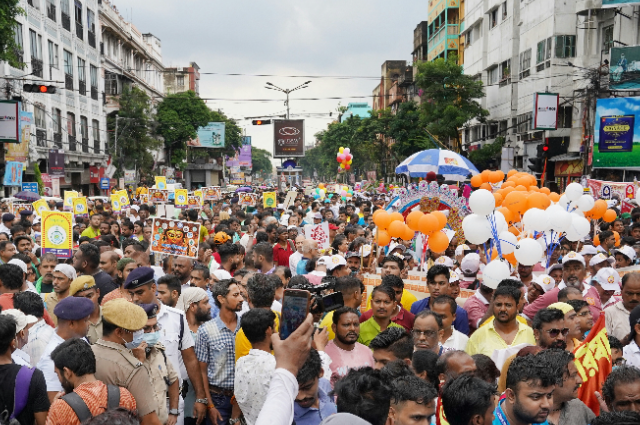
Jantar Mantar, an iconic historical monument that witnesses a large footfall of foreigners and tourists alike, now stands witness to thousands of young people gathering around its borders in order to march towards the Parliament. These weren't just ordinary folks. They were students and citizens who demanded accountability. Some carried placards; some shouted slogans asking the government for clarity.
Many of these students had spent months preparing for their competitive exams, only for the neat paper to be leaked. Yet as they approached the Parliament to seek an answer to their turmoil, the police intervened. Reports have described that authorities used batons and released tear gas after demonstrators tried to advance. Many protesters have alleged that they also used excessive force, whereas the authorities are countering by saying that this action was necessary to maintain law and order.
What began as frustration over an alleged examination irregularity has now become something larger, a nationwide movement that questions the citizens' right to protest while asking for public accountability.
From a Remark to a Movement
When you first come across the Cockroach Janata Party (CJP), you might wonder about its peculiar name. According to its organisers, the name emerged after students were likened to “cockroaches” during public debate about the examination controversies.
Initially, this movement aimed to hold the government accountable and focused solely on the alleged NEET paper leaks. Their demands were simple: justification, examination reforms, and the resignation of Education Minister Dharmendra Pradhan. These demands are crucial since over 22 lakh students appear for NEET annually. One alleged irregularity can alter results for millions of students and their families.
Yet, this movement rapidly transformed into something beyond examinations. It brought together unresolved issues and people's demands for fair governance and institutional accountability.
When Protests Become a Political Movement
Initially, when CJP members decided to hold this protest, their demands focused on education. Soon, they shifted towards governance, transparency, institutional trust, and issues like examinations and youth unemployment.
Sonam Wangchuk joined the movement through a hunger strike to draw wider public attention and emphasise government accountability. He ended his 26-day fast after receiving written assurances that peaceful protesters would not face legal action and that exam reforms would be discussed.
As Sonam Wangchuk states, "Be the hero of your own life, fulfill your responsibility as a citizen." Hereon, the movement gradually attracted more support from beyond the students. Citizens brought up their own demands and joined in on the fight that initially started from an alleged exam paper leak. While there was immense support, the biggest test for this movement came during the Parliament march.
The Day Delhi Stopped
As word spread about CJP's “Sansad Chalo” march, students from across the country began to join the movement. Reports estimate that around 10,000 protesters showed up on the day of the march to Parliament.
On that day, police imposed restrictions. Roads were blocked, and metro stations were affected in some areas. Demonstrators tried to march towards Parliament, but police responded with crowd control measures, including batons and tear gas. Multiple news reports say authorities used these measures to prevent escalation. During the protest's chaos, the founder of CJP was reportedly detained. After these clashes, the government initiated dialogue. Parliament invited representatives for talks, but no immediate agreement was reached.
This protest has shifted public attention from examination reforms to civil liberties. It talks about how the issue that started with an alleged paper leak has now transformed into the citizens' rights to protest and have free speech.
More Than An Education Issue
Hundreds and thousands of students and citizens marched at Jantar Mantar, demanding accountability from the government. Why did this movement resonate with the people so strongly?
There are many reasons for this. Competition in such exams is growing. Alongside that, youth unemployment rates are strikingly high. This led to pent-up public frustration, a lack of trust in institutions, and social media mobilisation that provided a connected support system during the protest.
During this march, the paper leak only acted as a catalyst; it will continue, yet the outcome of these discussions remains uncertain.
This story is no longer about an examination. Its themes have shifted to student frustration and civic action. Whether the movement achieves its demands remains uncertain. But it has already shown how significant the impact of a collective can be. Students' concerns are not limited to the classroom. They have become increasingly vocal about it, carrying their questions into the street and to Parliament, and ultimately asking for a public debate and for Parliament to provide a fair answer.
References:
- BBC News. Coverage of the Cockroach Janta Party protests and Parliament march. https://www.bbc.com
- India Today. Cockroach Janta Party Calls Nationwide Protest; Sonam Wangchuk Ends Fast.
- Reuters. India's youth leaders to talk with government but press on with nationwide protests.
- Associated Press. Indian activist Wangchuk ends 26-day hunger strike as 'Cockroach' protesters vow to press on.
- The Indian Express. Timeline: CJP protesters back at Delhi's Jantar Mantar after massive clashes.
- Counterview. The Cockroach Revolt: India's Youth and... (use for movement framing and commentary).
- India Today. I am not Gandhi, be your own hero: Sonam Wangchuk urges citizens to join protest.