
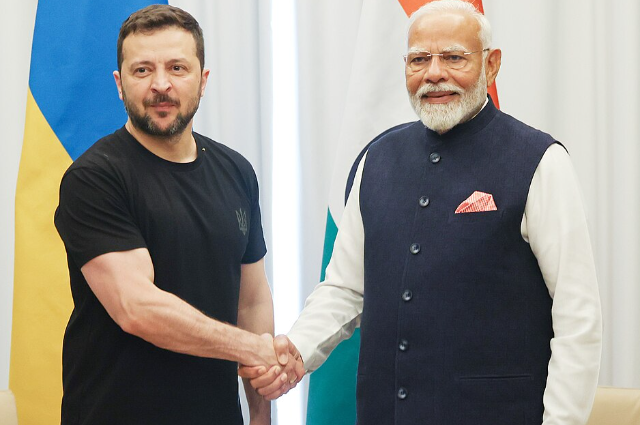
For over four years, the Russia–Ukraine war has tested alliances and reshaped international diplomacy. The conflict has split powers, disrupted trade routes, and ignited issues in terms of energy and food.
While the United States and several European nations have approached the situation for their diplomatic benefit, India has continued to advocate for judicious conversations and relations with both Moscow and Kyiv.
In October 2026, S. Jaishankar, the External Affairs Minister, said India had become “a little bit more involved beyond advocacy” in the conflict. He confirmed that New Delhi is conducting continuous discussions with both sides. The goal, he said, was to find ways to reduce violence. This marked a shift in India’s stance. It is not just calling for peace; it is also aiding in its facilitation.
This begs the question: what is driving this increased involvement, and is India acting out of concern for peace, or are its economic and strategic interests playing a role?
From Strategic Autonomy to Active Diplomacy
Since Russia's full-scale invasion of Ukraine in February 2022, India has stood for dialogue and peaceful solutions. India hasn’t cemented ties with only one country. It is trying to maintain connections with Ukraine. At the time, India had not cut ties with Russia. It has kept links in defence, energy and diplomacy.
Russia has been a partner for India for decades. It has supported India on security issues, especially during times of tension with other nations. This history matters to New Delhi. Their defence relationship includes military equipment and joint projects. India also relies on Russia for energy and missile technology.
Even their economic ties are growing. According to The Economic Times, India imported over $43 billion worth of crude oil in 2025. In the first half of 2026, imports jumped by about 25%. By now, Russia supplies around half of India’s crude oil needs. This makes energy security a major factor in India’s policy.
India is not only initiating conversations with Russia. It has also deepened ties with Ukraine. In September 2026, Jaishankar visited Kyiv and discussed the situation with Ukrainian Foreign Minister Andrii Sybiha. Their discussions highlighted methods to end the war. India’s stance is clear: it supports a humanitarian solution while maintaining diplomatic communication with both sides.
Strategic autonomy does not translate into remaining passive. For India, it provides an opportunity to use its relationships with both Russia and Ukraine to push for dialogue. It lets the capital act without being forced into choosing sides and while maintaining an independent foreign policy.
The Three-Part Proposal: What Has India Actually Offered?
In October 2026, reports state that India has put forward a three-part plan to reduce hostilities and protect essential trade routes. Hindustan Times reported that the idea originated in discussions among nations. The initiative focuses on infrastructure, commodity flows and commercial shipping. India has not publicly released the full text of the plan.
The first component concerns protecting energy facilities and other critical infrastructure. Attacks on power plants, oil facilities and ports create risks for civilian life. They can damage economic activity and undermine efforts to establish a ceasefire. A mutual pause on attacks could be a first step toward peace.
The second component discusses food and energy exports. Ukraine and Russia both export grain and energy through the Black Sea route. Disruptions to agricultural exports can lead to increasing international prices and have ramifications for countries dependent on imported grains. Protecting these routes could help stabilise food security in several parts of the world.
The third component deals with the protection of commercial shipping and merchant vessels operating on the Black Sea route. This issue has particular significance for India since reports have stated that several Indian ships have been attacked and sailors have been injured. Protecting merchant vessels, seafarers, and maritime trade is a key interest for India.
The strength of the proposal lies in its focus. Instead of trying to fix everything at once, it aims for small practical steps. That makes it more likely to succeed. However, its effectiveness will depend on whether both countries are willing to accept and implement the proposed measures.
Why the Trump–Putin Development Matters
Recent developments involving US President Donald Trump and Russian President Vladimir Putin further illustrate the complexity of international peace efforts.
On October 12, Reuters reported that the US had eased sanctions on diesel exports. The Trump administration hoped this would push Moscow back to the negotiating table. The move attracted criticism, and many argued that allowing such exports could provide financial benefits to Moscow.
Trump also announced an energy ceasefire. However, Ukrainian President Volodymyr Zelenskyy pushed back, stating that no such deal existed. A mutually agreed truce was suggested, yet reports still highlight subsequent Russian attacks. The announcement should therefore not be interpreted as confirmation of a comprehensive peace agreement.
For India, this is a lesson. Peace efforts and open negotiations act as crucial steps. However, they must be backed by action. India’s own plan focuses on aspects that can be measured: safety of ships, access to ports, protection of infrastructure. That makes it more credible than promises.
Can India Really Become a Diplomatic Bridge?
India's continued communication with Moscow and Kyiv provides it with an opportunity to convey proposals, offer insights, and encourage both sides to consider practical steps towards reducing hostilities. Through its foreign relations, New Delhi can maintain open channels of communication during times of prolonged conflict.
Jaishankar’s remarks show that India is advancing towards utilising its relationships for active communication. It is not just saying “end the war.” It is trying to facilitate that decision and implement tools that can benefit the nations. Its focus on trade, energy and shipping shows it is thinking about real-world problems while trying to combat serious situations in a diplomatically evolving landscape.
Success for India would not simply be a peace deal. It would be assessed through tangible outcomes such as the decline of attacks, the safety of merchants and ships and the distribution of essential supplies without interference.
From a Voice for Peace to a Facilitator of Peace
India's latest initiative suggests that its role may be evolving beyond repeated calls for dialogue towards more direct diplomatic engagement. Its approach reflects both a stated commitment to peace and practical interests in energy security, trade and maritime safety.
While the proposal requires alteration, it is still grounded in the provision of real needs and essentials. Its effectiveness will depend on the willingness of Russia and Ukraine to cooperate and translate diplomatic discussions into action.
The next test for India is not simply whether it can bring Russia and Ukraine to the negotiation table, but whether it can turn the language of peace into agreements that both sides are willing to honour.
References:
- The Indian Express — We are in talks with both Russia and Ukraine: Jaishankar.
- Hindustan Times — India proposes 3-part truce amid Russia-Ukraine war to keep grain, energy flowing
- The Economic Times — Russian crude deliveries to India crossed $43 billion in 2025 and rose 25% in the first half of 2026
- Reuters — US hopes diesel deal can 'soften' Moscow on peace talks, sources say
- Reuters — What's in the diesel deal between Putin and Trump? (October 12, 2026).
- The Diplomat — What “Beyond Advocacy” Means for India’s Role in the Russia-Ukraine Conflict (October 8, 2026).