
Most security personnel wouldn’t bat an eye towards a white Ambassador car with a fluctuating red beacon. The vehicle’s windscreen is decorated with markings stating “Parliament” and “Home Ministry.” There is nothing out of the ordinary about this scene. However, even in something that seemed routinely accurate, one policewoman made a distinction.
Kamlesh Kumari, a CRPF Constable, ran towards Gate Number 1. Without any hesitation, she reached for the emergency signal and raised an alarm. The heavy iron gates come to a complete close. Within a matter of seconds, terrorists lunge out of the Ambassador and engage in open fire. Kumari doesn’t have any protection, no firearm, no bullets, just a walkie-talkie. Eleven bullets strike her.
Her instincts were calculated. Her actions were swift. Her keen eye and prompt response changed the course of that whole Parliament attack. Even today, her courage is recognised, her act of bravery is taught, and it stands as a true example of how the greatest power lies with those who choose to act first.
The Woman Behind the Khakhis
Kamlesh Kumari joined the Central Reserve Police Force (CRPF) in 1994. After she got her commission, she was first posted to Allahabad with the 104 Rapid Action Force. During the course of her career, she travelled across different regions. In 2001, she was posted to the 88th Mahila Battalion. After the completion of this tenure, she was assigned to the Bravo Company, where she was responsible for Parliamentary security.
Alongside her professional achievements, Kumari also looked after and nurtured her family. She was married to Avdhesh Yadav, and together they had two daughters, namely, Jyoti and Shweta. Kamlesh Kumari thought of herself as an ordinary person from Uttar Pradesh. However, she conducted herself through extraordinary standards.
A Decision that Altered Everything
On 13th December 2001, amid the peak of Delhi's winter, a routine day at the Parliament was about to begin. At the start of the day, everything seemed normal. The sun rose from the east, security personnel took their positions, and officials entered the building.
Yet, no one knew that a seemingly quiet day could turn into a haunting incident. When a white Ambassador car, bearing license plate DL 3C J 1527, tried to enter the gates, a split-second decision changed everything.
Despite the car having the necessary markings to enter the Parliament office, Kamlesh noticed a distinction. Without wasting even a second, she rushed towards the front gate and pushed the emergency button. The iron gates closed, preventing the militants from driving towards the main building. However, even though she took swift action, the consequences were devastating.
Soon after the alarm was raised, the attackers leapt out of the vehicle and opened fire. Kumari was first in the line of duty and became a casualty. Luckily, the emergency alarm alerted other officers. Constable Sukhwinder Singh helped neutralise the suicide bomber. To his aid, Constable Santosh Kumar navigated the situation and killed three militants.
Kamlesh Kumari's sacrifice directly influenced the outcome of the incident. The credit goes to her quick thinking and swift action.
What Makes Courage
The concept of courage is often misunderstood. People seem to think that courage is the absence of fear. People believe that those who practice bravery are enlightened above others. However, in reality, that is not the case at all.
Kamlesh Kumari was also courageous. She was unarmed and in a vulnerable position. Yet, despite all the fear she had in her heart, she leapt to alert the other officers. She leapt in the hope of bettering the situation in front of her.
Courage isn't something that people feel ready to embody. Courage is not the absence of fear, but the thought of acting despite it. Kumari chose her duty to the nation and the people she serves over self-preservation. She was the first in the line of defence, and she acted accordingly.
Even today, those who work in frontline public service embody this spirit of courage. Many paramilitary forces, defence personnel, disaster response workers, firefighters, and even medical teams make split-second decisions. Those decisions don't come from research or from understanding the situation. They come from the act of courage, from taking a leap of faith, a chance that could save lives.
However, most of these moments don't make the headlines. Society likes to celebrate acts of visible heroism. Those who get to save people from a boiling tragedy. But society rarely reflects on those who stop the tragedy in the first place. Those who carry the responsibility of protecting public institutions every single day. Such jobs are taken for granted. But the story of Kamlesh Kumari challenges us to adopt a different perspective on what public service looks like and to understand that the challenges faced by people in such forces are time-bound and critical.
A Legacy Beyond the Ashoka Chakra
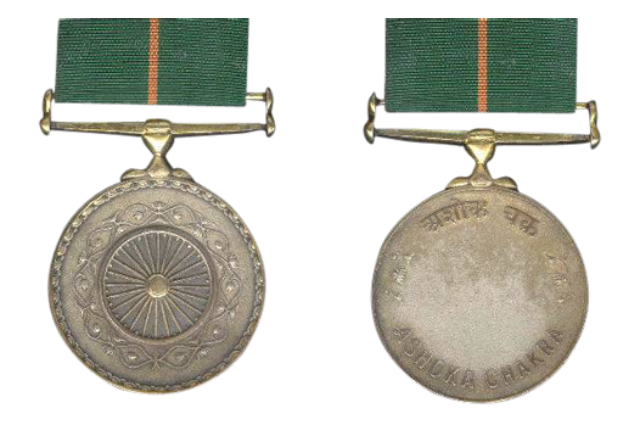
For the service she performed on 13th December 2001, she was posthumously nominated for and received the Ashoka Chakra award on Republic Day 2002.
Kamlesh Kumari is widely recognised as the first woman to receive the Ashoka Chakra for combat gallantry. This tribute was paid to her by the then Prime Minister Atal Bihari Vajpayee.
This award symbolises more than what she did during that incident. It preserves her memory and values the legacy she left behind. Her act and story continue to inspire and challenge current CRPF personnel, especially women entering uniformed battalions and services.
Her award also serves as a reminder that citizens depend on democracy, and that those elected as representatives are there to protect its institutions and the people who count on them during times of crisis.
An ordinary, cold, and cloudy winter day in Delhi. The big iron gates stand tall in front of the Parliament building. Security personnel are starting their work at the checkposts, and there, a woman constable is tending to her job. This daily schedule is soon disrupted by a group of militants.
Kamlesh Kumari stands in front of the gates. The emergency alarm was raised, and additional help was called, in anticipation of the terrorists’ next move. She had no weapon, no bullets, just a walkie-talkie, good instincts, and courage. Even during her final acts, all she thought about was protecting the people inside and saving those to whom she had taken an oath.
During her final act, what she did was tremendously helpful. She delayed the militants' entry long enough for the others to respond. She knew that in that moment, one step by her could be extraordinary, and she was correct. History often remembers all the glorious victories, but it should also talk about the ordinary people who make decisions in the blink of an eye.
Kamlesh Kumari did not live to receive all the gratitude that the people and her country had to offer. But her courage endures through spirit, and it stands as a guardian over Indian democracy.
References:
- https://crpf.gov.in
- Ministry of Defence, Government of India. Gallantry Awards – Ashoka Chakra: Kamlesh Kumari. (Official Gallantry Awards records.)
- https://timesofindia.indiatimes.com
- https://timesofindia.indiatimes.com