
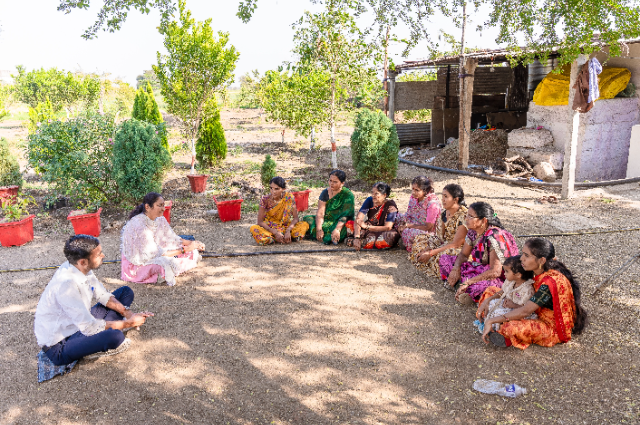
In childhood, the phrase "community thrives through a village" is often heard. Every adolescent is taught that community matters and that, during distressing times, their village will stand with them.
Yet, in today's world, this statement has become contradictory. Take Begusarai, for instance. A woman approached her community, alleging that she was the victim of a sexual assault. Yet, instead of getting support, she received public humiliation.
This incident took place in June 2026, in the Begusarai district of Bihar. It only came into wider public view in July, when a video circulated on social media. According to the woman, she complained that a neighbour broke into her house and allegedly raped her. Out of fear, she didn't immediately reach out to the criminal justice system; instead, she sought support from villagers and brought the matter to an informal panchayat.
Instead of receiving support, she was punished. They made her hold her ears and perform humiliating acts, including licking her spit from the ground. A man identified as the alleged accused was also reportedly punished.
On 1st August, an FIR was registered with the police, and the investigation started, where both the victim and the alleged accused were examined on the allegation of sexual assault and acts of humiliation.
A Complaint And Two Versions of the Same Story
According to the woman's statements, a neighbour had allegedly entered her house and sexually assaulted her between the dates of June 2nd and June 4th. Villagers also said they caught the man while he was trying to escape. After the incident, the panchayat was convened.
The Press Trust of India (PTI) has cited certain police reports containing an alleged complaint that the woman was raped in June, and that the panchayat proceedings followed this incident. However, an alternative account is also considered, as some locals said the man and woman were in an alleged relationship and were found together. Many state that the gathering was therefore responding to what might have seemed as inappropriate behaviour and an extramarital relationship rather than a rape.
However, the legal dynamics of this case must be considered. Whether the sexual activity was consensual is a question that cannot be solved by a panchayat, as it requires proper evidence and thorough investigation by the police authority. Even if an offence occurred, the criminal justice department must determine it.
An informal gathering such as a panchayat has no authority to impose punishment, especially when it is degrading in physical and emotional terms. Instances like this, which often go unheard and unrecorded, happen at a large scale, and they make us question whether social authority can eventually function as a judicial authority.
When The Panchayat Performs as a Court
Every citizen needs their community, a village, to support them during tiresome times. And village panchayats can be an important part of local governance. But they cannot transform into criminal courts.
An informal village gathering does not have the authority to pass judgment or impose punishment. Begusarai district’s official website lists 217 panchayats across 18 blocks and 1,229 villages. A digital scale clearly highlights the structure of local governance in this district. But through a fundamental lens, we can see that governance and criminal adjudication are completely different.
Under the Bharatiya Nyaya Sanhita, rape is explicitly recognised as a criminal offence and falls under Section 63. Section 64 prescribes its punishment. Rape under Section 64 (1) carries at least a minimum punishment of 10 years of rigorous imprisonment. This could potentially extend to life imprisonment along with a fine.
Therefore, since there are such heavy charges attached to rape cases, a village meeting cannot decide whether the complaint is valid, whether the accused is guilty, and they cannot impose their own form of punishment, especially substituting humiliation for proper investigation.
Simple conversations between village elders do not justify the outcome of a crime. The existence of community authority does not mean that serious crimes are exempt. It means a village has a structure to follow: small issues can be noted and brought to the attention of the proper authorities. This incident, therefore, shows how dangerous the gap between informal justice and social authority is, and what happens when custom, reputation, and pressure collide with formal law.
The Law Exists, But It’s Access That Matters
Even with well-defined laws, hefty books of criminal justice codes, and a proper legal framework, access to justice still depends on whether people can actually reach the framework confidently, swiftly, and safely.
The Begusarai case reportedly exposed the gap between proper justice and citizens' access to it. After the video footage circulated online, police recognised the incident and began investigating the allegations. Police said they were trying to verify whether the information was authentic and could be confirmed with the people shown in the digital clip. Because the footage itself could not automatically be considered video evidence, it needed to be authenticated first and verified through multiple sources.
That is where the larger authority comes into place. A criminal complaint should not need to become viral before the institution responds. The law exists and works, but is it accessible to the people who desperately need it?
When the law stops at the village gate
On a random weekday in June, a woman was begging to be heard, allegedly becoming a victim of rape; she only found herself being publicly punished instead of finding the help that she deserved.
The most disturbing part about this isn't that the panchayat allegedly imposed this degrading punishment, but that an informal gathering apparently had the power and position to act as the law.
Community justice can exist. In fact, it coexists with formal institutions. But community services such as the panchayat are there to take note of people's queries, respond with understanding and acknowledgement, and put forth their demands to the higher-ups. This coexistence is only supported when people have access to justice and aren't replacing it with informal forums.
A village can gather to discuss disputes, but it cannot decide a person's guilt based on an accusation. When a woman comes forward with a complaint, her justice should start with an investigation and proper verification, not punishment and ridicule.
References:
- https://www.thehindu.com
- https://www.bbc.com
- https://www.indiatoday.in
- https://www.ndtv.com
- Times of India — Rape victim forced to lick sputum by panchayat in Bihar; FIR filed
- NCRB/CyTrain — Bharatiya Nyaya Sanhita: Offences Against Women and Children
- NCRB/CyTrain — Bharatiya Nyaya Sanhita: Schedule and classification of offences
- District Administration, Begusarai — Village & Panchayats