
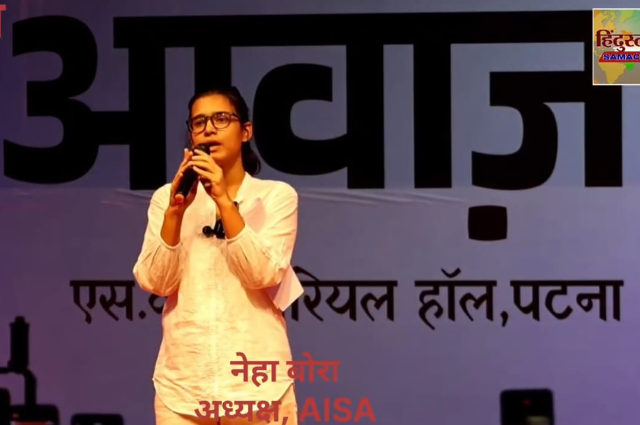
Performing on a theatre stage and addressing crowds at a protest may seem at odds. Yet, both have become part of Neha Bora’s journey. From theatrical expression to campus activism, Bora has moved across different spaces of public engagement, increasingly calling on those in power to be accountable.
At 29, Bora is a PhD scholar at Jawaharlal Nehru University (JNU) and the national president of the All India Students’ Association (AISA), a student organisation associated with the Communist Party of India (Marxist-Leninist) Liberation. She came into the national spotlight in July 2026, when she participated in a 23-day hunger strike at Delhi’s Jantar Mantar alongside education activist Sonam Wangchuk.
Since then, Bora has participated in protests concerning recruitment examinations in Jharkhand and alleged irregularities in electoral roll revisions. Her growing visibility has prompted questions about the making of a new generation of student leaders.
From State to Stage: The Making of an Activist
Bora hails from Khatima in Uttarakhand. Her childhood was filled with constant moves across the country as her father served in the Indian Army. She completed her schooling in Bengal before pursuing higher education in Delhi.
At Hindu College, University of Delhi, she pursued sociology. Later pursuing postgraduate studies at Dr B. R. Ambedkar University Delhi. She subsequently enrolled in JNU’s School of Arts and Aesthetics for doctoral research in theatre and performance studies.
Theatre and public issues have been closely connected throughout her journey. During her university years, Bora participated in socially engaged plays addressing civic and political concerns. She later also became associated with Sangwari, a Delhi-based street-theatre group. Her political engagement also developed amid the protests against the Citizenship Amendment Act (CAA) in 2019. She eventually joined AISA and rose to become its national president.
Her background in theatre offers an important perspective on her subsequent activism. Street theatre, or nukkad natak, takes performances beyond conventional stages and into public spaces, often using accessible storytelling to address social inequalities, political decisions, and everyday struggles.
The Fast That Brought Her Into Focus
July 2026 marked a turning point in Bora’s public profile. She joined fellow AISA activists Manish Kumar and Aameen Amitoj in a hunger strike alongside Sonam Wangchuk at Jantar Mantar. The protest lasted 23 days and ended on July 20, following appeals from opposition MPs, activists, and civil society figures.
The agitation drew attention to allegations of repeated examination irregularities and concerns over the NEET controversy, with calls for Union Education Minister Dharmendra Pradhan to resign forming part of the broader campaign.
Bora has described the decision to undertake a hunger strike as an effort to explore another form of protest after other avenues appeared exhausted. In an interview with The Indian Express, she said, “We’d exhausted all options; we thought, let’s explore a hunger strike too.”
Wangchuk’s determination also influenced her decision to continue. Recalling his presence at the protest, Bora said, “We got a lot of inspiration from his presence at the protest.”
The demonstration received considerable media attention and became part of a wider political campaign involving the Cockroach Janta Party (CJP), student organisations, and other activists. Some political commentary subsequently linked the movement to Pradhan’s departure from office.
For Bora, the hunger strike proved significant. It brought her into the national spotlight and associated her public image with the demands of students frustrated by examination controversies.
Charging Beyond Campus: From Examination Protests to Jharkhand
Bora’s activism subsequently extended to concerns beyond university campuses and national entrance examinations.
In August 2026, she travelled to Ranchi to support student protests over alleged irregularities in examinations. The march highlighted concerns over recruitment examinations, with protesters demanding accountability, clarity over the disputed tests, and a fair process for affected candidates.
Her participation in the Jharkhand demonstration reflected the expanding scope of her activism. While the Jantar Mantar hunger strike had drawn attention to examination-related grievances at the national level, the Ranchi protest connected her public profile to questions of employment, recruitment fairness, and opportunities for young people.
Detentions, Controversy, and the Question of Political Longevity
Bora’s growing visibility has also brought her into confrontations with the authorities. In October 2026, she participated in protests demanding accountability from Chief Election Commissioner Gyanesh Kumar over alleged irregularities associated with the Special Intensive Revision (SIR) of electoral rolls.
On October 11, confusion arose after police detained a woman resembling Bora at one protest location, while Bora herself was later detained near Vijay Chowk. Reports stated that around 50 people were taken into custody across the locations as police dispersed protest activity.
She was also detained during the October 16 Lehra Do Tiranga protest in Delhi. Authorities cited concerns including the absence of permission for the protest, while demonstrators disputed the manner in which the police handled the situation.
At the same time, Bora’s rise has prompted a wider debate about the political longevity of emerging protest leaders, including CJP founder Abhijeet Dipke. Indian political history offers examples of student activists and protest figures who have gone on to establish lasting political careers, as well as others whose public visibility has diminished over time.
Visibility alone does not guarantee lasting influence. The long-term significance of Bora’s activism will depend on whether the movements she represents can build sustained public support.
References:
- The Times of India — “Who is Neha Bora? From Delhi University to JNU, the Education and Activism of AISA’s President”
- The Indian Express — “AISA National President Neha: ‘We’d Exhausted All Options; We Thought Let’s Explore Hunger Strike Too’”
- The Indian Express — “Kanhaiya Then, Neha Bora and Abhijeet Dipke Now: Can the New Anti-BJP Stars Last?”
- Reuters — “Indian Activist Urged to Give Up Hunger Strike over Exam Leaks”
- Hindustan Times — “Who is Neha Bora? Activist in Focus over Jharkhand Protest Sat on Hunger Strike Next to Wangchuk at Jantar Mantar”