
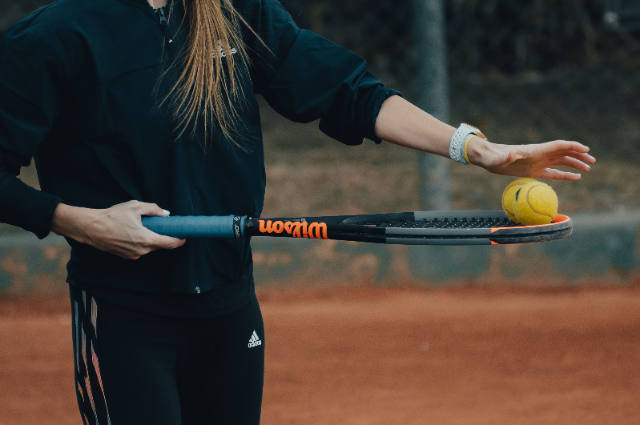
Every Wimbledon season, people's priorities change from tasks to tennis. Suddenly, the world is fixated on the Centre Court. Fans sway their eyes from left to right, watching as their favourite players serve. They root for rallies and take championship points into account. Only a few notice an object that is a constant in every match: the towel.
This is the towel that players wipe away their sweat with after long rallies. Some drape it across their shoulders between games, and others fold it carefully and place it on their chairs. These towels have become a major part and are one of the most recognised symbols of the Wimbledon tournaments. Yet, despite being so closely knitted with Britain's oldest tennis championship, these iconic green and purple towels are actually not manufactured in Britain; they haven't been for more than a decade.
Their journey starts at a small facility in Vapi, Gujarat. Thousands of kilometres away, Indian textile workers weave every thread seen on screens worldwide. Every official Wimbledon towel is handcrafted by these artisans before reaching Centre Court.
This story shows how global manufacturing is supported by some of the world's most celebrated traditions.
A British Icon with an Indian Address
Many tennis fans assume that Wimbledon towels are produced in England. And they once were.
However, the manufacturing shifted around 2009-2010 when Welspun Living acquired the British heritage brand Christy in 2006. Although Christy continues to design the towels, their production now takes place in Gujarat.
Earlier, production also took place in England. Now, this partnership with India has continued for more than 15 years, making India an integral part of Wimbledon's identity.
According to Welspun Living, the towels combine two cultural elements. As an official remarks, "Every Wimbledon towel represents a blend of British heritage and Indian craftsmanship." These towels are more than pieces of fabric; they are carriers of culture. They shed light on British design heritage and Indian manufacturing excellence, providing a platform for both traditions and crafts. Their identity, therefore, stretches across continents.
The Science Behind a Simple Towel
Towels are used by millions worldwide. They serve a multitude of purposes. And many believe that something that is so commonly available is just a piece of fabric. However, these towels are engineered products.
The planning for these towels begins 18 months before each tournament. Every towel takes approximately seven days to complete. This isn't a flimsy fabric. This is a sign of heritage. Hence, it involves a detailed process.
Every towel has premium cotton yarn. This yarn quality is used to ensure the utmost excellence. Once acquired, it is dyed before weaving. It involves jacquard weaving and colour matching. The artisans also perform proper finishing techniques to make the towel look complete. And then comes the quality testing to ensure that every towel passes with flying colours.
After completion, each towel undergoes fine-tuning to produce the perfect product. Christie's patented hydro cotton technology allows for fibres to become softer and more absorbent after repeated washing. The company states that the towels are designed to accentuate the softness and durability of the cloth.
Thousands of towels are produced every year for players. These towels are used by officials, ball kids, and for retail sales. Welspun describes every towel as a balance of performance, durability, and culture. The success of this cloth depends more on craftsmanship than visibility.
From Gujarat to Centre Court
India is known for its diversity, fertile lands, and growing textile industry. It is among the world's largest cotton producers. India contributes around 23-25 per cent of the world's cotton. The textile industry accounts for around 2 per cent of India's GDP and provides direct employment to over 45 million people. Those are important statistics. Gujarat is a key player contributing towards these numbers.
Gujarat has become one of India's leading textile hubs. This is because it has access to cotton, weaving infrastructure, spinning mills, and export networks. Alongside that, Gujarat is also home to skilled craftspeople. It has a strong, unified, and ambitious workforce.
For international brands, the Indian market seems tempting. Not just because combining Indian expertise with a foreign outlook presents a diversified and cultural picture, but also because India offers large-scale production along with quality control. These towels, therefore, represent so much more than just outsourcing. They showcase India's creative skills and manufacturing capabilities.
Globalisation Described Through a Garment
Many consumers associate products with the countries where the brands originate. However, today's manufacturing landscape is different. A product may be designed in Britain and woven in India, shipped across countries in Europe, and used by athletes from a dozen other countries.
Manufacturing is a global market, and it shows how multi-country supply chains have evolved. Every time Novak Djokovic, Carlos Alcaraz, or another Wimbledon champion picks up an official towel, they are unknowingly holding a product of Indian craftsmanship that has travelled across several countries to reach them. Sometimes, globalisation is hidden in the smallest of details, in the smallest acts that we often overlook.
At tennis championships, the trophies usually receive the headlines, and the towels rarely do. Yet, for more than 15 years, one of Wimbledon's most familiar and constant objects has become a creative showcase of India's textile expertise, displayed on one of the world's biggest sports stages.
A towel that starts its journey from Gujarat to the Centre Court reminds us that modern manufacturing has transcended the work of a singular country to international unity. Traditions preserve their heritage, but they increasingly rely on craftsmanship from across the world.
References:
- https://economictimes.indiatimes.com
- https://theprint.in
- https://www.ndtv.com
- https://www.welspunliving.com/
- https://www.christy.co.uk/
- https://texmin.nic.in/
- International Cotton Advisory Committee (ICAC) or USDA Foreign Agricultural Service. Global Cotton Production Statistics.