
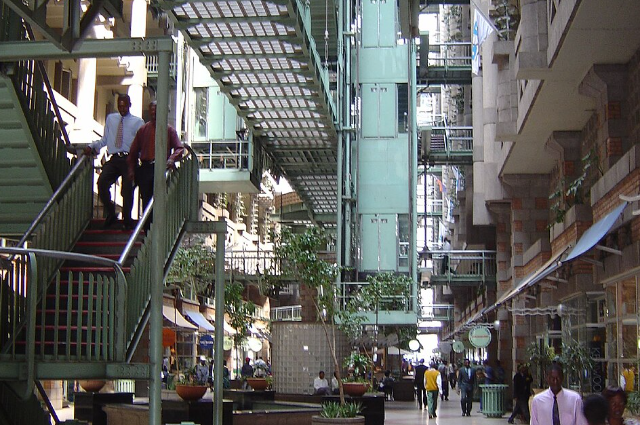
Under the scorching Zimbabwean sun, office workers prepare for another day surrounded by concrete buildings that turn into heat traps. As temperatures rise throughout the day, the employees stay confined in tiny boxes, constantly bearing the relentless humming of air conditioners.
Just a few meters away from these heat chambers stands another building. It doesn't have any expensive chillers or a giant cooling plant, yet the rooms remain comfortably cool. This building follows a unique layout and has a foundation that repels the heat. The architect behind this non-conventional air conditioning system didn't invent a revolutionary machine. Instead, he watched the termites.
This is the story of the Eastgate Centre, one of the world's most celebrated examples of biomimicry, located in Harare, Zimbabwe. Designed in the 1990s, this innovation proves that creating something entirely new doesn't always require extensive effort. Rather, it requires simplicity and closer attention to what nature has already perfected.
When The Engineers Aren’t Human
At first glance, a termite mound doesn’t look extraordinary. It simply stands as piles of soil. Yet inside, the internal temperature of these mounds remains remarkably stable. Despite fluctuating temperatures outside, these mounds maintain a cool, comfortable interior.
Worker termites are constantly moving air through tunnels, vents, and vertical chimneys. Through the creation of these tunnels, the airflow is regulated, leading to natural convection. These termite mounds follow simple science. Warm air rises, and cold air enters. Because of these pathways, fresh oxygen is circulated regularly, and the carbon dioxide has a chance to escape easily. The termites operate in such a manner that the fungus cultivated by them persists only within a narrow temperature range of around 30 degrees, despite outside temperatures varying often.
Nature had already created a passive climate control mechanism long before humans invented air conditioning. As Mike Pearce, the architect behind Eastgate Centre, states, “the building should work like a living organism rather than a sealed machine.”
Taking Inspiration From Insects
Mick Pearce, a Zimbabwean architect, closely monitored the inner workings of termite mounds. He worked with several engineers at Arup and wanted to reduce the operating costs, energy consumption, and dependence on air conditioning for their newer projects.
Instead of copying the termite mounds exactly, they copied the principles of ventilation. From his observations, Pearce noticed that during nighttime, the cold outside air would enter, and the concrete floors would absorb the coolness. Throughout the day, the stored cool air would slowly release. Warm indoor air would naturally rise, and roof chimneys would usher the hot air out. He also noticed that adding fans would assist the airflow only when required. Because of these observations, Pearce, along with his team, was able to construct a system where no conventional chilled air was required.
With their creation and attentiveness to nature's details, the Eastgate building doesn't fight the climate; it works with it. As Janine Benyus famously said, "Nature has already solved the problems we're trying to solve." Pearce followed through on those words and utilised nature's mechanisms for a sustainable, cost-effective, and easy application design.
Millions Saved Through Simplicity
Conventional corporate office structures tend to heat up quickly during the summer seasons. They require large amounts of energy to keep the insides cool. Eastgate, however, consumes much fewer resources.
For the centre's circulation, the architects and engineers designed a ventilation system that uses around 90% less energy for cooling, compared to similarly sized conventional buildings. By applying this technique, operating costs are substantially reduced, maintenance is lower, and smaller mechanical systems have been embedded in the building.
Tenants have reported paying significantly lower prices for cooling than they would in other commercial buildings. And with these economic benefits, another relief is that, due to lower electricity demands, carbon emissions and operational costs are also lower. This positively impacts Zimbabwe's electrical infrastructure. This experiment highlights how the greatest innovations aren't always successful because of expensive technology, but rather because unnecessary clutter is removed.
Biomimicry is Becoming the Future
Biomimicry is best defined as learning to solve human problems from already existing biological systems. For instance, Velcro is inspired by burr seeds. The kingfisher's beak inspires bullet trains and their sleek technology. Wind turbine blades are created by studying the fins of humpback whales. Similarly, the Eastgate Centre’s cooling systems stand as a testament to how nature’s creations can turn into magnificent mechanisms.
Termite mounds, something that has existed for centuries, have now been used to create cooling systems that are cost-cutting and sustainable. According to the International Energy Agency, conventional office buildings account for roughly 30% of the global final energy consumption and approximately 26% of global energy-related emissions.
Therefore, passive cooling systems are critically important as temperatures in cities rise. Climate change is making cooling demands rise across the globe. Instead of adding traditional air conditioning systems that are expensive and increase carbon emissions, future buildings should include fewer machines and take inspiration from biological habitats.
References:
- https://asknature.org
- https://nautil.us/the-termite-and-the-architect-234706
- https://constructsteel.org
- https://www.slideshare.net
- https://www.iea.org
- https://biomimicry.org