
For many Indians, sporting matches go beyond athleticism and recreation. They are synonymous with social unity, personal identity and national integration. Hence, every game and competition receives millions of viewers. Fans and spectators alike fill stadiums supporting the players and teams.
The Asian Games 2026 saw a similar scenario, one where proud Indians cheered for the success of their favourite athletes. As the games concluded, India finished fourth with a total of 85 medals, including 21 golds. Compared with the previous edition, the medal count seems lower. Yet, it brings another aspect of India's performance into the limelight.
Despite the decline in the medal count, India’s sportswomen made remarkable progress.
In 2022, Indian women won 45 medals. In 2026, the number dropped to 37. But their share of India's gold increased significantly. The Asian Games therefore not only count the number of medals but also highlight the change in their colour.
As The Medals Change Colour
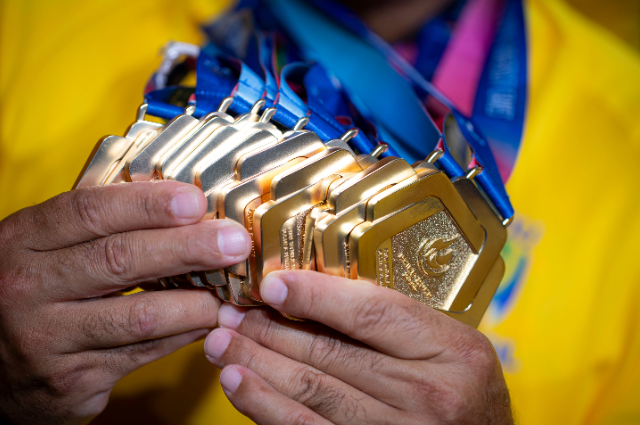
This competition’s scorecard notes that women players won 11 out of India’s 21 gold medals. And every single medal carries immense depth and history.
In women's hockey, the gold represented the end of a 44-year waiting period. India defeated China 1-0 in the final, as Lalremsiami scored a decisive 10th-minute goal. Through this victory, India secured a direct qualification for the Los Angeles 2028 Olympics.
The significance of the victory was not lost on the generation that had won India's previous gold. Eliza Nelson, captain of the 1982 side, described the moment as a “passing of the torch” to the Salima Tete-led team. The statement captures something larger than a sporting result: two generations of Indian women hockey players, separated by 44 years, meeting through the same gold medal.
Women's cricket presented a different kind of achievement. Instead of ending a long wait, the team demonstrated consistency by winning its second consecutive Asian Games gold. India defeated Sri Lanka by 147 runs in the final, scoring 216 for three before bowling Sri Lanka out for 69. Smriti Mandhana's 79 and Richa Ghosh's unbeaten 49 helped India retain the title they had won in Hangzhou in 2022.
Boxing showed another kind of transformation as India's women boxers won two golds and a bronze in 2026. India finished at the top of the women's boxing medal table, ahead of major Asian powers such as Kazakhstan, China and Uzbekistan. Santiago Nieva, Indian women's boxing head coach, described the result as evidence that the team is moving in the right direction.
These stories suggest that progress cannot always be measured by the medal count. Sometimes, it depends on how athletes are converting previous performances into gold.
Women Were Not Just Winning, They Were Breaking New Ground
The team victories were significant, but the Games also noted individual breakthroughs that demonstrated the changing dynamics of women's sport in India.
One of the most striking stories was that of Kumkum Mohod. A 17-year-old archer who made her Asian Games debut and bagged two gold and a silver medal. Her individual victory gave India its first-ever women's individual recurve gold at the Asian Games.
Shooting provided another example as Neeru Dhanda received a women's trap gold, ending India's 48-year wait for an individual Asian Games trap title. She also contributed to India's mixed-team trap gold alongside Kynan Chenai, where the pair produced an Asian record.
Pranavi Urs also made history as she became the first Indian woman to win individual Asian Games golf gold.
The stories of these players challenge the idea that women's sporting success in India is concentrated only in a handful of popular disciplines.
Cricket and hockey may fill the stadiums, but in the 2026 Games, Indian women changed the dynamic through their success in shooting, boxing, archery, golf and other disciplines. Their achievements show the gradual diversification of conversations around varied, even lesser-viewed women's sports.
From Success Stories to a Sustainable Structure
The gold medals also brought different generations of Indian women athletes into the same picture.
Established names such as Mirabai Chanu and Lovlina Borgohain now stand alongside younger athletes such as Kumkum Mohod. Their journeys are different, but together they demonstrate the widening range of Indian women competing at the highest levels.
The significance lies not simply in individual achievements. Women athletes are succeeding across archery, shooting, boxing, hockey, cricket, golf, athletics and several other disciplines. Women's teams are also producing significant results.
This makes the 2026 Games look less like a collection of isolated victories and more like evidence of an emerging pipeline. Yet the next challenge is making that pipeline sustainable.
The Asian Games are a major continental competition, but for many athletes the real focus is on the Olympics and World Championships.
Women's hockey has already secured India's place at the Los Angeles 2028 Olympics through its Asian Games victory. For other athletes, the question will be whether success in Nagoya can be converted into sustained performances on the international stage.
For young athletes such as Kumkum Mohod, this is only the beginning. For India's boxers, the task will be to maintain the momentum that has placed them at the top of Asian women's boxing. And for the wider sporting system, the challenge will be to ensure that opportunities reach athletes beyond established sporting centres and states.
More Than 11 Golds
India's overall medal haul at the 2026 Asian Games may have been smaller than in Hangzhou. But within that reduced tally was a significant achievement: Indian women won more than half of the country's gold medals.
In hockey, they ended a 44-year wait. In cricket, they defended a title. In archery, they broke new ground. In boxing, they changed the colour of their medals. In shooting and golf, they created individual milestones. And perhaps most importantly, they did so across different generations and different sports.
The story, therefore, is bigger than 11 gold medals.
It is about a shift in the perception of Indian women's sporting success. What once appeared as a series of exceptional individual breakthroughs is increasingly beginning to resemble an emerging system, one where young athletes enter established pathways, teams compete with greater consistency, and women are becoming central to India's sporting ambitions.
The challenge after Nagoya is no longer proving that Indian women can win. It is creating a sporting system in which winning can become sustainable and eventually, expected.
References:
- NDTV Profit — From Records To Gold: The Indian Women Who Ruled Asian Games 2026
- The Indian Express — Indian Women Who Scripted History at Asian Games 2026
- The Indian Express — Indian Women's Hockey Team Wins Historic Asian Games Gold, Secures Olympic Qualification
- The Indian Express — Santiago Nieva: Indian Women's Boxing Team Is on the Right Track
- Times of India — “The Torch Has Been Passed”: Eliza Nelson Hails Salima Tete-led India's Asian Games Gold
- Press Information Bureau (PIB), Government of India — Cabinet Approves Revamped Khelo India Scheme and Enhanced Support to National Sports Federations