
Under the unforgiving Karnataka sun stands a fruit vendor selling fresh oranges. Harekala Hajabba earns his daily living by selling fruits. He has gotten accustomed to the scorching summers and bargaining customers. Yet, when a foreign tourist approached his fruit stand and enquired about the price of the oranges, Hajabba felt stuck. He felt at a loss since he couldn’t converse in English. With barely any understanding of the language, he felt as though a barrier stood between him and his eager customer. Hajabba wasn’t able to respond or explain the rates, and eventually, the tourist walked away.
This incident took place in 1978. At that time, Hajabba was selling oranges in the busy streets of Mangaluru, right next to the bus station. Given the heavy footfall the vendors receive in that area, many would forget the interaction. For Hajabba, however, that simple exchange of barely any words stayed for nearly twenty years.
With every thread of that conversation tangled with his thoughts, his story highlights how discomfort and shame can leave their mark. An ordinary question turned into a revolution for education and prosperity.
The Educational Endeavour: When Knowledge Becomes Personal
Harekala Hajabba was born into a poor family. His childhood didn’t hold memories of school days, classroom learning or playful adventures. Instead, they were crowded with thoughts about aiding his family and working to provide necessities.
He followed his father into selling oranges from a very young age. Throughout his boyhood days, he was taught the values of selling and saving. Yet, he never received formal education. Throughout his adulthood, he was unable to read or write.
That one incident, a simple interaction with a foreign tourist, made Hajabba have a daunting realisation. His lack of education didn’t just affect his employment; it also impacted his confidence. Every day for the next twenty years, that simple question would revisit his thoughts, almost as though it was urging him to take action.
The repetitive thought enlightened him to accept that education isn’t merely for professional purposes and that knowledge builds more than a career; it builds confidence and dignity.
When Oranges Aid in Establishing a School
Years passed. Thousands of customers bought oranges, and conversations in native languages continued. Yet, 1999 marked the beginning of new opportunities for Hajaba. Instead of regretting his lost confidence, he decided to embark on an educational adventure, one where he would create opportunities for others.
Since his childhood, Hajaba had been helping his family with the sale of oranges. Hence, he knew how to use his money wisely. With saved earnings from his fruit-selling business, he approached the village elders for guidance and aid.
His case was simple. He realised that his lack of education had impacted his confidence and his personal and professional growth, and he couldn’t allow that to happen to others.
He requested the village elders for some land and support, yet he received only rejections. After presenting a compelling case, he finally received his plot of land and founded Newpadpu School.
In the initial phase, there were only 28 students. The school did not receive any financial aid. No government grants, no corporate funding, and even no NGO support. This school was running only on determination and community support.
Hajabba continued to see through this endeavour as he understood the value of education and wanted to invest in children's future. As Hajabba often says, “education is the greatest wealth anyone can have.”
A School and Its Everlasting Legacy
What was established in 1999 with a little dose of hope, faith, and simple earnings from a fruit-selling business now stands as a proper educational institution, a school that offers education to village students.
Newpadpu School now has approximately 175 students. It has classes up to the 10th standard and is equipped with decent facilities. Hajabba also ensured that the school had dedicated teachers who would guide students on the right path.
His endeavour to provide education for the future of our country immensely influences literacy and confidence. It builds social mobility and confidence. According to the 2021 National Statistical Office, India's literacy rate is approximately 77.7%. However, this standard does not account for the rural disparities that continue to affect thousands of children. Hajabba didn’t want the children of his village to become a part of that statistic. Hence, he was determined to establish an educational institution that would change the fate of their village.
Padma Shri that belonged to everyone.
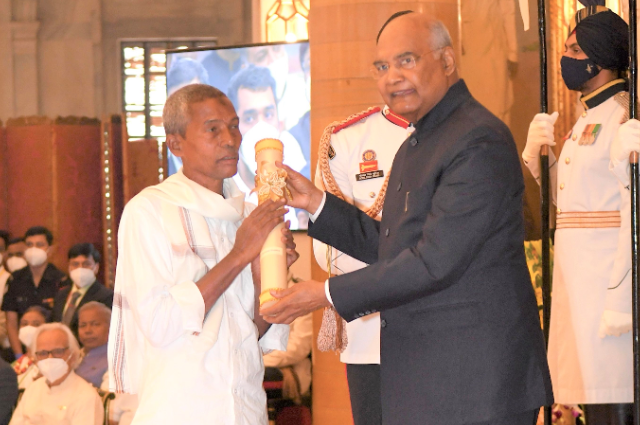
In 2020, the Government of India recognised the sincere efforts that Harekala Hajabba had made.
For his immense dedication and perseverance in providing proper education to the children of villages, he was awarded the Padma Shri, which is recognised as India's fourth-highest civilian honour.
As he was called to receive his award, he walked barefoot to the Rashtrapati Bhavan. He wasn’t accompanied by grandeur; he carried himself with simplicity. He wanted to retain his authenticity and showcase his true persona. That image largely resonated with the country.
Despite receiving one of India's highest honours, Hajabba remained humble. His modesty was rooted in his perseverance and the treacherous times he himself was privy to. Even when people congratulated him, his response was, “The award is not mine; it belongs to the school.”
Education Beyond Classrooms
People often make assumptions that great resolutions require wealth, political affiliation, or immense power. However, Hajabba's story challenges all those assumptions. His life's work showcases how one individual with modest earnings can create everlasting social change.
With barely any means or life savings, Hajabba's passion and his hope for future generations to have access to education led to the creation of Newpadpu School.
In India, rural communities still face challenges of school inaccessibility, high dropout rates, and poor quality of education. Yet, individual initiatives such as this continue to complement government efforts. Through his efforts, Hajabba came to be known as “Akshara Santha”, or the “Saint of the Alphabet.”
Hajabba helped children have the experiences he never could himself. He never got the chance to experience school life, classroom discussions or playful banter with friends during recess. He never even learned to read the alphabet. Yet, through his act of determination, he helped write a brighter future for hundreds of children.
References:
- https://www.ndtv.com
- The Better India. How an Orange Seller Built a School That Changed His Village. https://thebetterindia.com
- Times of India. From Selling Oranges at a Bus Stand to Building a School. https://timesofindia.indiatimes.com