
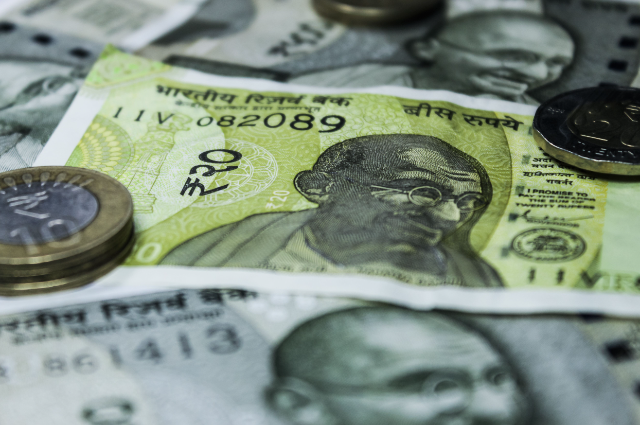
The increasing monetary pressures of 2026 have made several countries critically analyse their fiscal and global strategies. One such nation happens to be India. As noted on 1st October, the rupee had dropped to about ₹96.31 per U.S. dollar. This statistic was noted after it first reached an intra-year record low of about ₹96.96.
A better understanding, however, can be provided through a critical comparison with the condition of the Pakistani rupee. According to earlier data, one Indian rupee was equivalent to about 3.29 Pakistani rupees in May 2025. In May 2026, the data changed, showing that one Indian rupee now represented approximately 2.90 Pakistani rupees. This denotes a 12% drop in its value against the Pakistani rupee.
However, this does not signify that the Pakistani rupee has suddenly become stronger as a global currency than the Indian rupee. Instead, it tells a different story. It portrays something known as relative currency movements, where the Pakistani rupee has been able to stabilise after its severe crisis in 2023, while the Indian rupee is currently facing renewed pressure against the U.S. dollar.
Why Is the INR Under Pressure?
If we look at the Indian rupee from a historical standpoint, we can notice that it has depreciated against the dollar over the long term. However, 2026 has brought renewed pressure.
Current reports point to several factors that could be contributing to this situation. These include strong U.S. Treasury yields, higher crude oil prices, foreign investor outflows, geopolitical uncertainty and global dollar strength.
Since India imports roughly 90 per cent of its crude oil, an increase in oil prices raises the country's import bill and creates additional demand for dollars. Several reports have also stated that foreign investors have pulled significant amounts from Indian assets. During an already tense period, currency pressure only adds to this mix, while the Reserve Bank of India has intervened to prevent disorderly depreciation.
To keep the country running, India needs to balance its monetary and external spending. When India has to spend more dollars to pay for imports while investors are also moving money away from Indian assets, the rising demand for dollars creates additional downward pressure on the Indian currency.
2023 Pakistani Currency Crisis
In 2023, the Pakistani rupee went through a severe crisis. The country suddenly faced extremely low foreign-exchange reserves, high inflation, external financial pressures, dollar shortages and significant pressure on its exchange rate.
IMF data showed that Pakistan's gross reserves fell to around $4.5 billion in the financial year 2023, equivalent to only around 0.8 months of imports.
The IMF's 2023 Stand-By Arrangement was worth around $3 billion. Its objective was to rebuild reserves, restore external stability, return to a market-determined exchange rate and reduce inflation. We must note that Pakistan's currency did not stabilise simply because an IMF cheque suddenly made the rupee stronger.
What Did the IMF Programme Actually Do?
The IMF programme worked through several mechanisms.
Through foreign-exchange support, IMF financing provided Pakistan with access to additional foreign currency. This helped rebuild reserves and eventually gave the State Bank of Pakistan greater capacity to deal with external pressures.
The reserves rose from approximately $4.5 billion in FY2023 to around $9 billion by FY2024. Records also show that the reserves had reached about $16 billion by December 2025.
Alongside this, the IMF also pushed for exchange-rate reforms. Through these measures, the programme moved Pakistan towards a more market-determined exchange rate. This was intended to reduce artificial distortions and address foreign-exchange shortages.
Monetary tightening was another factor. Pakistan maintained a relatively tight monetary policy to help bring inflation down and combat high levels of price growth. IMF reporting shows that inflation declined significantly from its 2023 levels.
So, Did Pakistan's Rupee Actually Recover?
After the extreme volatility of 2023, Pakistan's rupee did find some stability. A recent IMF report states that the rupee remained broadly stable around PKR 280 per U.S. dollar during FY2026. The country's gross reserves also showed notable improvements.
However, there are still significant structural vulnerabilities that Pakistan continues to face as it remains under an IMF programme.
The IMF's 2026 review specifically notes that the programme has helped maintain macroeconomic stability and rebuild fiscal and foreign-exchange buffers. However, we must remember that stability is not the same thing as strength.
What Does This Mean for India?
The RBI has been actively intervening in the currency market. Recent reports have stated that RBI interventions have helped prevent the rupee from repeatedly testing its record low.
India's foreign-exchange reserves remain very large, at around $785.7 billion in late September, even though its forward dollar liabilities have also risen.
This means that India is not facing the same type of external financing crisis that Pakistan faced in 2023. The current problem is better described as currency pressure amid global oil prices, capital flows, interest-rate conditions and broader international economic uncertainty.
India's larger reserves and stronger economic base provide it with considerably more room to manage currency pressure, even though they cannot completely prevent depreciation.
What Does the Comparison Actually Tell Us?
Pakistan's experience showcases how an IMF programme can provide financing and impose a framework for monetary, fiscal and external-sector adjustments.
India's experience demonstrates a different story, one where a much larger economy with substantial foreign-exchange reserves can still face currency depreciation when global conditions become unfavourable.
A currency's exchange rate does not paint the entire picture of an economy. The interesting question, therefore, is not simply about which rupee is stronger, but about why their trajectories have diverged.
The rupee story is therefore not simply about one currency rising while another falls. It goes deeper, delving into how reserves, reforms, capital flows, oil prices and global economic conditions can reshape the value of money, sometimes in ways that appear surprising from the outside.
References:
- IMF — Third Review Press Release, May 2026
IMF: Pakistan's Third Review, May 2026 - IMF — Pakistan's 2023 Stand-By Arrangement
IMF: Pakistan 2023 Stand-By Arrangement - Reuters — Indian rupee hits 2026 record-low territory
Reuters: Rupee hits record-low territory in May 2026 - Reuters — September/October 2026 rupee pressure
Reuters: Rupee near ₹96 amid oil and global yields - Economic Times — INR vs PKR
Economic Times: Rupee falls against Pakistan's currency - NDTV Profit — Regional rupee comparison
NDTV Profit: Rupee's regional decline