
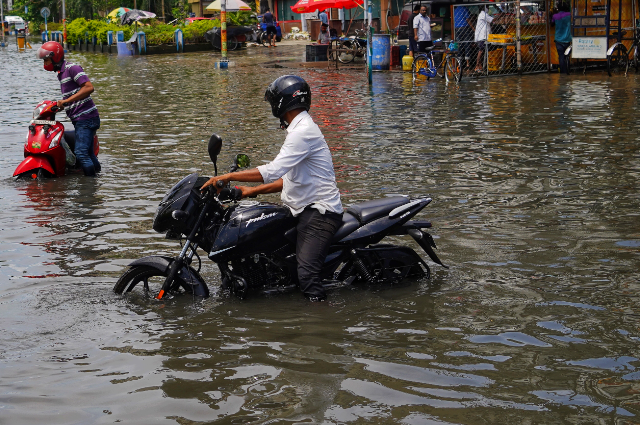
With erratic rainfall across the country, Kerala is no exception. Kannur was filled with floodwaters, and stranded amidst this chaos was 61-year-old farmer Benny. His rescue was attempted by several local volunteers, including R Rajesh and two others. Rajesh was apt for the task. He was an experienced swimming instructor, practised rappelling, and worked as a disaster response trainer. His background highlights his willingness and capability to enter dangerous floodwaters to rescue locals.
He and two other rescuers reached Benny, who had become stranded on an inlet near Meenthully. A crucial factor in the story is that Rajesh gave Benny his own life jacket and guided him towards safety. However, while returning, Rajesh was caught in a strong current and was swept away with force. Nearly three days after the incident, a search team found his body, bringing the rescue mission to a tragic end.
His demise presents a key question: who are the people who enter disasters voluntarily, and why do they do so when everyone else is trying to escape?
Rajesh was not a government official. He wasn't part of a formal rescue team. He represented a network of trained volunteers who repeatedly put themselves in dangerous situations across Kerala to aid and save the lives of ordinary citizens. In this case, the rescuer became the person who needed saving.
The Rescue That Became a Tragedy
Kannur was flooded after heavy rainfall, and Benny, a 61-year-old farmer, became stranded while attempting to reach his agricultural land. To aid in his recovery, Rajesh, along with other volunteers such as Shibin and Jithin, responded to the call.
According to The News Minute's account, Benny was stranded on an inlet, and the volunteers reached him using a rope-based rescue system. Rajesh initiated the rescue and gave Benny his own life jacket.
As an experienced swimmer, Rajesh was accustomed to navigating dangerous waters. But as the group made its way back, he stayed behind to help the others hold onto the safety rope. During the strong current, he lost his grip and disappeared into the floodwaters. Benny was protected by the life jacket Rajesh had given him. Rajesh was not.
His body was recovered nearly three days later as rescue teams searched the river and surrounding areas. Kerala felt his loss deeply. Chief Minister V D Satheesan described Rajesh's act as an “ultimate sacrifice and selfless love for humanity,” saying that he had given away his own life jacket to save another person.
But Rajesh's story does not stand only as a testament to one man's final decision or the life that his sacrifice saved. It also raises questions about the culture of volunteering that repeatedly places individuals like him in the path of disaster and whether that culture receives enough institutional guidance and support.
A History of Answering the Call
Rajesh's death was not an isolated heroic incident. His history is a cumulative record of repeated involvement in rescue operations.
In 2018, during Kerala's devastating floods, he travelled to Wayanad and participated in rescue work on the ground. He returned to Wayanad in 2024 during the landslides, where he was again involved in rescue operations and reportedly helped rescue a child. His sister Asha recalled that he received a salute from the district collector after the operation. In 2026, he once again joined volunteers responding to floods in Kannur. During this period, Rajesh had already helped move several families to safer locations and relief camps.
Rajesh simply wasn't a man who happened to be in the right place during one particular emergency. Whenever disaster struck, he was there, responding, rescuing citizens, and using his background in swimming, rappelling and disaster response to help those in need.
He did not use these skills only for personal adventure. He utilised them for community service, and his family described this as a recurring characteristic. His sister Asha put it simply, “whenever he heard about a disaster, he would jump into a rescue mission.”
This makes it difficult to describe Rajesh only as a one-time hero. His story was built through years of volunteering and repeated service to his community. And he wasn't performing these duties as a salaried member of the state. He chose to be part of the disaster response effort because he wanted to support people around him.
The Volunteers Behind Kerala's Disaster Response
Kerala's disaster response is not operated solely through government agencies. During landslides and floods, local volunteers, swimmers, adventure groups and community networks can become the first people capable of reaching isolated communities.
Rajesh's case showcases the gap between formal disaster-response infrastructure and people who possess specialised skills alongside intimate knowledge of local terrain and conditions.
Rajesh knew how to swim, rappel and conduct rescue operations. His abilities could therefore be immediately mobilised during emergencies. But there are personal financial costs to this kind of volunteering.
According to Rajesh's family, he took loans to organise rescue missions. His father, Raja Sekharan, explained that Rajesh did not have the financial resources to organise these efforts independently, but continued doing so for the public good.
Volunteers are often romanticised because their sacrifices can appear costless and heroic. Behind that heroism, however, are tangible costs: money, time, training, physical danger and separation from family.
Rajesh's wife, Shafiya, worked at a hospital canteen while Rajesh worked in adventure- and rescue-related activities. They had two children. Their family life also carried unfinished financial responsibilities. Shafiya recalled that she and Rajesh had spoken about clearing their debts and completing their house.
There are therefore dimensions to volunteering that extend beyond heroism and sacrifice. Volunteering is a noble pursuit, but invisible costs accompany it, not just financial, but physical, social and familial. The man celebrated for saving others had a family waiting for him to come home. Instead, they received the news that he would not.
What Does a State Owe Those Who Step In?
The aftermath of the rescue was bleak. Kerala responded by providing Rajesh with full state honours at his funeral. Chief Minister V D Satheesan visited the family and publicly described his death as an ultimate sacrifice, praising his selflessness and heroism.
The government also announced that it would complete the unfinished construction of Rajesh's house and support his family during their financial difficulties.
As part of the state's broader flood-relief package, the government announced ₹8 lakh in compensation for families of those who died, along with ₹10,000 towards funeral expenses. Rajesh's wife also confirmed that there was an assurance of government assistance.
Yet the strongest question remains: can financial compensation ever measure the contribution of someone who repeatedly volunteered during disasters? Is a monetary response enough for the danger and hardship faced by people who voluntarily place themselves between their community and a disaster?
Rajesh's story allows us to question whether disaster preparedness should depend so heavily on individuals willing to risk their lives, or whether there should be stronger safeguards around how volunteer rescue missions are conducted.
His death therefore becomes a conversation starter about protective equipment, training, coordination and institutional guidance for volunteers who take on rescue operations.
The Network That Remains
There is one life jacket that changed everything.
Rajesh handed his life jacket to Benny to protect him from the terrible floods. One strong current later swept Rajesh away. The contradiction is difficult to ignore. Kerala has established disaster-response institutions. But what happens when floodwaters cut off villages and isolate communities? Is that when local knowledge and individual courage become most important?
Rajesh's story shows that both strength and vulnerability can exist within the same disaster-response system. His responses to disasters in 2018, 2024 and 2026 show that his bravery was not an isolated act. It was the accumulation of years of volunteering and service.
There are still countless volunteers who remain. They are local rescuers, swimmers, people who know the rivers, understand the terrain and answer emergency calls when their communities need them. When the next disaster comes, Kerala will need these volunteers. But it will also need to protect them.
The question is not whether people like Rajesh will continue to step forward. They probably will. The question is whether the system will be ready to stand behind them and help them come home after they have done their job.
References:
- https://economictimes.indiatimes.com
- https://www.thehindu.com
- https://www.thenewsminute.com
- https://www.indiatoday.in
- https://indianexpress.com
- https://www.onmanorama.com