
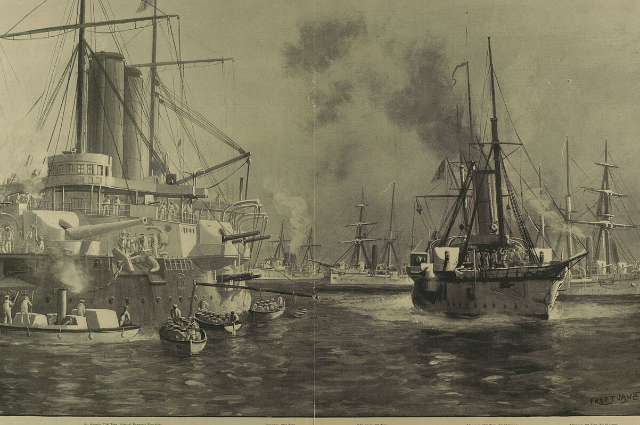
Picture a conflict that starts after nine in the morning and ends before nine thirty. There are no talks, no weeks of fighting, no extended campaign. Instead, a palace is bombarded and a royal yacht sinks hundreds of people. Wounded troops succumb, and a new leader is installed within hours.
This was the Anglo‑Zanzibar War fought on August 27 1896, between the British Empire and the Sultanate of Zanzibar, an island territory off the coast of East Africa, part of Tanzania. The Anglo‑Zanzibar War is recorded in history to have lasted about 38 minutes. The brevity of this conflict hides a larger story about imperial ambition, political sovereignty and the overwhelming military power that Britain held over Zanzibar.
A Succession Dispute That Escalated
The crisis began on August 25 1896, when Sultan Hamad bin Thuwaini died suddenly. Some accounts have raised suspicions of poisoning. These remain unproven. Within hours, his cousin Khalid bin Barghash occupied the palace. Declared himself the new sultan.
Britain, which had established Zanzibar as a protectorate in 1890, opposed Khalid's succession. Under the arrangements that governed the protectorate, British approval was required for the appointment of a sultan. British officials instead supported Hamoud bin Mohammed, whom British officials considered an acceptable candidate.
Khalid refused to give up the throne. He gathered around 2,800 defenders, including palace guards and armed supporters. Readied himself to stand against any challenge. Meanwhile, British warships gathered in the harbour of Zanzibar, forming a threat.
On August 26, the British issued a demand. They told Khalid to leave the palace and lower his flag by 9 a.m. that day. When Khalid refused, what had begun as a dispute over succession turned into a conflict. This was not about who would rule Zanzibar. It was about whether Zanzibar could choose its leader without British approval.
The Thirty-Eight Minutes of Fighting
On the morning of August 27, British forces had already positioned warships off the waterfront. The deadline passed. Khalid did not surrender.
At 9:02 a.m., British naval ships opened fire. Shells rained down on the palace and its defences. The bombardment was swift and devastating. Zanzibar’s artillery could not match the power of the ships. Buildings within the palace, many made of wood, caught fire immediately.
Khalid’s men tried to fight back. The royal yacht HHS Glasgow fired upon the vessels. The yacht was no match for the warships. It was soon sunk in the harbour. The palace was left exposed with a chance to continue the fight.
By nine forty in the morning the bombardment had finished, and the Sultan's flag had come down. Depending on which moment is counted as the start and finish of the battle, historians give different lengths, usually from about thirty-eight to forty-five minutes. The number often cited, thirty-eight minutes, is the time between the first shot at nine-two in the morning and the end of the bombardment at around nine- forty.
Five hundred people on the Zanzibar side were reported either killed or wounded, while one British sailor was wounded. The big difference shows the advantage that the British naval force had.
What Happened After the War?
Khalid escaped from the palace during the bombardment. Went to the German consulate for safety. German officials then helped him leave Zanzibar for German East Africa, which is the mainland of today's Tanzania. He was later captured by the British in 1916. Sent away to the Seychelles before finally being allowed to settle in Mombasa.
At the time, Hamoud bin Mohammed was put in place as sultan on the day of the battle. Although Zanzibar kept its sultanate, British influence over its politics grew more.
The aftermath also touched on the story of slavery in Zanzibar. The island had long been linked to the African slave trade, and Britain had spent many years pressing its rulers to limit and end the practice. In 1897, during Hamoud's reign, an order officially ended the status of slavery in Zanzibar. Freedom did not happen right away or fully in practice, and forms of home slavery continued. The war was therefore a change in British control over Zanzibar, while the bigger fight over slavery and freedom kept going beyond the battlefield.
The Meaning Behind the Shortest War
The Anglo-Zanzibar War is often called a curiosity because it was so short. It lasted less than an hour. When people only focus on the time, they miss the real story. The war was not about forces. It was about power imbalance.
Britain had a navy. Zanzibar had little in comparison. The British used their ships and guns to make sure their goals were met. This was gunboat diplomacy in action. It meant using power to push a political agenda without a long war.
Zanzibar was still a sultanate on paper. In reality, it could not choose its own leaders. Britain decided who would rule. The sultanate stayed. It was no longer free. The British controlled the rules behind the scenes.
This war shows how colonial power could work without taking over. You don’t need to rule to control. You just need to control who rules. You set the boundaries. You decide what is allowed. That’s how Britain kept influence without annexing Zanzibar.
Sometimes history changes not because of battles. It changes because one side has much power. The other side has no choice. A few minutes can be enough. The war may have been short, but the cost was overwhelmingly high.
References:
- The Historical Association — The Shortest War in History: The Anglo-Zanzibar War of 1896
- South African History Online — The Anglo-Zanzibar War of 1896
- Historically — Britain Defeats Zanzibar in a War Lasting Less Than an Hour
- Cambridge University Press — Chronology of Measures against Slavery
- UK Parliament, Hansard — Zanzibar: Debate on the Abolition of Slavery