
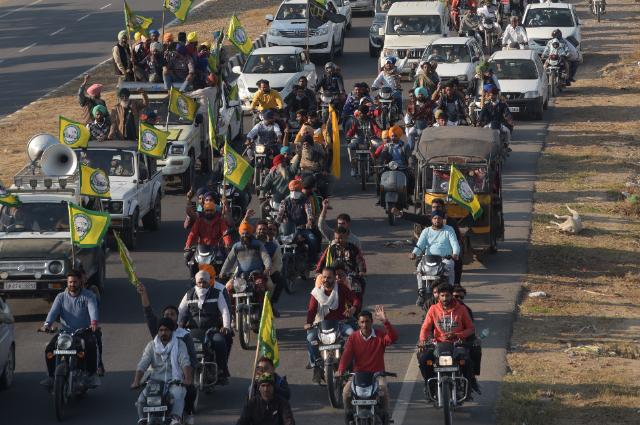
Delhi has been the centre of discussion as protests and marches are being organised with a repetitive rhythm. Just one day after thousands of students planned a march towards the parliament demanding institutional accountability and response over examination irregularities, another procession has begun to take shape.
This time, the banners and slogans carry a different message. Instead of students, the people with demands are now farmers. They have travelled from Punjab, Haryana, and neighbouring states towards Delhi under the banner of “Desh Bachao Morcha.” Their concerns aren't those of examination reforms, but of agriculture, trade, and survival.
In recent news, India's trade negotiations with the U.S. have sparked debate. As a result, many farming organisations fear that lower tariffs on imported agricultural products could increase competition for Indian farmers and expose them to a battle they are not equipped to withstand.
These protests, therefore, reflect a much larger picture that paints the landscape of how international trade must be balanced, practised only by well-equipped agricultural organisations, and should not affect domestic livelihoods.
Why Are Farmers Protesting?
The U.S.-India trade deal has sparked conversations amongst many farmers' unions. And while these deals remain under negotiation, their consequences have raised concerns about farmers' livelihoods. Many argue that the reduced tariffs on American agricultural imports, particularly on products such as maize, soybeans, dairy, apples, and other commodities discussed in the trade talks, could place India in a state of disadvantage.
The Indian agricultural landscape is different from that of the West. Many Indian farmers operate on limited mechanisation. They have small landholdings and fluctuating incomes. This makes it difficult for them to have a sustained livelihood. Unlike large-scale American agriculture, they have to worry about their daily earnings and cannot compete with lower-priced imports.
Several farming organisations have assembled under the “Desh Bachao Morcha.” Their demands are simple. They want stronger safeguards in place before any agreement is finalised to support their livelihoods and agricultural practices. For them, this is not the opposition to trade itself. It stands in opposition to unequal competition. They want a fair chance in a changing field.
Global Trade, Local Consequences
Trade agreements are made to benefit both parties involved. Ideally, they are designed to increase commerce, strengthen diplomatic ties, and expand imports and exports for both sides involved.
When it comes to discussing trade deals, governments often highlight the benefits they bring. They highlight aspects of economic growth, export opportunities, and strategic partnerships with key players. However, trade liberalisation can also produce uneven outcomes. Large exporters, for instance, would often benefit, while small producers may face adjustment issues.
Agriculture remains one of India's largest employers. It supports around 42% of the workforce. It also aids in the country's GDP by contributing around 16 to 18%. This translates into the issue that even relatively small policy shifts can affect millions of households. Due to these concerns, the farmers have raised questions about such trade negotiations, turning them into a political question.
The March to Delhi
Thousands of farmers believe that there would be dire consequences if the India-U.S. trade deal is signed without any alterations. Due to their growing concerns, farmers have travelled from Punjab, Haryana, and neighbouring regions to protest for the same.
Ahead of this march, security arrangements have intensified. Reports indicate that the Haryana police have increased the number of barricades around the key roads used by the farmers. They have also detained farmer leader Jagjit Singh Dallewal ahead of the march. Authorities have cited that these preventive measures have been taken to maintain public order.
As Joginder Singh Ugrahan, a farmer union leader, argues, sustained collective action has compelled governments to reconsider policies affecting farmers. Collectively, the farmers have planned demonstrations around Jantar Mantar. The protest came only one day after another major demonstration in the capital.
Two Protests, One Week
In a very short span of time, Jantar Mantar has witnessed two completely different clusters of change. Yesterday, students protested over an alleged paper leak. Today, there are farmers demanding fair trade practices, access to equal opportunities, and support for their domestic livelihoods.
These are two completely different groups. They are raising different issues, yet they are walking towards the same destination, Delhi. The capital has stood witness to how people come together, bringing different demands, yet asking for similar solutions.
Both the movements revolve around similar themes of accountability, participation, unity, but most importantly, trust. This showcases how protests are a crucial part of democratic mechanisms. They are a contributing factor for communities striving on hope and help from the authorities. The government is still deciding on a conclusion for the trade agreement and has stated that continuous negotiations are in motion.
The Government’s Position
Government officials have addressed this issue by stating that no final trade agreement has yet been made. They have added that India's interests, including those of the farmers, will be put forth and protected during these negotiations. The authorities have also added that the potential economic benefits would be beneficial for the country and would be expanded with trade along with the United States.
At the same time, the farmers' organisations are still continuing to push for their demands that written assurances must be submitted. They have said that the agriculture and MSP framework should not be adversely affected. The final agreement therefore remains under discussion.
The success of trade agreements is often measured through investment flows, export figures, or strong diplomatic ties. However, for many farmers, their value is calculated differently. It is not measured by numbers, yet it is reflected in crop prices, household incomes, and farmers' ability to continue cultivating their land.
As negotiations continue, this latest march to Jantar Mantar serves as a reminder that economic policy is never purely about economics; it also encompasses the country's varied aspects. Behind every trade agreement, there are millions of people waiting to see whether this deal will benefit them and aid their progress. A trade deal poses them with questions such as: Will it strengthen or unsettle their future?
References:
- Sunday Guardian Live. India–US Trade Deal: Why Are Punjab Farmers Marching to Delhi on July 21? https://sundayguardianlive.com
- The Times of India. Farmers Announce March to Jantar Mantar Amid CJP Protest Developments. https://timesofindia.indiatimes.com
- The Tribune. Central Government Bowed to Farmers' Pressure, Claims Joginder Ugrahan. https://www.tribuneindia.com
- NDTV Profit. Farmers Gather at Shambhu Border Ahead of March to Delhi. https://www.ndtvprofit.com
- World Bank. Employment in Agriculture (% of Total Employment) – India. https://data.worldbank.org
- Ministry of Agriculture & Farmers Welfare, Government of India. Agricultural statistics and farmer demographics. https://agricoop.nic.in
- Agriculture Census, Government of India. Small and marginal farmer statistics. https://agcensus.nic.in