
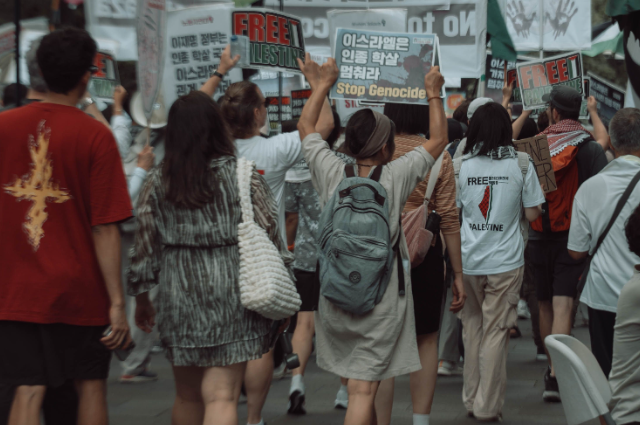
The 4B Movement
The evolution of feminism notes several key milestones wherein complex and systematic issues such as workplace discrimination, cultural inequalities and reproductive rights were addressed and improved.
The 4B movement is an act of digital feminism. Its concept is built around four specific Korean terms: bihon, meaning no to heterosexual marriage; bichulsan, referring to no childbirth; biyeonae, referring to no heterosexual dating or romance; and lastly, bisekseu, translating to no heterosexual sex. This movement poses a unique question for women: one where they are asked to withdraw from the traditional heterosexual life cycle expected of them. The 4B movement doesn’t just talk about not dating men, but it transcends into something deeper.
The four refusals are interconnected. Their cycle starts with marriage, leading to reproduction, then subtly shifting into domestic expectations, and finally leading to the act of obedience towards the patriarchal family structure.
Academic research papers describe 4B as a movement through which young Korean feminists got the chance to question why women's unmarried lives were treated as a setback and considered a temporary phase, while the state and economy continued to structure women's futures around marriage and reproduction. Here, 4B asks: what happens if women simply stop participating in the system?
A Movement Born From Online Anger
The origin of the 4B movement can be traced back to the mid-2010s when an intense online feminist culture emerged.
Megalia, a radical feminist online community, became an important part of this history. It developed in 2015 partly based on online misogyny, including misogynistic reactions surrounding the MERS outbreak.
During this period, Megalia became synonymous with “mirroring” misogynistic language and turning the language used against women back towards men. What started as a small movement then led to broader digital feminist discourse, creating an ecosystem that emerged as a form of resistance.
It included concepts such as Escape the Corset, which rejected restrictive beauty standards. It also involved anti-spycam activism and opposition to revenge pornography and digital sexual exploitation of women. Eventually, the 4B rejection of heterosexual relationships became a crucial part of this outline.
However, we must also consider the larger context. South Korea has experienced serious digital sex crime problems. In 2024, South Korea's Advocacy Centre for Online Sexual Abuse Victims supported 10,305 victims, representing a 14.7% increase from 2023. The number of victims affected by image synthesis or editing increased by 227.2%, while teenagers and people in their 20s accounted for 92.6% of those victims.
This data gives us a background for why this movement, advocating withdrawal from men, could emerge within a very specific social environment.
The 4B movement therefore did not just become a trendy internet slogan. It grew from a particular history where misogyny and gender inequality became sources of protest, especially against cultures of violence and distrust that disproportionately affect women.
The Country With the Worst Demographic Anxiety
To better understand the situation, we must also look into South Korea's fertility figures. South Korea recorded 238,300 live births in 2024, and this number was up 3.6% from 2023. Its total fertility rate rose to 0.75 children per woman, from 0.72 in 2023. This is considerable information because it marked the first annual increase in the fertility rate since 2015.
But 0.75 remains extraordinarily low compared to the roughly 2.1 births per woman generally associated with population replacement without migration.
This demographic decline is connected to much broader factors, such as expensive housing, career pressures, childcare costs, gender inequality, long working hours and changing marriage patterns. People have also developed changing attitudes towards raising a traditional family due to increasing economic insecurity. The 4B movement here became one expression of women's resistance to these expectations.
Then Trump Made 4B Global
After Donald Trump's November 2024 victory, 4B exploded across American social media, and this was driven heavily by TikTok. The platform became one of the main vehicles through which the movement gained international attention.
Google searches for 4B also spiked dramatically immediately after the election, as American women responded to Trump's victory, abortion and reproductive-rights concerns, and misogynistic rhetoric.
Women in America also feared for their reproductive autonomy and expressed anger over the political power of men who supported Trump.
But not every American woman interpreted Trump's victory as a reason to withdraw from men, and not every woman who opposed Trump also believed that heterosexual relationships themselves were the problem. The 4B movement did, however, spark an urge amongst some women to take a stand for their own rights and autonomy.
But Who Gets Left Out of 4B?
While the movement gathered appreciation through its roots of resistance and support towards women's rights, freedom and autonomy, there are several critical factors that we must address. One of its biggest criticisms came from concerns over exclusion, especially for trans and queer communities.
Critics argue that the movement's emphasis on heterosexual women and biological sex can reproduce a rigid gender binary. Some strands of South Korean radical feminism have also been associated with trans-exclusionary positions.
A 2026 study conducted in Feminist Media Studies examines the rise of trans-exclusionary feminism in South Korea and its relationship with strands of digital feminism. However, this does not become a blanket statement for the entire movement. Critics have argued that some strands of the movement could frame gender in a binary manner and have the possibility of becoming trans-exclusionary.
UCLA scholar Ju Hui Judy Han warned that the international popularity of 4B could revive what she described as its “most regressive part,” particularly anti-trans politics. She has also argued that “4B is not representative of Korean feminist politics.”
China: When Refusal Becomes Quiet Resistance
The 4B movement, with a global audience, also includes China. The country had already adopted a similar formula of 6B4T. This reform expanded on the original four principles, including acts of refusal of sexist consumer culture and restrictive beauty standards.
The framework differs because Chinese feminists operate under tighter political regimes and digital restrictions. On Douba, authorities have removed the "6B4T" keyword while shutting down over 10 feminist groups in 2021.
This instance makes China's standing particularly interesting, as the movement in this region is more than a copied version; rather, it is adapted to a stricter political scenario.
Is 4B Protest or Retreat?
The 4B movement can have multiple interpretations based on the community it is targeting. For supporters, 4B can be a form of autonomy, protection and economic independence. For many women, it translates into the refusal to participate in patriarchal structures, a way through which they can reclaim their bodily autonomy and independence.
However, critics also argue that the 4B movement has the potential to create a rather individualistic lifestyle rather than collective community action on political stances. Many also believe that it is too focused on heterosexual women and can become exclusionary towards trans and queer communities.
Some critics have also argued that this movement is a response to patriarchy that doesn't necessarily change institutions. Rather, it could create new social expectations around whether women should begin feeling pressure to prove that their feminism aligns with their acts of sexual or romantic withdrawal.
The 4B movement here poses a critical contradiction. It was created as a movement that gives women freedom, but it can itself become restrictive if there is only one correct way to be a feminist.
There Is No Single Way to Say No
The 4B movement began in a very specific manner in South Korea, and it started in response to misogyny and gender expectations imposed on women. However, after receiving international popularity, the movement also exposed the frustrations of women who might be excluded from this framework.
But the circumstances here aren't identical. A Korean woman responding to digital sexual violence, reproductive expectations and workplace inequality is operating under very different social circumstances from an American woman reacting to a presidential election.
The 4B movement here stands as a broader digital feminist movement, but it does not cater to all communities alike. A Chinese feminist adapting 6B4T is also operating within a different social and political environment. Therefore, copying the label doesn't necessarily mean copying the movement's exact format.
The 4B movement's most powerful idea is that women should have their own autonomy and should have the right to refuse the roles that were set within society's structure. Women have the right to create their own expectations and not fall back into the patriarchal rules set for them. 4B here poses a question about how society assigns roles to women and asks women to regain that freedom through the right of refusal.