
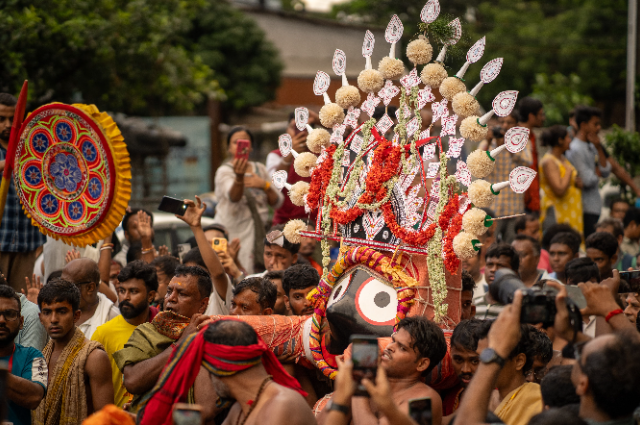
Most carpenters work on a commission basis, and their projects tend not to last very long. However, when a wooden structure rises nearly 45 feet into the sky and weighs several tons, the dynamic changes. Such a project requires months of magnificent skill, immense patience, and the expertise of at least a hundred skilled craftsmen. However, what happens when you build something with all your might and courage, only to dismantle it a few days later?
This dismantling is not because of damage or concerns of safety; rather, because of how tradition demands it. Odisha witnesses this unique tradition every year. For the Jagannath Rath Yatra, three enormous wooden chariots are built entirely from scratch. This is one of the world's oldest and largest religious processions. Millions of people gather to pull these towering structures through the streets, and yet only a few realise what the real story behind it is.
This annual assembling and dismantling of the chariots reflects something far superior to ritual. It showcases how Indian traditions value engineering and symbolism, and are rooted within the belief that renewal is more sacred than permanence. Odisha's traditions hence highlight how impermanence has its own beauty.
More Than a Festival: The World’s Largest Moving Chariot
Indian traditions and customs have been passed down for generations. They are celebrated widely and have become a part of our history through oral dialogues and scriptures. These traditions are celebrated with utmost respect and faith.
The Jagannath Rath Yatra has a similar story. This tradition has been celebrated for centuries and is regarded as one of India's most important Hindu festivals. Millions of devotees visit Puri annually. Hence, the story of the three chariots has a rich antiquity.
Nandighosha, also known as Lord Jagannath's chariot, is around 14 feet tall and cuts through the clouds and is carried on 16 wheels. Whereas Taladhwaja is the chariot for Lord Balabhadra, Bhadra. This one is 44 feet tall and is carried on 14 wheels. Lastly, the chariot for Darpadalana, or Goddess Subhadra, is 43 feet tall and has 12 wheels.
Each deity travels approximately 3 kilometres from the Jagannath temple to the Gundicha temple. The deities remain there for nine days before returning. Many scholars have described how the Rath Yatra is one of the world's oldest continuously celebrated chariot festivals.
The three chariots symbolise different aspects of divinity, yet move together in a shared journey that represents unity among devotees. And while people get accustomed to these traditions and celebrate them with all their might, they tend to forget that these remarkable chariots only exist for a brief moment each year.
The Destruction of Something Extraordinary
Monuments are made with the precision and certainty that they will stand the sands of time. Ozymandias, for instance, believed that his statue would last forever. And while most do, these chariots aren't built for eternity. They are made for intentional ephemerality.
Every year, new sacred timber is collected, fresh chariots are constructed, and old ones are dismantled. There is a deep-rooted symbolic meaning behind this. This festival and its chariots discuss the acts of renewal and impermanence that persist in our life cycles. It ushers us towards the meaning that faith shall remain alive despite the demolition of wood, and that rebuilding carries more depth and meaning than preservation.
Using the same chariot every year would actually contradict centuries of ritual tradition. The annual rebuilding reminds devotees that physical structures perish and faith continues. Many temples have the tradition of rebuilding as a reminder that everything material is temporary, whereas devotion and faith remain eternal. This makes the construction process a sacred act in itself.
A Masterpiece Built Without Modern Machines
Since these chariots are 43 to 45 feet tall and tear through the sky, their construction requires patience and precision, beginning months before the Ratha Yatra.
Sacred wood comprising phassi, dhaura, asimili, and simili is sourced from designated forests under traditional rituals. These are selected depending on the components that they comprise. Historically, timber has also been transported through river systems connected to the Mahanandi, though today organised transport networks are used to hasten this process.
Traditional carpenters, also known as Maharanas, have inherited generational knowledge and techniques for constructing these chariots. They don't involve any heavy machinery. They simply rely on traditional wood-making methods. Through the use of minimal modern technology, these chariots are assembled using generational carpentry practices.
Every decorative element, whether it be the canopy, the horse, the flag hoist, or the wheel, has a symbolic meaning behind it. Experts often describe construction as a living heritage, not just because the knowledge survives through people, but also because it is written in manuals and passed down through oral dialogues. Therefore, this festival celebrates not only the gods and deities, but also the artisans who spend hours crafting their chariots.
When a King Holds the Broom
The Rath Yatra is very rich in its culture, traditions and customs. It includes the tale of Chhera Pahanra, the king of Puri who sweeps all three chariots. It is said that this king uses a golden broom, sprinkles sandalwood water across these chariots and cleans them.
This translates into an allegory that no one stands above God. Whether it is a king or a common devotee, everyone is equal in the eyes of God. And everyone should be treated the same. Millions of people then pull the ropes together, and there are no reserved positions. Everyone stands collected, everyone stands united.
This symbolism is powerful, as it showcases how leadership becomes a form of service and how unity can lead to the accomplishment of great endeavours. Here, in this yatra, power becomes humility. Perhaps this explains why the festival continues to inspire millions of people.
Most monuments are built to outlast generations and withstand the force of time. Yet, Puri's chariots have a different tale to tell. They are built with the knowledge that they will disappear. Yet, each year, craftspeople return with their expertise, patience and perseverance.
They return to build again. Not just to form replicas, but to have fresh expressions of the same devotion. In an age obsessed with permanence, the ephemerality of this Yatra reminds us that traditions endure. Not because they never change, but because they are renewed again and again by human hands, by faith, and by collective memory.
References:
- https://www.india.com
- https://www.news18.com
- https://mahaprasada.home.blog
- https://www.outlookindia.com
- https://jagannath.nic.in/
- https://ich.unesco.org/