
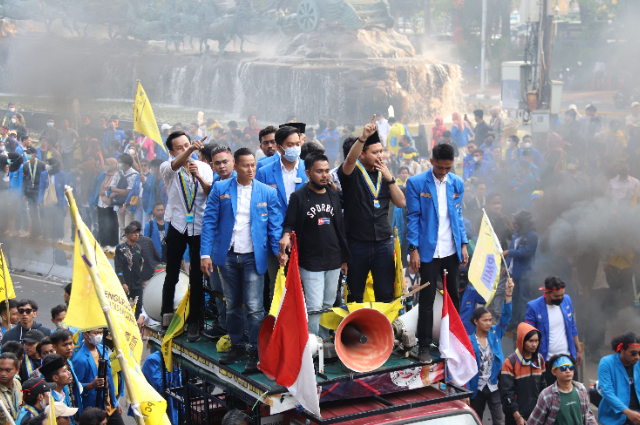
In Ranchi, the Jaipal Singh Munda Stadium usually stands witness to a vast array of sporting events. However, on this occasion, the stadium grounds were filled with hundreds of students and government job aspirants who gathered over allegations of irregularities and misalignment in recruitment examinations.
On 25th July 2026, the stadium stood witness to multiple hunger strikes, which soon became the most visible form of protest. However, when political leaders and student wing representatives reached the stadium grounds to express their support and alliance with the protesters, the students and aspirants had a different message for them.
A strong chant, “Rajneeti nahi chalegi, Zindabad Zindabad, Chhatra ekta zindabad”, was going around. This chant roughly translates to “politics will not work, long live student unity.” As hundreds of students gathered in harmonious chanting, the political representatives took note of their energy and left.
Pawan Kumar Goswami, a core committee member, stated, “We want it for the students.” Such student groups aren't formed with the idea of bringing politics into the centre stage, but to bring about change that is beneficial for those most affected.
Before the Politics, There Was the Exam
There were strong underlying grievances that built momentum up to the protest. The immediate trigger was the controversy surrounding the 14th Jharkhand Public Service Commission Combined Civil Services Examination, which was conducted in April 2026. The controversy intensified after the preliminary examination took place on 19th April 2026, as the alleged answer sheet was circulated on social media.
Soon after this incident, questions about transparency and ethical conduct of the examination process started arising. However, this wasn’t the sole cause for the protest. Aspirants who had appeared for JPSC and JSSC recruitment examinations also joined the agitation. They resonated with the cause of the protest due to several irregularities in their recruitment system. For instance, the JPSC examination advertised 103 slots; however, 2,204 candidates were shortlisted for the Mains.
In light of such events, the protestors put forth certain demands. They requested a CBI investigation into the irregularities, swift action against those responsible for the mishap, structural reforms in official bodies and a more transparent recruitment system. Additionally, they also demanded that the 14th JSPC preliminary examination should be cancelled.
One Stadium, Multiple Stages
Most protests have a single unified ground. The CJP protest that took place in New Delhi also had one stage. However, for Ranchi, the protest was different. There were two separate stages at the stadium. One was held by three members associated with the Jharkhand Loktantrik Krantikari Morcha (JKLM), and the other stage had four protesters on hunger strike. Alongside this, Brahmanand Kumar Mahto was a separate protester who was fasting independently under a statue of Jaipal Singh Munda.
Ranchi posed a unique statistic here. The protesters ranged from their early 20s to their late 30s and even early 40s, showing that this wasn't simply a college campus movement. It went beyond that and included people whose careers were tied to competitive examinations. Hence, this protest helped raise concerns among people who were constantly affected by such irregularities.
Rupesh Kumar Pal, for instance, was 30 years old and had appeared for the examination around 14 to 15 times since 2017. Another such case would include Umme Habiba, who was aged 27 and had appeared for the examination around 15 to 20 times. She stated that she would travel from Bokaro to Ranchi for the protest.
These instances show how the examination irregularity isn't just an administrative issue. Yet, they are more about the people who lost years of their lives trying to win in a system that needed structure and transparency.
When Everyone Wanted A Piece of the Protest
The stadium ground that was familiar with sporting events now saw the hustle and bustle of different political involvements.
Congress representatives and student body leaders visited the protests. Vinod Thackeray, the NSUI national president, met with the students and representatives. BJP-linked student groups also supported their demands for accountability.
However, despite their involvement, a contradiction was posed. Political parties were supporting the students' demands, but the students didn't necessarily want the parties supporting them just on political terms. As Pawan Kumar Goswami states, “We felt that the stage was slowly turning into the stage for a specific political party. And you're not welcome here if you want to do that.”
The students didn't necessarily reject the demands of the political parties. They were rejecting the possible idea that their movement could suddenly turn into a political campaign. Every party came with their own set of incentives. The Opposition would use the examination irregularities as an attack on the ruling government. At the same time, the students themselves needed political pressure because the institutions they were protesting were part of the state.
So the movement occupied a different middle ground, something unfamiliar. Something where the students required political accountability, but not ownership.
When the Demands Transformed into a Hunger Strike
On August 3rd, 2026, Devendra Nath Mahto began an indefinite hunger strike. By August 6th, around eight protesters had joined in on this strike across different protest sites. Mahto was on the fourth day of his fast when he stated, “I will continue this struggle till all of our demands are met, even if this white sheet turns into a shroud.”
This is when the protest became even more crucial. Their demands now translated into a hunger strike, a desperate need for the protesters to get accountability and a proper response from the officials.
The State Offers Talks, But Students Ask For Transparency
The state CID had already launched investigations and was uncovering the irregularities related to the recruitment cases. On August 6th, the reports stated that 19 people had been arrested in connection with the investigations.
During this time, the government also attempted conversation with the protesters themselves. Ranchi SDM Kumar Rajat and ADM Dhananjay Kumar invited a five-member delegation for talks. Students deliberated for around two hours but objected to closed-door discussions. They wanted discussions involving the students rather than having any private talks.
The Jharkhand leader of the opposition, Babulal Marandi, said, “These are not just discrepancies but the sale of jobs in Jharkhand.” He also supported the cancellation of the next exam and the CBI investigation.
The Politics They Were Rejecting
The protest was deeply political in the broader sense. It was demanding accountability from the state, and the nature of the demands was political. However, what they rejected was partisan ownership.
“Rajneeti nahi chalegi” therefore wasn't just about a rejection of politics itself. It stood for a broader demand: a demand for agency and for personal authority. They wanted their grievances to remain centred on the recruitment exams. Their demands were simply for transparency and fairness, and a hope that there would be better reforms for those who spent years preparing for such examinations.
The multiple stages of this protest hence demonstrate how the movement had internal fragmentation, but their chant was in broader alignment with the beliefs that they stood for: the belief that politicians shouldn’t be allowed to turn their struggles into somebody else's campaign. The students here weren't just asking for politics to disappear. They knew that the involvement of politics would be inevitable. They were simply asking for their own voices not to be diminished within such movements.
Refrences
- “Anatomy of Jharkhand protests: 2 stages, 8 on hunger strike, a quest to be ‘non-political’” — ThePrint, August 6, 2026 ThePrint article
- “Jharkhand: Protests Over JPSC, JSSC Exam Leaks Gather Momentum, Six on Hunger Strike” — The Wire, August 5, 2026 The Wire article
- “Jharkhand Student Protest: What We Know So Far About The Viral Answer Sheet, Hunger Strike And CBI Demand” — Brut article
- “Why are Jharkhand students protesting JSSC-CGL? The paper leak allegations and court battle explained” — ThePrint explainer.
- “Why are govt job aspirants protesting and what are their demands?” — The News Minute explainer
- “INDIA alliance demands action over Jharkhand students’ protest unrest” — Times of India, September 3, 2026, Times of India report.