
Every December, Bostonians gather on Boston Common to watch the lighting of an enormous Christmas tree. There are carols, speeches, hot drinks and cameras. It looks like an ordinary piece of municipal festivity, and most of the smiling crowd could not tell you anything unusual about it. But the tree is not really a decoration. It is a debt being repaid. Every year since 1971, the Canadian province of Nova Scotia has chosen the finest spruce in its forests, cut it with ceremony, and trucked it hundreds of kilometres south to Boston — a thank-you letter written in timber, for something Boston did in the winter of 1917, when a city burned and the Americans came through a blizzard to help.
To understand the tree, you have to go back to the morning of 6 December 1917, and to a harbour in eastern Canada where two ships made a mistake.
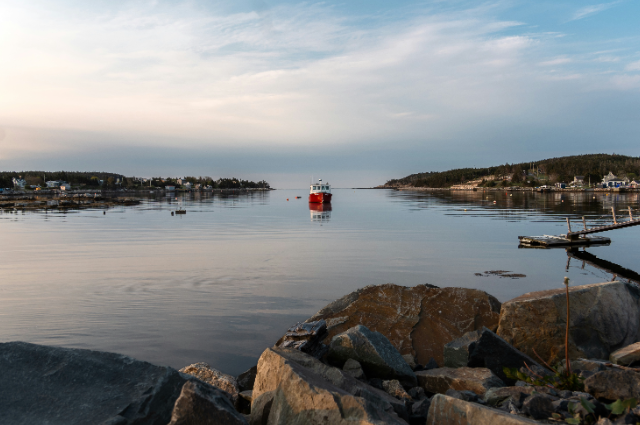
A Harbour At War
In the fourth year of the “First World War, Halifax, Nova Scotia, was one of the busiest ports in the world.” Convoys carrying soldiers, food and munitions assembled there for the dangerous Atlantic crossing, and the city's population had swollen to around sixty thousand. The harbour narrowed to a strait barely half a kilometre wide — a passage called the Narrows — between the city proper and the neighbouring town of Dartmouth. Through this bottleneck passed every ship that entered or left the inner harbour, like traffic squeezing through a single toll gate.
On the morning of 6 December, two ships approached that gate from opposite directions.
The Mont-Blanc was coming in, a slow, ageing French freighter chartered by the French government. She had arrived from New York the previous evening, too late to pass through the anti-submarine nets that sealed the harbour at night, and had waited outside until morning. Her holds were a floating arsenal: roughly 2,925 tonnes of explosives, among them some 2,367 tonnes of picric acid, 250 tonnes of TNT and 62 tonnes of guncotton, all bound for the battlefields of France. On her deck, as a last-minute addition, sat drums of benzol — a highly flammable liquid fuel. Her holds were even lined with wood and fastened with copper nails so no spark could be struck. Nothing aboard her, however, could protect against the sea itself, or against another ship.
The Imo, a much larger Norwegian steamship, was sailing out empty. “The Commission for Relief in Belgium” had chartered her to collect food and supplies in New York for a starving, occupied country, and the words "Belgian Relief" were painted in huge letters on her side. She too had been delayed — her coal had arrived late the previous evening, and by the time loading finished, the submarine nets were up. She spent the night in the basin, impatient.
Two ships. Two delays. Neither ship was supposed to meet the other that morning. But history is often written in the margin between a schedule and a setback.
Eleven Whistles
The Narrows had rules, like any road: keep to your side. Yet the Imo, anxious to make up lost time, came down the channel faster than the harbour speed limit allowed and, after two awkward encounters with smaller vessels, found herself far over on the wrong side.
The Mont-Blanc's pilot, Francis Mackey — an experienced harbour pilot who had boarded the ship the night before and had asked, uneasily, for special precautions because of his cargo, which were never granted — saw the Imo approaching as if she meant to cut across his bow. He sounded one short blast of his whistle: I have the right of way. The Imo answered with two blasts: I am not moving over.
What followed was a conversation no two ships should ever have. Whistle answered whistle, each captain convinced the other would yield. Both engines stopped. The Mont-Blanc swung desperately to port, trying to cross in front. At the last moment the Imo threw her engines into reverse — and the sideways thrust of her propeller swung her bow straight into the Mont-Blanc's side.
It was 8:45 in the morning. The collision itself was almost gentle — barely one knot of speed, no explosion, no one killed. A schoolboy watching from the shore might have been disappointed. The Imo's bow had opened a gash in the French ship's first hold, nothing more. But as the Imo backed away, steel ground against steel, sparks fell among the benzol drums toppled on deck, and the spilt fuel caught fire.
The fuse of the largest bomb mankind had yet assembled was now alight. And almost nobody in Halifax knew it.
The Crowd At The Window
Here lies the darkest detail of the whole story. Ammunition ships were supposed to fly a red flag warning of their cargo. The Mont-Blanc flew none — for fear, it was said, of attracting German submarines. So as the burning ship drifted with the slack tide toward the Halifax waterfront, trailing a column of black smoke, the city did what people have always done at the sight of a spectacle: it came out to watch.
Dockworkers gathered on the piers. Factory hands pressed against windows. Children on their way to school stopped to stare. In the houses of Richmond, the working-class district rising above Pier 6, mothers held babies up to the glass for a better look at the burning ship. Firefighters from the Halifax Fire Department brought the Patricia, Canada's first motorised fire engine, down to the pier and began unrolling their hoses. A tugboat, the Stella Maris, was manoeuvring close, preparing to help. Officers of the Royal Canadian Navy sent a whaler and a pinnace across the water toward the fire. Fourteen-year-old Barbara Orr, walking to school, paused to watch the smoke like everyone else — then felt an inexplicable dread, a sudden dead quiet, and hurried on. Moments later the blast threw her to the ground; she survived, but the family home in Richmond did not.
The Mont-Blanc's crew, meanwhile, rowed for their lives toward the Dartmouth shore. They knew exactly what was below deck. They shouted warnings at every vessel they passed—but in French, and in the noise and confusion of a wartime harbour, nobody understood. Captain Aimé Le Médec and his men beached their boats, ran up the wooded hills, and threw themselves into the trees, leaving a city of sixty thousand people watching the fire with no idea they were staring at their own executioner.
For about twenty minutes, the ship burned. Benzol drums on deck exploded one by one, rising like flaming rockets, and the crowd grew larger with every burst.
“Guess This Will Be My Last Message”
Two hundred and thirty metres from Pier 6 stood the Richmond railway depot of the Intercolonial Railway, where train dispatcher Patrick Vincent Coleman — Vince Coleman to everyone who knew him — was working the telegraph key with his colleague, chief clerk William Lovett.
A sailor burst in with the news the crowd did not have: the burning ship was full of explosives and would blow up at any moment. Coleman and Lovett ran for their lives. But a few steps from the door, Coleman stopped. In his head was a timetable. The overnight express from Saint John, New Brunswick — train No. 10, carrying up to three hundred passengers — was due into the Richmond yard within minutes, on a track that ran directly past the burning ship.
Coleman turned around. He went back inside, sat down at his key, and began to tap out warnings down the line. The message he is remembered for has been handed down in this form:
"Hold up the train. Ammunition ship afire in harbour making for Pier 6 and will explode. Guess this will be my last message. Good-bye, boys."
He kept sending until there was no more time. Whether his telegram alone stopped train No. 10 is something historians still debate — one conductor reported being held for fifteen minutes by the dispatcher at Rockingham, a few kilometres short of the city. What is beyond debate is that Coleman stopped every other train inbound for Halifax, and that his message told the entire railway what had happened. When the lines from Halifax later went dead, no one along the route wasted hours wondering why. Help began moving almost immediately.
Vince Coleman, forty-five years old, a husband and father, died at his desk. His telegraph key, watch and pen are kept today in the Maritime Museum of the Atlantic in Halifax.
9:04 And Thirty-Five Seconds
At precisely 9:04:35 in the morning, the fire reached the cargo.
The Mont-Blanc simply ceased to exist as a ship. At the point of detonation, temperatures reached about five thousand degrees Celsius. The blast wave raced outward at more than a thousand metres per second, releasing energy equivalent to roughly 2.9 kilotonnes of TNT. Until the atomic bombs of 1945, no explosion made by human hands had ever been larger.
The numbers have an obscene, surreal quality. The ship's half-tonne anchor was found more than three kilometres away, flung over the city's rooftops. A gun barrel landed in Dartmouth, across the harbour. A column of white smoke rose more than three kilometres into the sky. The blast was felt in Cape Breton, over two hundred kilometres distant, and heard on Prince Edward Island. The displaced harbour water rushed back as a tsunami that climbed eighteen metres above the high-water mark, swept the Imo bodily onto the Dartmouth shore — and wiped out a Mi'kmaq community that had lived at Tufts Cove for generations.
Everything within a radius of eight hundred metres — the entire district of Richmond — was obliterated. Not damaged: obliterated. Wooden houses became matchwood in a heartbeat; then the matchwood caught fire. Fires broke out across the North End, feeding on stoves knocked over in collapsed kitchens. In all, some 1,600 buildings were destroyed and around 12,000 damaged. The crowd that had gathered to watch the fire — the dockers, the schoolchildren, the mothers at their windows — stood at the very centre of it. Hundreds were blinded by flying glass; roughly three hundred people suffered full or partial blindness, a wound so characteristic of that morning that the disaster helped give birth to the Canadian National Institute for the Blind.
Nearly two thousand people were killed — the official count reached 1,963 — and some nine thousand were injured. In the whole tragedy, one statistic still reads like a misprint: of the Mont-Blanc's entire crew, all but one survived. The men who ran away lived. The city that watched died.
And Then It Snowed
Nature, not yet finished, added a final cruelty. On the morning of 7 December, a fierce nor'easter — unforecast, unsuspected — swept in from the Atlantic. By afternoon the temperature had plunged below freezing, winds gusted beyond ninety kilometres an hour, and forty centimetres of snow buried the ruins. Survivors trapped under collapsed houses now faced death by cold. Hastily repaired telegraph lines came down again. Relief trains crept through drifts, dug out by hand. The fires, at least, were smothered; that was the storm's only mercy.
But the blizzard also produced the story's turning point — the moment that explains the Christmas tree.
News of the explosion had reached Boston by telegraph within about an hour. By 11 a.m. it lay on the desk of Massachusetts Governor Samuel McCall, who wired Halifax immediately: "Massachusetts stands ready to go the limit in rendering every assistance you may need." He did not wait for a reply. That same evening, at ten o'clock — roughly twelve hours after the blast — the first American relief train pulled out of Boston carrying doctors, nurses from Massachusetts General Hospital, Red Cross workers, medical supplies, food, clothing and glass for shattered windows. When the blizzard blocked the line, the train halted, and rail workers shovelled it free by hand; the relief party wired ahead for still more supplies before they had even arrived. They reached Halifax early on 8 December and slept in the unheated train, without food or water, before going to work — turning a boys' school into a functioning hospital within a day.
They were not alone. A dozen relief trains arrived that first day from towns across Nova Scotia and New Brunswick; the passengers of train No. 10 — the very train Coleman had tried to hold back — had climbed out at the edge of the wreckage, torn sleeping-car sheets into bandages, and carried the wounded north to Truro. But it was Boston's speed, generosity and staying power — the Massachusetts-Halifax Relief Committee went on helping for years, even furnishing the new homes of the rebuilt Hydrostone district — that Haligonians never forgot.
The Tree
In December 1918, with the war over and its ruins still being cleared, Nova Scotia sent Boston a Christmas tree. Thank you, it said. We remember.
The gesture lapsed, but the memory did not. In 1971, a Christmas tree growers' association in Lunenburg County revived the gift, and in 1976 the provincial government adopted it as an annual official act of gratitude. It continues to this day. Each autumn, scouts walk the forests of Nova Scotia searching for a perfect white spruce; each December, they cut it with bagpipes and ceremony, sign it in a "book of thanks", and drive it to Boston, where thousands gather to watch it lit. Most of the cheering crowd, as I said, do not know what they are really looking at.
What The Story Leaves Behind
The Halifax Explosion changed the real world, not only the emotional one. A judicial inquiry opened within a week and, swayed by the anti-French mood of the moment, first blamed the Mont-Blanc's captain, her pilot and the harbour's chief examining officer — an outcome so one-sided that an appeals court later divided the fault between both ships. Out of the wreckage came reform: harbour traffic rules were rewritten, hazardous cargoes were required to be identified, and the era of the anonymous floating bomb came to an end. The mass of eye injuries advanced surgery and rehabilitation; the rebuilt North End, with its fire-resistant concrete Hydrostone houses, became a landmark of urban planning. But the reason the story deserves to be told, a century later and seven thousand kilometres away, is simpler.
Ordinary people decided everything that morning in minutes. A pilot asked for protection and was refused. Two captains argued with whistles and lost. A crowd chose curiosity over caution. And one railway clerk, given twenty minutes and an open door, chose to turn back to his desk.
We like to imagine that history is moved by generals and governments. Halifax suggests otherwise. It was moved by the gap between a coal delivery and a rising tide; by a warning shouted in the wrong language; by the decision of a man who knew his message might be his last, and sent it anyway. And a city three hundred kilometres away answered, without waiting to be asked twice.
That is why the tree matters. Gratitude, unlike disaster, does not expire. Halifax found a way to say thank you once a year, forever — and a hundred years on, the spruce still travels south each December, carrying the whole story silently in its branches: the fire, the snow, the train, and the strangers who came.
References:
- Parks Canada, “Halifax Explosion National Historic Event” (parks.canada.ca) — collision, casualty figures, tidal wave, CNIB connection.
- Encyclopaedia Britannica, “Halifax explosion of 1917” — Mont-Blanc cargo manifest (2,367 t picric acid, 250 t TNT, 62 t guncotton, 246 t benzol), 9:04 a.m. detonation, 18-metre tsunami, 1,600 buildings destroyed.
- Maritime Museum of the Atlantic, Nova Scotia — “Explosion in the Narrows” and “Vincent Coleman and the Halifax Explosion” — Coleman's message, the Rockingham evidence, and the historical debate over train No. 10.
- Canadian War Museum, “The Halifax Explosion” — official death toll 1,963, ~9,000 injured
- Wikipedia (featured article), “Halifax Explosion” — timeline (8:45 collision, 9:04:35 explosion), 800-metre destruction radius, Mi'kmaq community at Tufts Cove, relief operations, inquiry and appeal.
- US Naval Institute, Naval History Magazine, “Havoc in Halifax” (Feb 2024) — crew abandoning ship, French warnings unheard, Mackey's request for precautions, Barbara Orr account, population figures.
- Canadian Medical Association Journal (PMC5726964), “The 1917 Halifax Explosion: the first coordinated local civilian medical response to disaster in Canada” — medical response and arrival of American units.
- CBC News (Dec 2017), “Why a nasty snowstorm following the Halifax Explosion came as a surprise” — 7 December blizzard: 40 cm snow, 90 km/h gusts, delayed relief trains.
- Massachusetts Historical Society, “News of the Halifax Explosion Reaches Boston” (Dec 2017) — Governor McCall's telegram and the 10 p.m. departure of the first Boston relief train.
- Halifax Municipal Archives, “Halifax Explosion Sources” — Boston relief train's arrival on 8 December; Massachusetts-Halifax Relief Committee.
- Government of Nova Scotia, “Tree for Boston” (novascotia.ca); New England Today, “How Boston Got Its Christmas Tree”; “Boston Christmas Tree” records — the 1918 thank-you tree, revival of the annual gift in 1971, provincial adoption in 1976, Hydrostone rebuilding.