
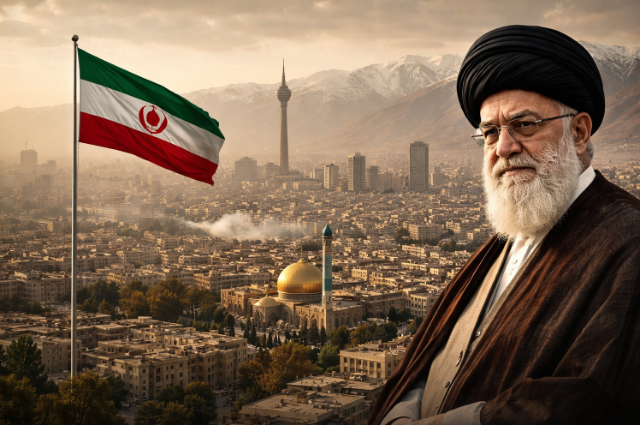
In 1955, in the holy Iranian city of Mashhad, a quiet yet symbolic moment unfolded in a dimly lit room where a 16-year-old boy sat alone, dressed in the robes of a cleric. In one hand, he held a burning cigarette, and in the other, a pen moving steadily across paper. He was writing poetry, beginning with the word “Ameen,” a word that carried both spiritual weight and a sense of quiet hope. But this moment of solitude was soon interrupted by rising noise from outside, those are chants, slogans, and the unmistakable sound of protest. Curious, the boy walked to the window and saw a procession of people marching against the king of Iran. Without hesitation, he left his unfinished poem behind, along with the half-burnt cigarette, and stepped out to join the crowd. That boy, who once balanced poetry and rebellion in the same breath, would one day become the most powerful man in Iran, Ali Khamenei.
To understand this moment, one must understand the Iran of that era, a nation standing at the crossroads of tradition and modernity. Under the rule of Shah Mohammad Reza Pahlavi, Iran was rapidly transforming into a Western-style state. European culture was influencing everything from clothing to entertainment. Nightclubs, cinema, and Western education were becoming symbols of progress, especially in urban centres. However, this rapid modernisation also created a deep cultural divide. For many Iranians, especially those rooted in religious traditions, this shift felt less like progress and more like a loss of identity. It was within this ideological tension that Khamenei was raised.
Born in 1939 into a religious Shia Muslim family, Khamenei was deeply influenced by his father, who was a cleric. Following in his footsteps, he entered religious education at a young age and decided by the age of 11 that he would become a cleric himself. Despite his religious upbringing, he was academically capable in subjects like mathematics and English, skills that connected him to the very modern influences he would later oppose. He was known for reciting verses from the Quran in school, earning admiration from teachers and peers. Yet, he was also a young boy navigating contradictions, often mocked by others for wearing clerical attire at such a young age.
This duality defined his early years. On one hand, he was deeply rooted in faith and tradition. On the other hand, he was exposed to a rapidly changing world. While Iran’s cities embraced modern lifestyles, the seeds of resistance were quietly being planted among those who felt alienated by these changes. The young Khamenei was among those absorbing this tension, slowly shaping his worldview. The unfinished poem in that room was not just an abandoned piece of writing; it symbolised a turning point. The boy who once wrote verses in isolation had taken his first step into a larger movement, one that would eventually reshape the destiny of an entire nation.
The Awakening of Defiance ( From Student to Revolutionary)
By the early 1960s, Iran was no longer just experimenting with modernisation; it was beginning to fracture under its own weight. The reforms introduced by Shah Mohammad Reza Pahlavi, often celebrated in global circles as progressive, were increasingly viewed within Iran as imposed and disconnected from the cultural and religious fabric of society. Western clothing, entertainment, and social norms were becoming widespread, especially in urban areas, but beneath this visible transformation, dissatisfaction was quietly growing. For many Iranians, particularly those rooted in religious traditions, this shift felt like an erosion of identity rather than advancement. It was in this climate of ideological conflict that Ali Khamenei, no longer a boy but a young cleric, began to move from observation to participation.
Having already committed himself to religious studies, Khamenei’s intellectual and spiritual journey gradually intertwined with political awareness. He was not isolated from the changes around him; rather, he was deeply affected by them. His education, which included exposure to both traditional Islamic teachings and modern subjects, allowed him to see the widening gap between Iran’s leadership and its people. As the Shah’s policies continued to centralise power and suppress dissent, opposition began to organise not just politically, but ideologically. Among the most influential voices leading this resistance was Ayatollah Ruhollah Khomeini, a cleric who openly challenged the Shah’s authority and condemned the growing Western influence in Iran.
Khomeini’s message resonated strongly with many young clerics, including Khamenei. It was not merely a call for political change but a demand for the restoration of an Islamic identity in governance and society. Khamenei aligned himself with this movement, stepping into a path that was both dangerous and transformative. Opposition to the Shah’s regime was not tolerated. It was met with surveillance, arrests, and harsh punishments. Yet, despite these risks, Khamenei continued his involvement in anti-government activities, participating in protests and spreading revolutionary ideas.
His commitment came at a cost. Over the years, Khamenei was arrested multiple times by the Shah’s security forces. These imprisonments were meant to silence him, but instead, they strengthened his resolve. Prison became more than just a place of confinement; it became a space where his ideological beliefs were tested and reinforced. Surrounded by others who shared his opposition to the regime, Khamenei’s identity as a revolutionary began to solidify. Each arrest added to his credibility within the movement, marking him not just as a supporter but as someone willing to endure personal sacrifice for a larger cause.
As the decade progressed, public dissatisfaction intensified. Economic inequality, political repression, and the perception that Iran was being shaped by foreign powers, particularly the United States, fuelled widespread anger. What made this period significant was the convergence of different groups like students, workers, intellectuals, and religious leaders, who, despite their differences, united against a common adversary. By the late 1970s, this collective frustration reached a breaking point.
The revolution of 1979 did not emerge suddenly; it was the result of years of simmering unrest. When it finally erupted, it brought down one of the most powerful monarchies in the region. The Shah fled the country, and Ayatollah Khomeini returned from exile to a hero’s welcome. For many, it felt like a moment of liberation, a reclaiming of identity and control. For Khamenei, it marked the transition from being a participant in history to becoming one of its emerging architects.
Blood, Survival, and the Consolidation of Power
The success of the 1979 Iranian Revolution did not bring immediate stability; instead, it opened the door to a new and uncertain phase in the country’s history. The monarchy had fallen, and the Islamic Republic had been established under the leadership of Ayatollah Ruhollah Khomeini, but the revolutionary unity that had once brought diverse groups together quickly began to fracture. Different factions, some secular, some religious, some left-leaning, now found themselves at odds over the future direction of Iran. In this volatile environment, power was not only being built but also fiercely contested. It was during this turbulent period that Ali Khamenei began to emerge as a significant figure within the new political order.
By the early 1980s, Khamenei had transitioned from being a revolutionary participant to a recognised leader within the Islamic establishment. His loyalty to Khomeini, his record of resistance against the Shah, and his growing influence made him an important part of the system that was still finding its footing. However, with visibility came vulnerability. The new regime faced opposition not only from external forces but also from internal groups who believed the al-thawra (the revolution) had been diverted from its original goals. Among these were organisations that actively resisted the Islamic government, sometimes through violent means.
In 1981, this internal conflict reached Khamenei in a deeply personal and dramatic way. While addressing a gathering in Tehran, a seemingly ordinary tape recorder placed near him exploded. It was a calculated assassination attempt, designed to eliminate one of the rising figures of the new regime. The blast left Khamenei severely injured. His right arm was permanently damaged, and he suffered significant hearing loss. The attack was a stark reminder that the revolution, far from being complete, had entered a dangerous new phase where even its leaders were not safe.
Yet, Khamenei survived, and that survival proved to be a turning point. In the context of revolutionary Iran, surviving such an attack elevated his status beyond that of a political figure. He began to be seen as someone who had sacrificed for the cause, someone who had faced death and endured. This perception strengthened his standing within the leadership and among supporters, turning him into a symbol of resilience and commitment to the Islamic system. His response to the attack reflected this transformation; rather than retreating, he emphasised that as long as his mind and voice remained intact, he could continue his role. It was a statement that reinforced both his determination and his strategic understanding of power.
At the same time, Iran was facing another crisis. A separate bombing killed key leaders of the government, including the president and prime minister, creating a sudden vacuum at the top. The country needed stability, and quickly. In this moment of urgency, Khamenei stepped forward as a candidate for the presidency. His revolutionary credentials, combined with the sympathy and recognition gained after the assassination attempt, made him a strong contender. He won the election and became the President of Iran in 1981.
However, his presidency began under the shadow of war. Iraq, under Saddam Hussein, launched an invasion of Iran, triggering a prolonged and devastating conflict that would last for eight years. The Iran-Iraq War not only tested the country's resilience but also shaped its leadership. As president during this period, Khamenei operated in an environment defined by crisis, survival, and constant pressure. These years would further refine his political instincts and strengthen his position within Iran’s evolving power structure, bringing him closer than ever to the centre of authority.
From President to Supreme Leader
By the end of the 1980s, Iran stood at a critical turning point. The longest and most exhausting Iran-Iraq War had finally come to an end, leaving behind a nation drained of resources and deeply scarred by loss. The revolutionary fervour that once united millions had begun to settle into a more rigid political structure, one that revolved heavily around a single figure, Ayatollah Ruhollah Khomeini. As the founding Supreme Leader of the Islamic Republic, Khomeini was not just a political authority but the ideological core of the entire system. His presence held together the delicate balance between governance, religion, and revolutionary legitimacy. So when he passed away in 1989, Iran was confronted with an urgent and unsettling question: Who could fill that void?
At the time, Ali Khamenei was serving as the President of Iran, having already spent nearly eight years in office during one of the most challenging periods in the country’s history. Despite his political experience and close association with Khomeini, Khamenei was not widely seen as the most qualified candidate for the position of Supreme Leader, particularly from a religious standpoint. Within the clerical hierarchy, there were others considered more learned and more traditionally suited for such a role. Even Khamenei himself reportedly expressed hesitation, believing that he lacked the depth of religious scholarship required for the position. However, the circumstances of the moment demanded not just religious authority, but political continuity and stability.
What ultimately worked in Khamenei’s favour was a combination of factors that went beyond traditional qualifications. He was a known figure within the revolutionary leadership, someone who had remained loyal to Khomeini’s vision and had proven his resilience through years of struggle, imprisonment, and even an assassination attempt. He had also demonstrated his ability to navigate complex political and military challenges during his presidency. Most importantly, he had the support of key figures within Iran’s power structure, who saw in him a leader capable of maintaining the system’s continuity.
To facilitate his appointment, significant changes were made to Iran’s constitutional framework. The requirements for becoming Supreme Leader were adjusted, allowing Khamenei to assume the role despite earlier concerns about his qualifications. In 1989, he was officially appointed as the Supreme Leader of Iran, marking the beginning of a new phase in the country’s political evolution. This transition was not merely a change in leadership; it represented a shift in how power would be exercised and consolidated in the years to come.
The position of Supreme Leader in Iran is unlike any conventional political office. Rooted in the principle of Velayat-e Faqih, it grants ultimate authority over the state’s key institutions, including the military, judiciary, and media. While Iran maintains elected bodies such as the presidency and parliament, their powers operate within the boundaries set by the Supreme Leader. In essence, the role combines both religious and political authority, placing its holder at the very apex of the system.
Khamenei’s early years as Supreme Leader were marked by careful consolidation of power. Rather than dramatic shifts, his approach was gradual and strategic. He strengthened institutions that were loyal to him, particularly the Islamic Revolutionary Guard Corps, which grew in influence not only as a military force but also as a key player in Iran’s political and economic landscape. Over time, this network of aligned institutions helped reinforce his control, ensuring that authority remained centralised.
As years turned into decades, Khamenei’s leadership became a constant in a rapidly changing world. Governments rose and fell, global alliances shifted, and the Middle East witnessed repeated turmoil. Yet, within Iran, the position of Supreme Leader remained firmly in his grasp. However, with longevity came scrutiny. Questions began to emerge, both within and outside the country, about the nature of power, governance, and the direction of the Islamic Republic. The revolution that once promised transformation was now being evaluated through a different lens, one that increasingly asked whether the concentration of authority had come at the cost of the very ideals it sought to protect.
War, Assassination, and an Unfinished Legacy
As the world entered the mid-2020s, the long-standing tension between Iran and the United States transformed into something far more dangerous: open conflict. What had once been a cold hostility shaped by sanctions, proxy wars, and political rhetoric escalated into direct military confrontation. At the centre of this storm stood Ayatollah Ali Khamenei, a leader who had spent over three decades consolidating power, resisting Western influence, and shaping Iran’s ideological direction. But as global pressure mounted and regional instability intensified, the conflict reached a decisive moment, one that would redefine not only Iran’s future but also the balance of power in the Middle East.
The situation escalated dramatically in early 2026. The United States, alongside Israel, launched coordinated strikes targeting Iran’s military infrastructure, nuclear facilities, and high-ranking leadership. These operations were not isolated; they were part of a broader strategic effort to weaken Iran’s capabilities and disrupt its growing influence in the region. Iran responded with missile attacks on Israeli territories and U.S. military bases across the Middle East, turning the conflict into a full-scale regional crisis. The Strait of Hormuz, a critical route for global oil supply, became a flashpoint, with disruptions causing worldwide economic concern and skyrocketing energy prices.
Amid this escalating war, the most shocking development came on February 28, 2026. In a targeted airstrike in Tehran, Ayatollah Ali Khamenei was assassinated. The operation, reportedly carried out with coordinated intelligence and military precision, marked one of the most significant political killings in recent history. His death was confirmed shortly after, sending shockwaves across the world and triggering immediate political and social reactions.
Khamenei’s assassination did not bring an end to the conflict; it intensified it. Across Iran and in regions with strong Shia influence, protests erupted, condemning the attack and demanding retaliation. In countries like Iraq, demonstrators attempted to storm U.S. diplomatic zones, reflecting the widespread anger and volatility triggered by his death. Meanwhile, within Iran, the newly formed power Structure quickly moved to stabilise itself. An interim leadership system was established, and eventually, leadership transitioned within the same ideological framework, ensuring continuity rather than transformation.
At the same time, the war itself continued to escalate. Recent reports indicate large-scale military strikes, destruction of key Iranian assets, and retaliatory missile attacks targeting critical locations, including areas near nuclear facilities. The scale of the conflict has raised global alarm, with fears that it could spiral into a wider regional or even global war. The United States has issued strong ultimatums, while Iran has remained defiant, refusing to back down despite mounting pressure.
What makes this moment particularly significant is not just the violence but the uncertainty it has created. Khamenei was not merely a political leader; he was the central figure holding together Iran’s ideological and power structure for decades. His absence leaves a vacuum that is difficult to fill, even within a system designed for continuity. At the same time, the conflict has blurred the line between political strategy and human cost. Thousands have already been affected through loss, displacement, and fear, while the future remains deeply uncertain.
In many ways, the story that began in a quiet room in Mashhad with a boy writing poetry and stepping into a protest has come full circle. It ends not with a peaceful conclusion, but with war, uncertainty, and a legacy that continues to shape events even after his death. The unfinished poem of that young boy has turned into a history written in conflict, ideology, and power, a story whose final chapter is still being written.
The Price of Power and the People in the Crossfire
The story of Ali Khamenei is not just the story of a man rising to power; it is the story of how power, once achieved, begins to shape everything around it, often at a cost that is paid not by leaders but by ordinary people. From a young boy writing poetry in Mashhad to becoming the Supreme Leader of Iran, his journey reflects ambition, ideology, survival, and control. But beyond the narrative of rise and resistance lies a deeper question: What happens when power stops listening?
Iran today stands as a nation caught between two forces. On one side is the state, strong, structured, and unyielding, built on the principles of revolution and religious authority. On the other side are its people who are young, aware, and increasingly vocal about their aspirations for freedom, dignity, and change. This tension is not new, but it has grown sharper over time. Protests, crackdowns, and cycles of resistance have become part of the country’s modern identity. Each wave of dissent tells the same story: a gap between authority and expectation that continues to widen.
At the same time, Iran’s position on the global stage has turned it into a focal point of geopolitical struggle. Its long-standing hostility with the United States and Israel has transformed political disagreements into existential threats. Words like “security,” “defence,” and “sovereignty” dominate the conversation, but behind these words are real consequences, economic sanctions, military tensions, and the constant fear of war. In such a climate, leadership becomes not just about governance, but about survival.
However, the most uncomfortable truth lies in the middle of this conflict: the people. The ordinary Iranian citizen is forced to navigate both internal restrictions and external pressures. They face economic hardships due to sanctions, social limitations due to strict governance, and the looming fear of conflict due to global tensions. In many ways, they are living at the intersection of two powerful forces that rarely consider their everyday realities.
History often celebrates revolutions as moments of liberation, but it also reminds us that revolutions can evolve into systems that mirror the very control they once opposed. Iran’s journey reflects this paradox. The same revolution that promised independence and identity now faces questions about freedom and accountability. And at the centre of this paradox stands Khamenei, a leader who represents both the strength of the system and the criticisms against it.
In the end, this is not just a story about one man or one country. It is a reflection of a larger truth about power itself. When authority becomes absolute, it risks becoming distant. And when it becomes distant, it risks losing the very people it was meant to serve.
As the world watches Iran, the question is no longer just about politics or. It is about humanity, about whether systems built on control can adapt to voices demanding change, and whether leaders shaped by revolution can respond to a generation that no longer fears it.