
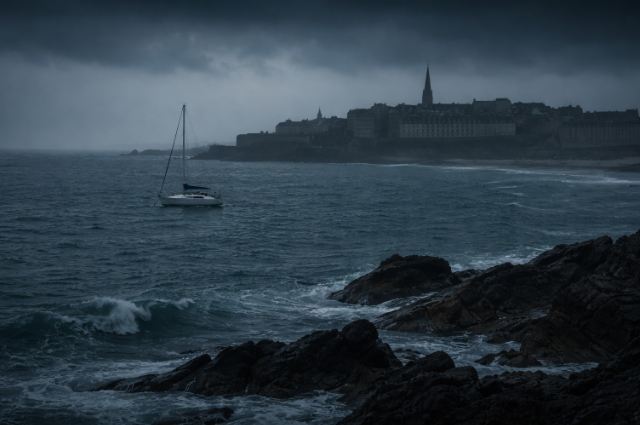
It’s the early hours of a Wednesday morning and the crew of a fishing vessel spots a lifeboat drifting near the French coastline. Inside they find only a jacket and check book under the name of Doctor Yves Godard, A physician from France who had recently vanished at sea with his wife and two children. But what began as a routine missing person’s case would soon spiral into something far stranger. A trail of unsettling evidence, conflicting clues, and increasingly surreal turns, quickly becoming one of the most unusual mysteries Europe had ever seen.
Before Disappearance
It’s a gloomy Tuesday morning and local police got a call about a suspicious vehicle that’s been parked at the Port des Sablons, Saint-Malo for a couple days. It continued presence raised suspicion, prompting the authorities to examine it closely. The vehicle turned out to belong to the same doctor who went missing with his family a week prior. A Volkswagen camper van Model T4 has been sitting right where he left it unnoticed for several days. As soon as the van was open though, it became very clear to the officers that this was no ordinary disappearance. First, significant traces of blood were discovered throughout the whole interior. The volume and distribution suggested a serious, possibly fatal injury. Second, used morphine vials were found discarded, indicating the admission of strong sedatives. And third, cleaning products, including an open bottle of mir, a cleaning detergent, and a can of Yako VX500 motor oil, indicating an attempt to clean or mask evidence. The discovery of the van and his contents marked a turning point. What was initially considered a possible Maritime accident began to appear more like a premediated crime. What took place in his van? Where was Yves and his family? And whose blood was this?
A search of the Godard family home was issued soon after. Situated in the calm and peaceful neighbourhood of Tilly-sur-Seulies. In the living room, significant blood stains were found on the underside of the couch cushions which had been flipped over to hide. More blood was found on the staircase leading upstairs into the master bedroom. Lifting mattress, investigators found a large dark blood stain about 30 cm wide soaked into its underside. Additionally, fine droplets of blood sprayed on a nearby wall at neck height, suggesting a violent wound. There was no sign force entry or burglary. The crime scene appeared to have been deliberately cleaned up. Surfaces were wiped down, and evidence was either hidden or sanitized. After forensic analysis, the blood was confirmed to be from Marie France Godard, Yves’s wife and the mother of his children. With the blood found in the house and the van being confirmed to be hers, the next step was to find a rational explanation of what could have happened that day.
Witness Statement
According to Bernadette Chasles, Godard’s next Neighbour, the family left that morning in the Volkswagen van in a hurry. Around 8:45 a.m., she swaged to the police that she saw Yves, the two kids, and Marie France, who apparently gave her a little wave. Her words, of course, are those of an elderly woman, which are necessarily subject to caution. In reality, Yves had reserved a few weeks earlier a Sunny Odyssey 30, Sailboat from Jeanneau shipyards. And according to the rental company, only Yves and his children showed up that morning. Did Yves kill his own wife? If he did, how did he dispose of her body? The drive between their house and the Port was around an hour and 45-minute journey. Surely, he couldn’t have done it then and especially while his kids are still in the van. As the blood on red mattress and the sofa cushions were turned over to hide the evidence. And the van for its parts, an attempt was made to sanitize it with water and cleaner. The police were confirmed that Yves Godard was no longer a missing person. He was now their prime suspect in what was quickly becoming an international murder mystery.
On September 10th, 1999, A judicial murder investigation is opened. An international arrest warrant is issued against Yves and within a day his profile is uploaded to Interpol’s red notice database. A signal to 190 countries to stop this man if you see him. Every port along the channel was scanned ferry terminals, private Airfields, and customs offices. If Yves was drawn to flee the country, the walls were closing in fast. But despite the days of effort, the sailboat remained missing. The children lost, Marie France gone, and Yves had vanished. one question remained, though. How could a doctor and a family man from Normandy go from a well-known and respected member of his community to becoming the most wanted man in Europe? Who exactly was Yves Godard?
Who Is He?
Long before this whole situation, Yves worked as a doctor in Caen, a midsize city in northwestern France. But he was no ordinary physician. He specialized in Acupuncture and alternative medicine. He ran a small clinic and those who knew him described him as a calm, kind man who’s deeply committed to his work. Among colleagues, Yves stood out for his unconventional yet effective methods. He was soft-spoken and focused. And while he never sought recognition, it often found him. At home, he appeared just as devoted. He lived with his wife Marie France and their two children Camille and Marius in a modest house situated in a quiet Normandy village and Neighbours described them as a peaceful family. Yves would often spend weekends with these kids fishing or playing in a garden. He made time for them in spite of his Hectic Schedule. Marie France was seen as warm and kind, though a bit reserved, friends described her as a loving mother who had overcome personal hardship and found stability with Yves. There were no signs of conflict, no arguments, no disturbances. From the outside, they looked like a balanced, close-knit family. And yet, out of the blue, on a random day, Yves cancels all his appointments, wraps up his remaining tasks, and quietly shuts his clinic.
Investigation and Sightings
Days later, he’s wanted internationally for a crime no one could have ever imagined him capable of committing. But there was no time to understand his reasons. The police were already running against the clock. And as investigators began tracing his last known steps, the last confirmed sighting of Yves by French Authorities was on the evening of September 2nd, 1999. French customs officers aboard a patrol vessel were conducting a routine maritime inspection of the coast of Brittany between Cap Fréhel and Cap d'Erquy. They approached a sailboat that was running on engine power despite calm seas and perfect wind. This sailboat named Nick, the boat Yves had rented just a day earlier. After boarding the boat and checking their papers, nothing seemed out of the ordinary except for a persistent gut feeling the officers couldn’t shake. One of them would later recall that something felt off. So much so that he made a passing comment to his colleagues. That guy gave me a weird vibe, like a man who had just thrown his wife overboard. In hindsight, this remark feels less like a casual joke and more like a spontaneous revelation, an unconscious insight that brushed too close to the truth. They didn’t know this at the time, but Marie France was already missing and her blood had already soaked through the family home.
The Nick was later seen anchored in Bréhec bay. Over the following day or two, several witnesses recalled seeing Yves and his two children in the area. On September 4th, hikers walking along the Cliffs of Pointe de Minard noticed the Nick slowly drifting at Bréhec Bay, apparently empty with no one on board. This would be Nick’s final verified sighting. On the 16th, 11 days after the dingy was found, amateur sailors of the coast of the Channel Islands of Guernsey and Alderney discover a Life jacket floating offshore. The jacket was traced back to the Nick. Then on a 23rd, a life raft was recovered near Bridport on England’s southern coast. At first glance, the evidence all pointed to a maritime disaster. Did the Nick sink? Did Yves and his kids drown out at sea? But closer inspection revealed the opposite.
Findings
The canvas canopy seemed to have been slashed cleanly with a blade, and the gas cartridge that inflates the raft was missing. More importantly, the raft was discovered weeks after the supposed accident at sea. Yet, the raft seemed in pristine condition, like it was deployed only a few days earlier. It appeared like the raft didn’t merely drift there over time, but had likely been placed deliberately. There was no debris from the nick that was ever recovered. No snapped mast, no torn sails, no hole fragments, normal debris one can expect to find after an accident at sea. It seemed like someone was trying to stage a faux shipwreck. On October 2nd, 1999, out of nowhere, the police brigade receive an anonymous letter in the mail. The letter simply reads,
“Dr. Yves Godard is indeed alive. He lives in the Irish sea on the aisle of man. Take this Seriously.”
The letter had no signature, No dates, and no usable fingerprints. French authorities immediately reached out to local police on the British Island. Surprisingly, officers on the island of man confirmed a French man accompanied by a boy and a girl did stay at the Mannin Hotel. An employee at the Tourist’s office recounts how a man with a young boy and girl came in asking for a room for 4 to 5 days. She told him that all partnered hotels were full and offered to take his contact info, but he declined. Unfortunately, the surveillance cameras were down for 2 days, precisely the time the trio was allegedly seen. Soon after, a hotel owner on the island claimed he too hosted a French man with two children between September 7th and the 14th. According to him, their appearance perfectly matched that of Yves Godard, Camille and Marius. Both testimonies, the hotel owners and the tourist office employee seemed credible, but no hard evidence confirms their identity.
Remote Islands
As the mystery deepens, the investigators began to ask questions. Did these witnesses truly see Yves, or were they projecting a familiar face onto strangers? Godard was deliberately only stopping in remote islands, which he knew were harder to trace, sparsely populated, and hard to survey. The further north he went, the less likely French authorities could catch up to him quickly. This would be a good time to mention that Yves was an experienced sailor and these Islands were most likely familiar territories to him. He was more at an advantage being at sea than on land. But after further investigation, it became clearly obvious that this whole thing was planned way ahead of his time. The deeper the investigators went, the clearer it became to them that this was premediated. That each step from the route taken to see to the seemingly stage debris suggested long-term planning. And the more they dug into Yves’s past and personal life, a new much darker person came to light instead.
Medical Practice to Cult Joining
The Yves Godard everyone knew, the kind, soft-spoken doctor devoted to his patients and children, was only half the truth. Since getting into a relationship with Marie France, Yves had gradually began distancing himself from his former circles. His loved ones barely recognized him anymore. He slowly immersed himself in various spiritual practices. He even goes so far as to approach the IVI cult or Invitation à la Vie, a controversial French spiritual movement founded in the 1980s, mixing elements of Christianity with alternative healing practices and beliefs, a group that Marie France was also involved in as she tried to align herself with her husband’s spirituality. This connection to IVI doesn’t seem accidental. The Nick, which had been spotted at the cove of Bréhec Bay, was anchored just steps away from the home of Yvonne Trubert, the very founder of the IVI movement. In any case, it was now far too late to hope for clear answers from Yvonne.
CDCA
Months have passed since the family’s disappearance, and if she had any connection to the case, she had more than enough time to cover her tracks. This lean would ultimately go nowhere, leaving the sectarian connection as a strange and unresolved footnote in the story of the missing doctor. And yet, Yves's dive into spirituality seems to mark a turning point. As he became more deeply involved in esoteric practices, it’s clear he’s searching for more than just inner peace. He begins to reject all established structure until eventually it’s the entire system he seems to be calling into question. Among the many documents reviewed by investigators, one in particular stands out.
An information sheet bearing the acronym CDCA, short for at first glance, the CDCA presents itself as a union defending small business owners, artisans, and independent workers. Its stated mission is to oppose the monopoly of France’s social security system and the growing weight of taxation on professionals. But behind this facade, the CDCA reveals a much different face. Very quickly, their protests take a radical turn. Refusal to pay any social contribution, calls for civil disobedience, and increasingly aggressive demonstrations. Eventually, members of the union simply stopping the state a single scent. At the head of the movement is a man named Christian Poucet.
A controversial figure known to the police convicted to two years in prison for threatening a magistrate. Under his leadership, the CDCA crosses red lines. It is an opaque organization with murky ties to organized crime. Christian Poucet doesn’t just promote tax rebellion. He encourages his members to entrust him with their money, promising to protect it by placing it in tax havens far from the eyes of the French government. From the moment he joins, Yves gets involved while staying true to his discrete nature with no protests, no visible action. To maintain his image as a respectable doctor, he opts for a quieter role, handling administrative tasks. However, he does more than work behind the scenes. He fully embraces the movement’s ideology. He stops paying taxes, gives up his pension, severs all financial ties with his state, and eventually transfers all his assets, his children. Legally, he no longer owns anything, and therefore has nothing to be seized. In return, the CDCA offers him workarounds: health insurance in England, offshore investments, and bank accounts in tax havens.
This discovery changes everything like how could a previously outstanding family man become entangled in such a shady network? And what if behind this reserved doctor was a far more prepared man than anyone ever imagined? A man with discrete connections capable of activating a parallel network of not just radical political actors but also spiritual followers to throw off investigators to stage disappearances and to reinvent himself somewhere else. The police’s investigation into the CDCA was cut short after receiving a second anonymous letter. This one read,
“Dr. Yves Godard is in the Hebrides region or precisely Lewis. Save Camilie and Marius.”
Despite its anonymity, it was a lead they couldn’t ignore. Whoever this was, they seemed to know something no one else did. Behind the scenes, Investigators began referring to the sender by the nickname of the Crow. Just 2 days later, the French police received a new lead. A local employee on Lewis Island recalled selling a roundtrip ferry ticket to a French man traveling with two young children. French investigators would act in haste, but failed to coordinate properly with the Scottish Crown Office. A necessary step for conducting law enforcement operations on UK soil. As a result, the Edinburg police intervened. The investigation was deemed diplomatically inappropriate and the operation was shut down before any arrest could be made.
Another Lead
On 27th, the French police left Lewis empty-handed and the trail goes cold again. It’s the 16th of January, 2000, While the police were following one mysterious lead after another, a new development had already occurred precisely, one buried beneath the sea. A fishing vessel near Île de Batz coast pulls in their net to find a canvas travel duffel bag tangled in it. Inside was a multitude of Yves’s personal belongings. Soon after, more of Yves’s personal belongings began washing up near Ébihans archipelago, a place he had visited often in his youth to go sailing. Among them are business cards, a bank card, and his professional medical license but something immediately stood out. The items are in almost perfect condition, surprisingly well preserved for something that should have spent years in the ocean. That is when a new theory takes shape. What if these items did not drift ashore naturally? What if someone had deliberately placed them there? Long after the disappearance, in order to mislead investigators, but who would that be and why, one name quietly resurfaced, the CDCA.
This secretive organization that Yves was involved in may be holding more answers than anyone imagined. The police would head to the office of the CDCA president to try and get information out of him. He would give them a record of a bank account opened in Portugal under Yves's name whose main shareholder is none other than Christian Poucet himself, but the hope is short-lived. When they access the account, they find that no transactions have been made since 1997 and a balance of around 2,800 Francs. Behind the image of a protective union, the CDCA hit another phase. Officially, they promised to help members escape tax pressure. In reality, the people who insured their money lost ownership of it. Yves, like thousands of other small shopkeepers and artisans, may have seen his account emptied without his knowledge. What if Yves had become a victim of this large-scale scam and was trying to recover his money by any means necessary? If Yves really was dead, maybe his death was no accident. But the investigation into Christian Poucet would come to an abrupting halt when out of nowhere, Christian is mysteriously assassinated.
His untimely death only raised more questions. Was the God family investigation threatening certain interests? Or was it just a coincidence? The shadows surrounding the case only deepened. Not long after, the doctor’s insurance broker, another key figure in the CDC’s financial web, also dies under suspicious circumstances. During take-off for a private flight from the Montpellier airfield, both engines of his planes would cut out, causing the Aircraft to crash. When investigators examined the wreckage, they found the fuel tanks completely empty, despite the gauges indicating they were full. Could the experienced pilot really have forgotten refuel? Or had the plane been sabotaged? The financier’s death raised even more questions because he was directly responsible for managing an intricate network of offshore companies stretching from southern France to England to the aisle of man, the same place where Yves and his children were reportedly seen multiple times. With Christian Poucet dead and leads vanishing fast, what little remained of the CDC’s trail, pad already went cold.
Physical Remains
On the night of June 5th, 2000, a fishing vessel working on the Bay of Saint-Brieuc pulled something unexpected from its nets. It was a fragment of a human skull. A few hours later, the crew recovered another bone, also human. The remains were transferred for forensic examination, and after 2 weeks the results came in. They belonged to Camille Godard. She was only 6 years old at this time. Until then, there had still been hope that Yves had fled with his children and were possibly still alive somewhere under new identities. The discovery of Camille’s remain shattered that hope completely. But this hope would completely die out only 6 years later when a fishing boat operating over Hurd’s Deep, a deep underground trench in the English Channel hauled up two more fragments of human bones in their net, a femur and a tibia. The remains were quickly sent off for forensic testing and the results, the bones were confirmed to be Yves Godard’s. His death was now officially confirmed. Instead of bringing clarity, however, this discovery only deepened the mystery. If Yves had truly vanished at sea in 1999, why did it take 7 years for his remains to appear? Still without any traces of the sailboats? And why here of all places? Hurd’s Deep is no ordinary stretch of seabed. It’s an immense underground trench known for being used as a dumping ground for toxic waste and discarded materials. Accessing it is challenging, and conducting a thorough search is even more difficult. This is where someone would take a body if they intended to get rid of it permanently. Then, only days after the remains were identified, a new letter arrived. It was anonymous, but there was no doubt that this came from the crow. What was strange about this letter, however, was that it wasn’t a plea for help or a new lead. Instead, it claimed to know where Marie Frost’s body was buried.
On the back, it had a map directing the police to the back edge of the town cemetery, specifically to a garbage pit behind the fence. Searching the spot, buried just beneath the surface, the police discover fragments of human remains, including parts of his skull, a tibia, kneecaps, and bones from an arm. There was no clothes or jewellery, and the bones had been placed shallowly in the ground. After weeks of forensic testing, the DNA results came back inconclusive. The bones had decayed to a point where proper DNA comparison was implausible. But now the authorities were left with even more questions. If the bones weren’t Marie France, then whose were they? And how did the sender or this Crow know where to find them? How did the Crow know where Yves had been? And why were they trying to help the police locate him? Had they been involved? Did they witness something? Or were they part of a larger effort to manipulate the investigation this entire time? From that point on, the Crow would vanish and no new leads emerged. The investigation stalled and on September 14th, 2012, the French justice system officially closed the case. All that remained was the confirmed death of a father and his daughter. Although the likelihood of an accident was excluded, murder could not be formally declared either. As for the disappearances of Marie France and her young son , they remained even today without answers.
With the case officially closed, all that remains are fragments. A mother, a son, a father, and a daughter who all disappeared without a trace. A trail of personal items scattered in strange locations. Letters from a person who seemed to know too much and the quiet, deliberate movements of a man who, by all accounts, had flew underneath the radar for 7 years. The deeper investigators looked, the more it felt like someone had planned all of this in advance. The boat, the route, the stage debris, even the timeline of events. It all seemed designed to confuse, but some questions still hanged over the case even now. Why was Yves boat seen near the home of the IVI cult leader shortly after the disappearance? Was the CDCA involved in more than just the financial schemes? Why was Christian Poucet executed in cold blood when the police started investigating him? Who was the Crow? Were they helping out of guilt or were they involved from the start? And the most difficult question of all, did Yves Godard really kill his wife or was he set up this entire time? After all these years, all these questions still remain unanswered. And that’s the most unsettling part that after so much time, so much investigation, and so much loss, the truth may never come to light.