
Every morning in New Delhi began the same way for Renuka. Sundar’s alarm rang before sunrise, the kettle hissed softly, and the faint smell of coffee filled their small apartment. Sundar spoke little during breakfast—not because he didn’t care, but because routine had dulled words over time. At exactly 8:15 a.m., he adjusted his shirt cuffs, smiled at Renuka, and stepped outside. The door closed gently, almost apologetically, as if it knew it was leaving her behind with hours that felt heavier than they should.
Renuka remained seated long after the sound of his footsteps faded. The house grew quiet, not the peaceful kind, but the kind that echoed. Years earlier, doctors had explained her condition with sympathy and finality. She listened calmly, then nodded, and thanked them. She had learned quickly that tears changed nothing. But acceptance did not remove longing—it only taught it to settle deep inside her chest, where it waited patiently.
Every afternoon, Renuka stood on her balcony. She watched children run across the courtyard, watched mothers call them back, scold them, feed them, pull them into protective arms. She never looked away quickly. She believed that watching was a way of keeping hope alive, even when hope had nowhere to go.
One day, that routine broke.
Renuka noticed a woman standing near the vegetable shop downstairs, her voice unsure, her Hindi broken, her hands moving awkwardly as she tried to explain what she wanted. The vendor grew impatient. People stared. The woman apologised too many times.
Renuka stepped forward without thinking.
She translated gently, smiled reassuringly, and finished the conversation. The woman’s relief was immediate. She introduced herself as Deepa, newly arrived from Tamil Nadu with her husband, Prasad. Like Renuka, she spent her days alone while her husband worked long hours.
Their friendship formed slowly, naturally, without intention. They cooked together, shared tea in the afternoons, complained about Delhi’s heat, and waited every evening for the sound of keys in the door. They never spoke about loneliness directly, but it lived between them, acknowledged without words.
When Deepa announced her pregnancy, Renuka’s smile came easily—but her breath caught. She congratulated her warmly, hugged her tightly, and then went home and cried behind a locked door. She did not resent Deepa. She resented fate. Still, the next morning, she chose to love.
Renuka became Deepa’s constant support. She walked beside her slowly, held her hand on crowded stairs, fed her when nausea stole her appetite, and spoke softly to the unborn child when Deepa rested. On a quiet night, when Deepa went into labour and no one else was home, Renuka acted without fear. She carried her, rushed her, stayed with her.
When the baby cried, Renuka felt something awaken inside her.
She held him first.
The weight of him felt familiar, as if her arms had been waiting.
“Aditya,” she whispered.
Aditya grew up belonging to two houses, but his heart leaned naturally toward Renuka’s. He slept in her home more often than his own, listened to her stories, followed Sundar around like a shadow. Deepa and Prasad never questioned it. They understood something deeper was at work.
Renuka never tried to replace his mother. She simply existed for him—steadily, patiently, lovingly.
When Prasad received a Singapore posting, the departure came suddenly. On the last day, Aditya slept deeply, exhausted from play. Renuka stood beside him for a long time, knowing she could wake him, knowing she couldn’t.
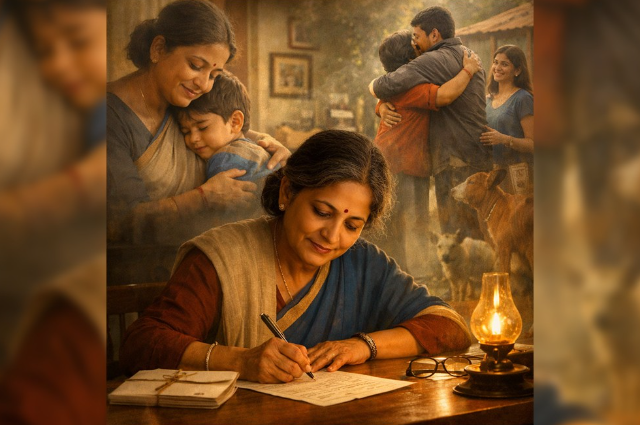
Instead, she wrote a letter.
Every word carried what she couldn’t say aloud. Advice, love, assurance. A promise that distance could not erase connection.
She watched the flight leave the sky.
And returned home to silence once again.
Years passed.
Aditya grew into success in Singapore, but not freedom. His life was filled with expectations—business, responsibility, obedience. On his birthday, his father announced his marriage as if it were a project timeline.
That night, Aditya found Renuka’s letter.
He read it slowly.
For the first time, he remembered what it felt like to be chosen.
He packed his bags and left.
Malleswari, known as Malli, worked in Singapore as a project coordinator. She had come there to earn, to support her widowed mother in Vizag, to stand on her own feet. Airports still confused her. That night, fear followed her more than courage.
She took the wrong corridor. Stood in the wrong line. Saw Aditya walking confidently and followed him instinctively, afraid of being left behind.
When he stopped suddenly and asked why she was following him, she froze.
“I’m sorry… I don’t know where to board.”
That was all.
No destiny. Just human confusion.
They boarded the same flight. During the long hours, silence slowly turned into conversation. Aditya spoke about Renuka. About the letter. About running away.
Malli listened without judgment. She didn’t try to rescue him. She simply allowed him to exist honestly.
In Delhi, they depended on each other practically. She spoke Telugu when needed. He navigated the city. Slowly, quietly, affection grew—not dramatic, not declared, but steady.
Finding Renuka took time.
The sanctuary felt alive. Birds, animals, plants—all nurtured with care. Malli understood instantly that this place was built from loneliness turned into purpose.
When Renuka saw Aditya, her knees weakened.
Time folded.
When Aditya’s parents arrived unexpectedly, anger replaced peace. Aditya felt trapped again.
At the airport, Renuka spoke firmly.
“Running avoids pain. Speaking transforms it.”
Those words stayed.
Aditya returned to face his parents. He spoke honestly—for the first time.
About fear. About love. About Malli.
Malli stood beside him—not asking, not begging.
His parents listened. The wedding was simple. The sanctuary grew. Children laughed again. Renuka watched with peace. Because motherhood is not about birth. It is about presence.