
Aarav arrived in San Francisco in early August, a man shaped more by the roads he had walked than by the wealth he had inherited. Born into an established Tamil business family, he carried money the way other people carried umbrellas—useful, but never worth showing off. He spent his days drifting between continents, helping strangers simply because kindness felt more valuable than currency, and finding meaning in places where people rarely looked for it.
He expected nothing extraordinary from the city except its fog, its steep streets, and it's quiet. But life does not always announce its turning points.
He first saw her on Indian Independence Day, at a small gathering near the waterfront. Families had draped themselves in tricolour shawls, children were running with kites, and the air was warm with the smell of chai and cardamom. In the middle of the cheerful noise stood a woman draped in a gulabi cotton-silk saree, soft as early dawn. She stood alone, hands clasped, eyes lowered—not lonely, but distant, as though her thoughts were somewhere far behind her.
Aarav offered her a seat. She accepted with a polite nod. She introduced herself only as Lakshmi Rajyam, her voice calm, dignified, carrying the faint trace of Telugu. He did not ask more; she did not offer more. They spoke lightly, almost cautiously, like two people who sensed each other’s silences before their words. When the event ended, they walked their separate ways, never imagining that the city had already chosen to weave their paths together.
Days passed. Then the coincidences began. Aarav saw her again outside a bookstore where she stood staring at a window display without really seeing it. Later, he saw her at a South Indian café, quietly stirring her coffee as though trying to dissolve something unspoken. He saw her one evening in the thick San Francisco fog, trying to locate an address on her phone, looking momentarily lost in a world she lived in but didn’t belong to. Each time, he offered help, and each time, she accepted with a soft gratitude that felt older than words.
Lakshmi had come to San Francisco for a business meeting. Her family lived abroad; her husband and grown children loved her deeply. Yet she carried a loneliness that no one else could recognise, for she had learned long ago how to smile without revealing the ache behind it. Her life was comfortable, respectable, and admired—but she confessed once, during a long walk along the bay, that San Francisco felt like a beautiful cage. A cage where the fog hid sorrows too quietly, and the city lights watched too closely.
She never resembled a woman running from her life. She resembled a woman who found no place inside it to rest.
In the third week, she wore a yellow handloom saree with a thin blue border when they went to a small Indian grocery store. Aarav walked beside her, carrying a basket of spices. That was when two Telugu women recognised her. Their faces lit with surprise. They called her “Athiloka Sundari,” praising her, reminding her of something she had left behind. Aarav looked at her, eyebrows raised. She sighed gently and said, “Long ago, I acted… only for some time. That part of my life is finished.”
He didn’t react with admiration or excitement. Instead, he simply nodded and said, “Alright.” And that was the moment Lakshmi realised why she found peace in this stranger: he cared for her humanity, not her shadow.
Later that week, a Telugu producer from India called her, offering a supporting role in a new film, telling her it would be a perfect return. Lakshmi listened politely, letting him praise her past. When he finished, she said, with a calm finality, “I am not that person anymore. Please understand.” Then she hung up and quietly wiped her eyes before the tears could fall.
During their time together, Aarav never pried into her sorrows. Instead, he simply listened. They spoke about Tamil harvest festivals and Telugu Sankranti traditions, about their childhood streets, about the kindness of neighbours from decades ago. Aarav told her about his travels, about the people he met in forgotten corners of the world. Lakshmi told him about her family—how much she loved them, how much she missed them, and how sometimes, despite that love, she could not find a moment of silence inside her own heart.
One evening near the end of the month, she wore a blue saree when they had tea at a small hillside café. Aarav noticed that she looked calmer than usual, but her eyes held a faraway softness, like someone watching a memory pass by. The month was ending. Her meetings were over. Her flight was booked. The city was preparing to say goodbye to her.
On her last night, she called him. Her voice was steady but carried something fragile beneath it. “Aarav… could you come to the airport? I need to see you before I leave.”
She had never asked him for anything until that moment.
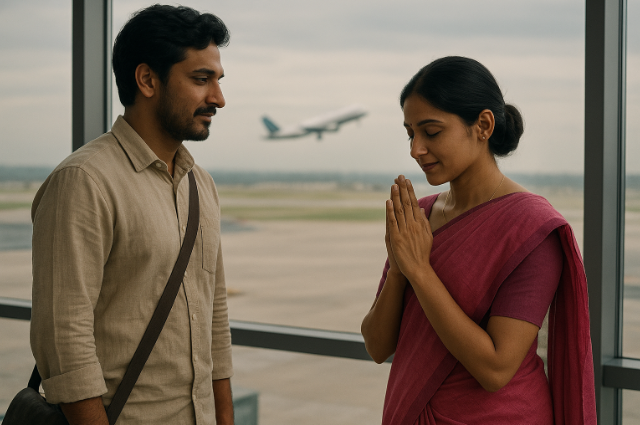
He reached the airport to find her standing by the large glass windows, wrapped again in a deep gulabi saree, the colour softer in the airport lights. She didn’t greet him immediately. She looked at him with a mixture of relief and uncertainty, like someone afraid to speak the truth she had carried for too long.
“I don’t know what this month has been,” she said finally, her voice lower than usual, “but it changed something. You gave me a kind of peace I did not know I needed.”
Aarav smiled gently. “You used to be a star. You could have forgotten people easily. But now…” He paused, letting the words settle. “Now you are a chairperson. And you still won’t forget me.”
She laughed softly, despite the tears shining in her eyes. “I won’t. Not because of who you are… but because of who I became when I was around you.”
Her flight was called. She took a step back. Then another. But she stopped before turning away and whispered, “Thank you for treating me like a person, Aarav. Not a title. Not a memory.”
She folded her hands in a gentle namaste. He returned it with the same warmth.
As she walked toward the boarding gate, her steps slowed, as though she wished to turn back one last time. And she did. Their eyes met across the distance — not lovers, not friends, but two wandering souls who had met at the right moment, even if it was only for a fleeting month.
Then she disappeared into the tunnel of light, leaving behind a silence he carried like a rare gift.
Aarav remained by the glass wall long after her plane had taken off, watching the sky swallow the silver wings. He knew she would return to her family, to her responsibilities, to the world that needed her. And he knew he would return to the road, to the strangers whose stories were waiting for him.
But for the rest of his life, whenever he thought of San Francisco, he would remember a woman in a gulabi saree who found peace for a brief moment in the presence of a traveller who expected nothing in return.
And somewhere far above the clouds, Lakshmi Rajyam closed her eyes, realising that some strangers do not enter your life to stay—they enter it to remind you that you are still capable of feeling something deep, gentle, and true.