
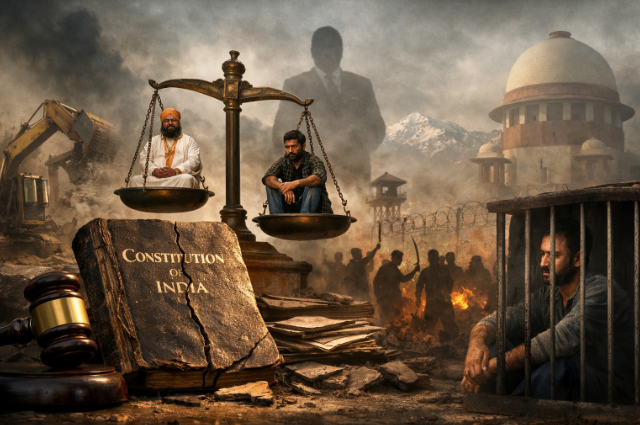
This article provides a critical post-mortem of the Indian constitutional landscape between 2020 and 2026, arguing that the Republic has transitioned into a state of “Procedural Autocracy.” By analysing the “Differentiated Jurisprudence” applied to political dissenters versus influential convicts, the author demonstrates how the “Rule of Law” is being systematically replaced by a “Rule by Law.”
The study centres on the ”Bail-Parole Paradox,” contrasting the 2026 Supreme Court rejection of Umar Khalid’s bail—grounded in the restrictive Section 43D(5) of the UAPA—with the 15th executive parole granted to convicted murderer Gurmeet Ram Rahim Singh. The article further explores the weaponisation of retrospective laws in the prosecution of Arundhati Roy, the erosion of federalism in the detention of climate activist Sonam Wangchuk under the NSA, and the state’s abdication of its monopoly on violence in the face of rising mob lynching.
Utilising a framework of “Constitutional Morality” as envisioned by Dr B.R. Ambedkar, it is argued that the spirit of the Constitution is being hollowed out through the selective use of municipal codes and special statutes to bypass due process—a trend exemplified by the rise of “Bulldozer Jurisprudence.” The article concludes with a call to the Bar and the Bench to reclaim their roles as the “sentinels on the qui vive,” asserting that the restoration of the Republic requires a return to a unified legal standard where the law acts as a shield for the powerless rather than a sword for the powerful.
The Erasure of Constitutional Morality: From Transformative Vision to Procedural Autocracy
The Indian Constitution was never intended by its framers to be a static document or a mere administrative manual for the governance of a post-colonial territory. It was, in the words of Dr B.R. Ambedkar, a “transformative” instrument designed to bridge the chasm between a deeply hierarchical traditional society and a modern, egalitarian democratic order. Central to this vision was the doctrine of “Constitutional Morality.” This concept, which Ambedkar famously borrowed from the historian George Grote, posits that the survival of a democracy depends not just on the text of its laws, but on a shared commitment to the spirit of those laws—a spirit that mandates fairness, the protection of the individual against the state, and a profound respect for the “soul” of the legal process. In Ambedkar’s view, the letter of the law is a hollow shell if it is not animated by a morality that restrains the majority from trampling upon the minority and prevents the executive from assuming the role of the judiciary.
However, as we navigate the fraught political and legal terrain of 2026, we are witnessing the systemic erasure of this morality. It is being replaced by what legal scholars now describe as “Procedural Autocracy.” This is a state of affairs where the government utilises the literal text of statutes—often “Special Laws” enacted under the guise of national security—to bypass the fundamental rights guaranteed in Part III of the Constitution. In this regime, the “Rule of Law” has mutated into “Rule by Law.” The law is no longer a shield for the citizen; it is a surgical weapon in the hands of the executive, used to excise dissent while insulating power.
The current landscape is defined by a “Differentiated Jurisprudence.” This is a dual-track system where the judicial and executive response to a legal crisis is dictated not by the nature of the offence, but by the identity and political utility of the offender. For the dissenter, the intellectual, and the marginalised, the legal system is a labyrinth of “statutory bars” and “special courts” designed to ensure indefinite incarceration without a verdict. For the loyalist and the influential convict, the system is remarkably elastic, offering a “revolving door” of paroles, furloughs, and administrative leniency. This article examines the collapse of the Rule of Law through a post-mortem of the Indian Republic’s current state, focusing on the architecture of judicial asymmetry, the weaponisation of retrospective laws, the erosion of federalism, and the systemic marginalisation of the minority.
Chapter I: The Architecture of Judicial Asymmetry – Khalid vs. Ram Rahim
In the winter of 2026, the Indian Republic stands at a jurisprudential crossroads that threatens to permanently bifurcate the concept of Indian citizenship. For an advocate, the law is expected to be a predictable, objective yardstick—a set of rules that apply with blind equality to every individual regardless of their creed or creedal convictions. However, the current landscape suggests the emergence of a “Dual-Track Justice System” that has effectively dismantled the fundamental promise of Article 14—the right to Equality before the Law. The most visceral and heartbreaking evidence of this rot is the contrasting treatment of pre-trial political detainees like Umar Khalid and convicted criminals like Gurmeet Ram Rahim Singh. Their divergent paths illustrate a disturbing reality: in modern India, the “process” has become the punishment for the dissenter, while the “punishment” has become a mere administrative inconvenience for the powerful.
The Fortress of UAPA: The Case of Umar Khalid and the Death of “Bail is the Rule”
Umar Khalid has been in custody since September 2020, arrested under the draconian Unlawful Activities (Prevention) Act (UAPA). On January 5, 2026, the Supreme Court delivered a 142-page judgment that many legal scholars view as a “Constitutional Abdication.” Despite spending over 1,940 days in prison—exceeding five years of a life he will never get back—the Court denied him bail. The Court’s reasoning was anchored in the assertion that Khalid’s role in the alleged “larger conspiracy” of the 2020 Delhi riots placed him on a “qualitatively different footing” than co-accused individuals who had previously been granted relief.
As advocates, we must scrutinise the technical barriers used to justify this state-sanctioned theft for years. The primary tool is Section 43D(5) of the UAPA. This provision is a jurisprudential anomaly in a democracy; it mandates that a judge must deny bail if the prosecution’s version is prima facie true. Since the landmark Watali judgment of 2019, Indian courts have been effectively prohibited from “weighing” evidence at the bail stage. They are instructed to accept the prosecution’s narrative—no matter how tenuous, hearsay-based, or inconsistent—at face value.
In the 2026 Khalid verdict, the Supreme Court took this surrender of judicial oversight even further. While the bench acknowledged the constitutional right to a speedy trial under Article 21, it introduced a chilling “sliding scale” of culpability. The Court argued that because the allegations painted Khalid as an “architect” of a conspiracy rather than a mere “facilitator,” his five-year incarceration had not yet crossed the “threshold of unconstitutionality.” This creates a terrifying precedent. If five years of pre-trial detention, during which the trial has barely moved past the stage of framing charges, does not cross the threshold, then the threshold effectively does not exist. By deferring his right to seek bail for another year, the Court has sanctioned “preventative internment,” turning the judiciary into a silent spectator to the executive’s whims and signalling that for some, the presumption of innocence is a dead letter.
The Revolving Door of Mercy: The Case of Ram Rahim and the Executive’s Leniency
Contrast this fortress of “statutory thresholds” with the fluid, almost generous, liberty granted to Gurmeet Ram Rahim Singh. Here is a man whom the judicial system has already found guilty beyond a reasonable doubt of the most heinous crimes—rape and murder. Yet, on January 4, 2026, just twenty-four hours before Khalid’s bail was rejected, Ram Rahim walked out of Sunaria Jail on his 15th parole.
While Khalid remains a “threat to national security” despite never having been convicted of an act of violence, Ram Rahim is treated with the utmost “reformative kindness.” Under the Haryana Good Conduct Prisoners (Temporary Release) Act, 2022, the state government has found a consistent legal “track” to release him for 40 days at a time. By early 2026, he had spent a total of over 406 days outside jail since his conviction.
The unconstitutional irony is staggering and deeply corrosive to public trust in the law. Parole is an executive decision, and in the case of Ram Rahim, these releases have frequently and suspiciously coincided with electoral cycles in Haryana and Punjab. This suggests that in the current era, “good conduct” is not a character trait to be earned by a prisoner, but a subjective term of convenience reserved for those who hold significant political or social leverage—the “vote-bank” prisoners. When the state grants a convicted rapist the right to “social reintegration” fifteen times in a few years, while denying an unconvicted student leader the right to see his family for five years, it signals that the law is no longer about the crime, but about the utility of the criminal to the state. This is the hallmark of a system where the executive has effectively usurped the judicial function of punishment.
The Erasure of Constitutional Morality: Weaponising the Code
This “Judicial Asymmetry” represents the final collapse of Constitutional Morality. Dr Ambedkar’s warning that “Constitutional Morality” must be cultivated was a recognition that the law is a fragile thing, easily twisted by those in power. It requires that the spirit of fairness prevails over the letter of a harsh statute. It requires a judge to look at an unconvicted man who has been in jail for five years and realise that the state’s failure to conduct a trial is a greater threat to the Constitution than the man himself.
Today, we see the inverse. We see the “Weaponisation of Procedure.” For Umar Khalid, the procedure (the UAPA’s bail bar) is used as a bypass to avoid the Constitutional requirement of a trial. For Ram Rahim, the procedure (the state’s parole rules) is used as a bypass to avoid the judicial sentence of life imprisonment. This is not the “Rule of Law”; it is “Rule by Law”—a state where the law is a shield for the loyalist and a sword for the critic. As legal professionals, we must call this out for what it is: a structural betrayal of the Preamble. If the “innocent” must rot in the name of national security while the “guilty” roam free in the name of administrative reform, the Republic has not just lost its way—it has lost its moral compass.
Chapter II: Retrospective Legal Warfare – Arundhati Roy and the Death of Finality
The bedrock of any civilised legal system is “Legal Certainty”—the principle that a citizen must be able to reasonably foresee the legal consequences of their actions at the time they are committed. This principle ensures that the law is not a trap but a guide. However, the decision in June 2024 by the Delhi Lieutenant Governor to sanction the prosecution of Booker Prize-winning author Arundhati Roy and former professor Sheikh Showkat Hussain for a speech delivered in 2010 signals the birth of a “Retrospective Autocracy.” This move represents a tectonic shift in Indian criminal jurisprudence, where the state no longer seeks to prevent crime in the present but to curate the past for political retribution.
Weaponising the Statute of Limitations: The Ethics of Delay
Under the Bharatiya Nagarik Suraksha Sanhita (BNSS)—which replaced the CrPC—and even under the legacy code, there are clear periods of limitation for taking cognisance of offences to ensure that trials are fresh and evidence is reliable. While Section 468 of the legacy code provided a shield against stale prosecutions, the state has utilised the “Special Law” status of the Unlawful Activities (Prevention) Act (UAPA) to bypass these traditional safeguards. By reaching back 15 years to exhume a seminar speech titled “Azadi: The Only Way,” the state is not seeking justice; it is practising “Political Archaeology.”
As an advocate, one must argue that such “stale” prosecutions are a fundamental violation of the Doctrine of Laches and the right to a speedy trial under Article 21. A delay of a decade and a half is not merely an administrative lapse; it is a calculated choice. If the speech made in October 2010 was truly a threat to the sovereignty and integrity of India, the state’s decision to remain dormant for fourteen years defies the very logic of national security. The revival of this case in 2024, sanctioned specifically under Section 13 of the UAPA (which deals with advocating or inciting unlawful activities), suggests that the law is being used as a tool of retrospective discipline. It tells the citizenry that no act, no matter how distant, is truly settled, and no “closed chapter” is safe from the state’s retrospective gavel.
The Chilling Effect on Article 19: The “Kashmirization” of Dissent
The prosecution of Roy and Hussain bridges a dangerous gap between the “exceptional laws” of Kashmir and the “normal” laws governing mainland India. This represents what scholars call the “Kashmirization of Mainland Jurisprudence.” For years, the UAPA and other preventive detention laws were used in the Kashmir valley as tools of statecraft; today, they are being exported to New Delhi to silence intellectuals and authors.
The complaint centres on the assertion that Roy claimed Kashmir was never an “integral” part of India—a statement that, while controversial, was made in the context of an academic and political seminar. By invoking Section 13 of the UAPA, the state has effectively equated “dissenting speech” with “terrorist activity.” This has a catastrophic “Chilling Effect” on Article 19(1)(a). When the state demonstrates that it has a fifteen-year memory for a single seminar speech, it ensures that every journalist, academic, and student in 2026 practices a form of preemptive self-censorship. The fear is no longer just of being arrested today, but of having one’s past audited by a future regime with different political sensitivities. This weaponisation of time ensures that the “Marketplace of Ideas” is replaced by a graveyard of silenced opinions.
The Selective Application of Sanction
As legal professionals, we must also note the selective nature of the Prosecution Sanction. In October 2023 and subsequently in June 2024, the Lieutenant Governor granted permission to prosecute under the UAPA while notably excluding the charge of Sedition (Section 124A IPC), which had been stayed by the Supreme Court in 2022. This “pivot” to UAPA highlights the statute’s role as a convenient substitute for sedition.
Where the sedition law failed due to judicial scrutiny, the UAPA provides a sturdier, more draconian vehicle for the same objective: the criminalisation of political thought. The state’s ability to selectively “pick and choose” which century-old or decade-old statements to prosecute—while ignoring more contemporary incitements to violence by political loyalists—is the ultimate proof of a differentiated legal setup. It is a system that uses the long arm of the law not to reach for justice, but to reach for the throat of its critics.
Chapter III: The Siege of Ladakh – Sonam Wangchuk and the Erasure of Federalism
The constitutional crisis of 2025-2026 is not merely a matter of individual liberty; it is a crisis of regional identity and the survival of the federal spirit. The detention of Sonam Wangchuk—one of India’s most celebrated innovators and an environmental icon—under the National Security Act (NSA) in late 2025 serves as a terrifying case study in the criminalisation of regional aspirations. For an advocate, the Wangchuk case is a clear signal that the state no longer distinguishes between a “protester” demanding constitutional rights and a “traitor” threatening the sovereignty of the nation.
The Betrayal of the 6th Schedule: From Hero to “Anti-National”
Ladakh’s demand for statehood and the protection of its fragile ecology under the 6th Schedule of the Constitution is a demand for the fulfilment of a promise made during the reorganisation of Jammu and Kashmir in 2019. Inclusion in the 6th Schedule, which grants tribal populations autonomous governance over land and resources, is seen as essential for a region with a 97% tribal population. For years, Wangchuk led peaceful, Gandhian hunger strikes in sub-zero temperatures to remind the Union government of its electoral manifesto.
However, the narrative shifted dramatically on September 24, 2025, during the “Final Fast.” When a long-standing peaceful protest turned violent in Leh, resulting in the deaths of four young demonstrators and injuries to dozens of security personnel, the state’s response was swift and disproportionate. Instead of engaging in dialogue, the Union Home Ministry and the Ladakh administration branded Wangchuk an “instigator” with “foreign links,” accusing him of inciting an “Arab Spring-style” revolt. On September 26, 2025, just before he was to address the media, Wangchuk was arrested under the NSA and transported 1,600 km away to Jodhpur Central Jail in Rajasthan.
The Weaponisation of the National Security Act (NSA)
As advocates, we must highlight the grave procedural lapses and the strategic use of the NSA in this case. The NSA is a preventive detention law that allows the state to incarcerate an individual for up to 12 months without a trial, a charge, or even the immediate right to a lawyer. In the habeas corpus petition filed by Wangchuk’s wife, Gitanjali Angmo, before the Supreme Court, it was pointed out that the grounds for his detention were based on “stale FIRs” and “vague imputations” that lacked any direct link to the September violence.
Furthermore, the authorities failed to provide the very video evidence they claimed proved his “provocative” nature until 28 days had passed—a clear violation of Section 8 of the NSA, which mandates communication of grounds within 5 to 10 days. By the time the Supreme Court began hearing the matter in late 2025, Wangchuk had already spent months in a high-security prison far from his native climate and legal support. This is the “De-territorialization of Justice”: by moving a regional leader to a distant state, the government effectively severs their connection to their movement and their community.
Federalism as a “Convenient” Theory
The Wangchuk detention represents a direct assault on the Public Trust Doctrine. When a citizen is jailed for reminding the government of its own constitutional promises, the “Rule of Law” is replaced by the “Rule of the Administrator.” The use of the CBI to investigate Wangchuk’s educational institution (SECMOL) and the cancellation of its FCRA license alongside his arrest show a coordinated effort to dismantle the institutional pillars of regional dissent.
In a federation, regional aspirations are supposed to be the lifeblood of democracy. However, in Ladakh, the Union has used its direct control (as a Union Territory) to suppress these aspirations. If a Padma Shri awardee and a “national hero” can be branded anti-national for demanding a seat at the constitutional table, then for the average Ladakhi citizen, federalism has become a hollow shell. The situation underscores a grim reality: national security is being used as a blanket to smother the democratic rights of a strategically sensitive but politically marginalised frontier.
Chapter IV: The Minority Question – Mob Lynching and the Breakdown of the State Duty
If the previous chapters have dealt with the state’s direct use of law as a weapon, Chapter IV addresses a more insidious constitutional failure: the state’s strategic withdrawal of the law. In the India of 2025-2026, the monopoly on violence—traditionally the hallmark of a sovereign state—is increasingly being outsourced to non-state actors. The fate of Muslim minorities, in particular, has become a litmus test for the “Equal Protection of the Laws” guaranteed under Article 14. The reality, as evidenced by Reports from the South Asia Justice Campaign and the Centre for the Study of Society and Secularism (CSSS), is that the state has allowed a “culture of impunity” to replace the “rule of law” when the victims belong to specific marginalised identities.
The Death of the Poonawalla Guidelines: From “Sacrosanct” to “Ignored”
In 2018, the Supreme Court delivered a landmark judgment in Tehseen Poonawalla v. Union of India, where it described lynching as a “horrendous act of mobocracy” that could not be allowed to become the “new normal.” The Court issued a slew of “preventive, remedial, and punitive” guidelines, including the appointment of Nodal Officers in every district and the creation of fast-track courts to conclude trials within six months.
However, as of February 11, 2025, the Supreme Court itself admitted a degree of institutional fatigue. In disposing of a PIL seeking micro-monitoring of these guidelines, the Court ruled that it was not feasible for it to manage every incident across the country, directing aggrieved parties to seek recourse in High Courts. This “decentralisation of oversight” has occurred precisely at a time when compliance is at its lowest. Statistics from 2025 reveal a marginal but disturbing increase in mob lynching: 14 major incidents claiming eight lives were recorded in that year alone. More broadly, the India Persecution Tracker for 2025 documented at least 25 religiously-motivated killings of Muslims by non-state actors by the end of the third quarter. The “Poonawalla Guidelines” have been replaced by a “State-Sanctioned Bystanderism,” where the police are often seen as late arrivals or, worse, facilitators of the mob’s will.
The Failure of Article 15: The Ritualisation of Hate
As legal professionals, we must look beyond the violence to the structural discrimination it represents. Under Article 15, the state is prohibited from discriminating against any citizen on the grounds of religion. Yet, the data from 2024-2025 suggests that hate crimes are not just frequent but targeted. The Quill Foundation recorded 947 hate-related incidents between June 2024 and June 2025, noting that only 13% resulted in formal police complaints (FIRs).
Furthermore, the nature of this violence has become ritualised. In many reported cases from Haryana, Maharashtra, and Uttar Pradesh in 2025, victims were forced to perform religious acts or chant slogans, a clear sign that the violence is intended to assert a majoritarian social hierarchy. When the state selectively protects some citizens (the vigilante) while over-regulating others (the victim, often booked under cow-slaughter or anti-conversion laws), it violates the Negative Discrimination clause. The message to the minority is clear: your constitutional rights are contingent upon the mob’s approval.
The Institutionalisation of Vigilantism
The breakdown of state duty is most evident in the legal immunity granted to “Good Samaritans” in several state-level cow protection laws. These “good faith” clauses effectively provide a statutory shield to vigilante groups, allowing them to intercept, assault, and detain citizens without the fear of prosecution. This is the “De facto Deputization” of the mob.
When the Status of Policing in India Report 2025 highlights that over half of the police constabulary justifies mob violence as a “natural form of punishment,” we are no longer dealing with a failure of individual officers, but an Institutional Breakdown of Constitutional Morality. For an advocate, the 2025-2026 landscape is one where the state has not just failed to prevent lynching, but has integrated the logic of the mob into its administrative and judicial responses. The “Rule of Law” cannot survive in an environment where the state’s monopoly on violence is shared with those who align with its ideological core.
Chapter V: Bulldozer Jurisprudence – The Collapse of Due Process
Perhaps the most visceral and visible symbol of the “Shadow Constitution” in the India of 2025-2026 is the bulldozer. What began as an administrative tool for municipal clearing has mutated into a terrifying instrument of state retribution—a phenomenon popularly termed “Bulldozer Justice.” To an advocate, this practice represents the ultimate collapse of the “Procedure Established by Law” under Article 21. It is a system where the executive has effectively decapitated the judiciary’s role, serving as investigator, judge, and executioner in a single afternoon.
Summary Punishment vs. The Separation of Powers
The fundamental premise of our legal system is the Presumption of Innocence. No citizen can be punished until their guilt is proven in a court of law after a fair trial. However, “Bulldozer Justice” operates on the inverse: punishment precedes the trial. In cases across Uttar Pradesh, Madhya Pradesh, and Haryana, homes of individuals accused (not convicted) of communal violence or social unrest were razed within 24 hours of an incident.
On March 31, 2025, the Supreme Court bench of Justice Abhay S. Oka and Justice Ujjal Bhuyan delivered a stinging rebuke to this trend. In a case involving high-handed demolitions in Prayagraj, Justice Bhuyan famously remarked, “Using a bulldozer to demolish a property is like running a bulldozer over the Constitution.” The Court correctly identified that the executive cannot assume an adjudicatory role. By demolishing a home because its inhabitant is an accused, the state is not enforcing municipal laws; it is practising “Collective Punishment.” It punishes the elderly parents, the spouse, and the children—none of whom are accused of any crime—violating the core constitutional tenet that guilt is individual, not familial.
The “Inhuman” Visual: The Tears of the Girl in Prayagraj
The 2025 Prayagraj case serves as a dark milestone in this critique. The Court was moved by a viral video showing a small girl, clutching her school bag, crying as she ran away from the dust of her demolished home. Justice Oka described the state’s action as “inhuman and illegal,” highlighting the “total lack of sensitivity” on the part of the statutory development authority. The Court noted that notices were perfunctorily “affixed” to walls rather than served to individuals, denying residents the 15-day window required by law to file an appeal.
As a corrective measure, the Court ordered the Prayagraj Development Authority to pay ₹10 lakh in compensation to each of the six families. While this award is a significant judicial pushback, it exposes a deeper systemic flaw. The compensation is paid from the public exchequer—taxpayer money—while the officials who authorised the lawless destruction face no personal criminal liability. Without “Personal Accountability” for officers, the bulldozer remains an attractive tool for a state that prioritises symbolic optics of “toughness” over the substantive requirements of justice.
The Right to Shelter: An Integral Part of Article 21
As legal professionals, we must ground this critique in the evolving jurisprudence of the Right to Shelter. The Supreme Court has repeatedly held that the right to life does not mean “mere animal existence” but a life with dignity, which includes a roof over one’s head. By 2026, the use of municipal statutes to bypass criminal law has become a refined form of Statecraft.
Municipal laws are intended to be neutral; however, when they are selectively invoked only against dissenters or specific communities immediately following a protest, they lose their neutrality and become tools of Summary Punishment. The “Lawless State of Affairs,” where “might is right,” is the exact opposite of the Republic our founders envisioned. The bulldozer does not just demolish bricks and mortar; it demolishes the very edifice of the Rule of Law, leaving in its wake a rubble of constitutional promises that no amount of monetary compensation can truly rebuild.
Chapter VI: Restoring the Republic
The Republic of 2026 is one where the Constitution is followed in letter but betrayed in spirit. We see UAPA for the dissenter, Parole for the loyalist, and Impunity for the mob. This “Shadow Constitution” has created a landscape where the primary function of the law is no longer to deliver justice but to manage and process power. As legal professionals, we cannot remain silent spectators to this transition from a transformative democracy to a procedural autocracy.
The Looming Institutional Crisis: Independence from Within
As we have analysed, the threat to the Constitution is not just external executive overreach but an internal institutional fatigue. Recent controversies in early 2026—such as the Supreme Court Collegium’s modification of judge transfers at the behest of the Union government—highlight a “state of permanent vulnerability.” When bold and upright judges, who stand by the Constitution in difficult times, face punitive transfers or are bypassed for elevation, the message to the rest of the judiciary is clear: conformity is rewarded, and courage is penalised.
This has led to what many call “Judicial Deference,” where constitutional challenges are deferred, and interim relief is rarely granted until the political outcome of a case has already been settled. For the Republic to survive, the Judiciary must reclaim its role as the “Sentinel on the Qui Vive.” This requires not just a pushback against the executive but a reform of the collegium system to ensure it protects its bravest members rather than sacrificing them for administrative peace.
Final Thought: Reclaiming the Moral Compass
The restoration of our Republic requires us to return to the foundational truth articulated by Dr Ambedkar: The law must be a shield for the powerless, not a sword for the powerful. A system that allows an unconvicted student leader to rot in jail for 2,000 days while a convicted rapist walks free 15 times is a system that has lost its moral compass.
The "Great Unravelling" of the Indian Republic can be halted, but only if the institutions of democracy—the Judiciary, the Bar, and the citizenry—refuse to accept the “new normal” of procedural autocracy. We must insist that Constitutional Morality is not a dead letter but a living, breathing requirement of our democracy. The Constitution is not just a parchment promise; it is a battleground, and it is the duty of every legal professional to ensure that on this battlefield, Justice, and not just Law, prevails.