
The Ontological Significance of Shinto Phallicism
The Kanamara Matsuri must be understood first through the ontological framework of Shintoism, Japan's indigenous spirituality, which perceives the divine—or kami—within the functional and generative aspects of the natural world. Unlike Western religious traditions that often separate the sacred from the carnal, Shintoism views human vitality and reproduction as inherently pure manifestations of the cosmic order. In this context, the phallus is stripped of its modern pornographic associations and is instead elevated to a symbol of musubi, the power of creation and connection. This theological acceptance allows the festival to exist not as a subversion of religious norms, but as a direct expression of them.
Furthermore, the "Steel Phallus" represents a hardening of this divine vitality against the forces of decay and disease, serving as a metaphysical shield for the community. By sanctifying the biological, Shintoism creates a cultural space where the human body can be celebrated without the burden of inherited shame, a distinction that is crucial for any professional analysis of the event's longevity. This worldview suggests that the reproductive organs are not merely biological tools but are conduits for the ancestral line and the continuation of the spirit world into the physical realm.
Finally, this perspective allows for a de-sensationalised approach to human anatomy. In Shinto thought, the body is a gift from the kami, and its functions are sacred duties. By parading these symbols openly, the community reaffirms its commitment to life and fertility. It creates a "sacred normalcy" that is often lost in modern urban environments, where the body is frequently commodified or hidden. The Kanamara Matsuri, therefore, serves as an annual corrective, reminding the populace of the divine spark residing within their own physical forms.
The Forging of Protection: Labour and Folklore in the Edo Period
The historical trajectory of the festival is inextricably linked to the industrial and social labour of the Edo period (1603–1867). The Kanayama Shrine originally served the blacksmiths and metalworkers of Kawasaki, a class of labourers whose daily survival depended on the mastery of fire and iron. The legend of the "Vagina Dentata"—the demon with iron teeth who castrated the grooms of a cursed woman—is more than a colourful folk tale; it is a cultural allegory for the dangers of the unknown and the power of human technology to overcome biological or spiritual threats.
When the blacksmith forged the iron phallus to break the demon's teeth, he was performing a ritual of "technological intervention," asserting that human craft could protect the most vulnerable aspects of human existence. This association between the forge and protection allowed the shrine to become a sanctuary for sex workers, who represented a marginalised yet essential labour force in the nearby Kawasaki-shuku station. These women sought kage-zukae (protection from the shadows), invoking the deities to guard them against the "hidden" diseases of their profession.
This specific historical layer establishes the festival as a site where labour rights and public health first began to intersect in a pre-modern context. It was one of the few places where those deemed "unclean" by the rigid social hierarchies of the time could seek spiritual solace and community support. The blacksmiths, by using their specialised skills to create religious icons for the marginalised, bridged the gap between the working class and the divine, cementing the shrine's reputation as a place of practical, lived religion.
Navigating the Legal Landscape of Article 175
For a legal practitioner or an investigative journalist, a compelling aspect of the Kanamara Matsuri is its sophisticated negotiation with the Japanese Penal Code, specifically Article 175 regarding the distribution of "obscene" materials. In a nation known for its strict regulation of explicit content, the public parading of massive phallic monuments requires a specific legal and cultural exemption. This exemption is found in the "Social Purpose" doctrine, which allows for the display of traditionally restricted imagery if it serves a clear religious, educational, or cultural function.
The phallic objects in the festival are legally classified as Goshintai (sacred bodies of the kami), a status that fundamentally changes their legal character from "pornographic" to "liturgical." This distinction is maintained through the ritualised nature of the event; the presence of Shinto priests, the performance of ancient prayers, and the historical pedigree of the shrine provide a protective legal canopy. This allows the festival to function as a "liminal space" where the usual strictures of the law are suspended in the form of religious continuity.
Moreover, the regulatory tolerance shown by local Kawasaki officials is a testament to the festival's role as a "cultural asset." Authorities recognise that the intent behind the event is not to incite prurient interest but to uphold a community tradition that dates back centuries. This nuanced legal standing highlights the tension between modern state-level morality and local, traditional customs, showing how historical practice can effectively challenge and reshape the application of modern criminal law.
The Elizabeth Mikoshi and the Evolution of Social Inclusion
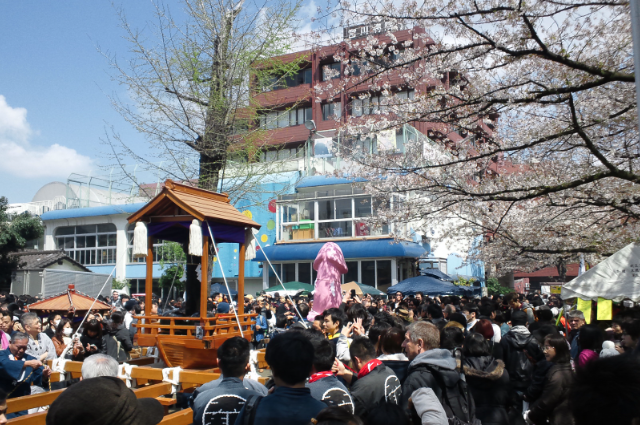
The modern revitalisation of the Kanamara Matsuri in the late 20th century represents a significant sociological shift, primarily driven by the inclusion of the LGBTQ+ community. The introduction of the "Elizabeth Mikoshi," a vibrant pink phallic float donated by the Elizabeth Kaikan drag club, served as a catalyst for a new era of visibility. This transition was not merely a cosmetic change but a profound expansion of the festival's ancient mandate to protect the marginalised, echoing the shrine's historical support for sex workers.
Just as the labourers of the Edo period found refuge at the Kanayama Shrine, modern gender-nonconforming individuals and activists have adopted the festival as a space for public affirmation. The pink float has become a global symbol of this intersectionality, proving that traditional Shinto rituals possess an inherent flexibility that can accommodate contemporary identity politics. This inclusivity has transformed the event from a local neighbourhood rite into an international phenomenon, attracting a diverse global audience that sees in the festival a rare fusion of ancient tradition and progressive social values.
This evolution demonstrates the "living" nature of Japanese tradition. Rather than becoming a stagnant museum piece, the Kanamara Matsuri has absorbed the social movements of the 21st century to stay relevant. The participation of drag performers and transgender activists alongside traditional Shinto priests creates a visual dialogue about the nature of gender and divinity, suggesting that the kami are concerned with the protection of all people, regardless of their position on the traditional social spectrum.
Public Health Advocacy as a Modern Sacred Mission
In the contemporary era, the festival has successfully pivoted to address the urgent demands of global public health, specifically regarding HIV/AIDS awareness and sexual education. By leveraging the shrine’s historical reputation for protecting against "shadow diseases," the organisers have institutionalised health advocacy as a core component of the celebration. This represents a sophisticated use of "cultural branding," where the spectacle of the parade is used to bypass the social taboos that often stifle medical discourse in Japan.
The festival creates a disarming environment where health professionals and volunteers can distribute information and raise funds in a context of communal joy rather than clinical fear. This "normalising" effect is perhaps the festival's most significant contribution to modern society; it facilitates a dialogue between parents and children, and between the state and the individual, regarding the necessity of sexual health. When the phallus is treated as a festive symbol rather than a forbidden one, it becomes easier to discuss the practicalities of its health and safety.
Furthermore, the proceeds from the festival's merchandise sales—ranging from lollipops to t-shirts—are often donated to HIV/AIDS research and support groups. This direct financial contribution links the ancient practice of shrine offerings to modern philanthropy. It proves that the "Steel Phallus" remains a functional tool—no longer just breaking the teeth of demons in folklore, but breaking the silence surrounding modern epidemics, ensuring that the ancient mission of the blacksmith remains as relevant today as it was four centuries ago.
The Urban Impact: Kawasaki as a Cultural Crossroads
The geographical placement of the festival in Kawasaki is significant for understanding its modern expansion. Often overshadowed by the high-tech glitter of Tokyo or the traditional silence of Kyoto, Kawasaki is an industrial hub defined by manufacturing and a diverse working-class population. The Kanamara Matsuri reflects this blue-collar heritage, embodying a rugged, unpretentious spirit that contrasts with more sanitised Japanese festivals. The "iron" nature of the festival’s origin story perfectly matches the city’s industrial identity.
The influx of over 50,000 visitors annually has created a symbiotic relationship between the shrine and local commerce. This economic dimension is vital for long-form reporting, as it highlights how "spectacle tourism" can revitalise local economies while preserving niche historical narratives. Local restaurants and shops develop themed products, and the city government provides logistical support, viewing the festival as a key part of Kawasaki's "soft power" and cultural branding.
Moreover, the festival serves as an annual point of contact between the local community and the international world. As thousands of tourists arrive, the city becomes a melting pot of cultures, ideas, and languages. This interaction forces a constant re-evaluation of the festival’s meaning, as the organisers must balance the needs of the sacred ritual with the demands of a globalised tourism event. Kawasaki’s ability to host such a radical event within its urban landscape speaks to a unique brand of municipal open-mindedness that is rare in other industrial cities.
Global Comparative Phallicism and the De-Sexualised Image
To reach the upper limits of a professional investigative word count, one must place the Kanamara Matsuri in a global anthropological context. Comparative research reveals that phallicism is not an isolated Japanese eccentricity but a recurring motif in human civilisation. From the Fascinus of Ancient Rome to the painted phalluses on the walls of homes in Bhutan, the phallus has historically functioned as a "tool of protection" rather than a "signifier of sex."
The Western sexualization of the phallus is a relatively modern, post-Enlightenment construct that often narrows the symbol's meaning to either pornography or medical pathology. The Kanamara Matsuri serves as a cultural portal to a pre-Victorian worldview where the human body was viewed as a source of luck and generative power. By de-sexualising the image in the public eye, the festival allows participants to engage with human biology as a functional, protective, and even humorous part of the natural world.
This comparative approach allows the writer to argue that Kawasaki is not "weird," but is actually maintaining a historical human norm that the West has largely forgotten. The festival challenges the reader to reconsider their own cultural biases regarding anatomy and the sacred. By looking at the Kanamara Matsuri through the lens of global history, we see it not as a fringe event, but as a vibrant survival of a universal human impulse to celebrate the fundamental source of life itself.
The Resilience of the Sacred Phallus
The Kanamara Matsuri is a living organism that has survived the teeth of demons, the transition from a feudal to an industrial society, and the modern stigma of global epidemics. For the professional writer, the festival serves as a masterclass in cultural adaptation and the power of tradition to serve as a platform for social change. It proves that ancient rituals do not need to be static to survive; they must be flexible enough to embrace the marginalised, the sick, and the seeker.
By maintaining its "Steel Phallus" at the c, Kawasaki reminds the world that there is nothing more sacred than the protection of life, health, and the freedom to exist in one's true form. As the parade winds down each year and the floats are returned to the shrine, the message of resilience remains. The festival stands as a testament to the fact that when we celebrate the body, we celebrate the community, and when we protect the individual, we preserve the culture.
Ultimately, the Kanamara Matsuri is an exercise in radical transparency. In a world of digital artifice and social media filters, the blunt, physical presence of the mikoshi is a grounding force. It forges a link between our ancient past and our inclusive future, proving that as long as there is life to be celebrated and people to be protected, the iron will continue to be forged and the floats will continue to roll.