
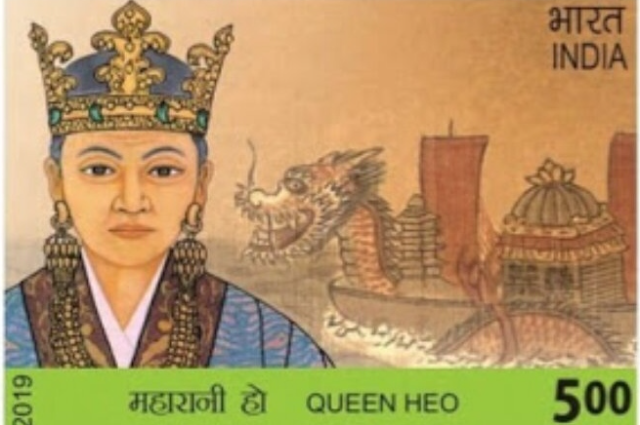
The story of Queen Heo Hwang-ok stands as one of the most enchanting and culturally significant legends shared between India and Korea. Passed down through centuries, her tale reflects the extraordinary power of love, destiny, and cultural exchange. Although rooted in ancient texts and folklore, the legend of Queen Heo continues to inspire people today, offering a remarkable example of how two distant lands were once connected through the journey of a single woman.
According to the 13th-century Korean historical compilation Samguk Yusa, Queen Heo Hwang-ok was born as Princess Suriratna in the ancient Indian city of Ayodhya. Her parents, King Padmasen and Queen Indumati, ruled over the kingdom of Kausala. From her birth, the princess was believed to be blessed with grace, intelligence, and a sense of divine purpose. Her life, however, changed when her father received a prophetic dream that would alter her destiny forever.
In the dream, a celestial being instructed King Padmasen to send his daughter across the seas to marry a king in a faraway land. This king, the dream revealed, was blessed by heaven and awaited his destined queen. Believing deeply in divine will, the king prepared an elaborate voyage for Princess Suriratna. She was accompanied by attendants, treasures intended as gifts, and sacred stones meant to calm the seas during the long journey. With blessings from her parents and her kingdom, she set sail toward the unknown.
After an arduous journey across the ocean, the princess arrived on the southern shores of the Korean peninsula around the year 48 CE. Her arrival was nothing short of extraordinary for the people of the Geumgwan Gaya kingdom. King Kim Suro, the founder and ruler of Gaya, welcomed the princess with great respect and curiosity. The ancient texts describe how the king immediately recognised her as the woman foretold by divine signs. Her wisdom, poise, and spiritual presence made a strong impression on him.
The two were soon married, marking the beginning of a deeply cherished love story. Despite coming from distant lands with different customs, languages, and traditions, the bond between King Suro and Queen Heo grew into a symbol of unity. Queen Heo adapted to her new home with grace, becoming a beloved figure among the people of Gaya. She introduced new cultural elements, practices, and goods from her homeland, enriching Korean society in subtle but meaningful ways.
Historical accounts and folklore suggest that Queen Heo played an essential role in strengthening the cultural foundation of the young kingdom. She assisted with administrative affairs, contributed to cultural exchanges, and supported Gaya's growth. The sacred stones she brought from India were placed beneath important structures, believed to ensure stability and harmony. These stones remain part of Korean historical memory even today.
Queen Heo and King Suro went on to have several children, whose descendants formed some of the most prominent Korean clans. The Gimhae Kim clan, the Gimhae Heo clan, and even the Incheon Yi clan trace their lineage back to Queen Heo, making her a central ancestral figure for millions of Koreans. This remarkable genealogical connection continues to fascinate scholars and families alike.
Over time, Queen Heo’s story became more than a romantic legend. It evolved into a bridge between two ancient cultures. In modern times, both India and South Korea have embraced her legacy as a symbol of historical friendship. Monuments and memorials dedicated to Queen Heo exist in both countries. In Ayodhya, the land believed to be her birthplace, a memorial honours her journey and her influence. In Gimhae, South Korea, her spirit is celebrated through temples, monuments, and annual ceremonies that commemorate her arrival.
The story also highlights how love can transcend borders, languages, and traditions. At its heart, Queen Heo’s tale is about courage. She left her homeland, not knowing what awaited her, guided only by faith and divine destiny. Her decision forged a link between India and Korea that has lasted more than two thousand years. It illustrates the universal truth that human connections can overcome the greatest distances and differences.
Beyond romance, her journey represents cultural exchange at its finest. Through her, ideas, customs, and spiritual beliefs travelled from ancient India to ancient Korea. Her presence demonstrated that societies grow stronger when they welcome diversity and learn from one another. In that sense, Queen Heo’s legacy is not just historical but deeply philosophical. It reminds us that unity between nations often begins with simple acts of understanding and openness.
Today, her legend continues to inspire renewed interest in the ancient ties between the two nations. Diplomats, scholars, and travellers reference her story as a symbol of goodwill. Cultural programs, festivals, and exchanges often highlight Queen Heo’s role in connecting Indian and Korean histories. What began as a divine prophecy in an ancient king’s dream has become a lasting narrative of friendship that bridges two vibrant cultures.
As we reflect on her journey, we are reminded that stories like hers endure because they speak to something universal. They remind us of love’s power to move people across oceans, the courage required to start anew in unfamiliar lands, and the beauty of bringing cultures together. Queen Heo Hwang-ok’s life story, though wrapped in legend, continues to inspire unity, cultural respect, and the belief that destiny sometimes leads us to places far beyond our imagination.
Her tale endures not merely as a historical legend but as a timeless celebration of love, courage, and cultural harmony.