
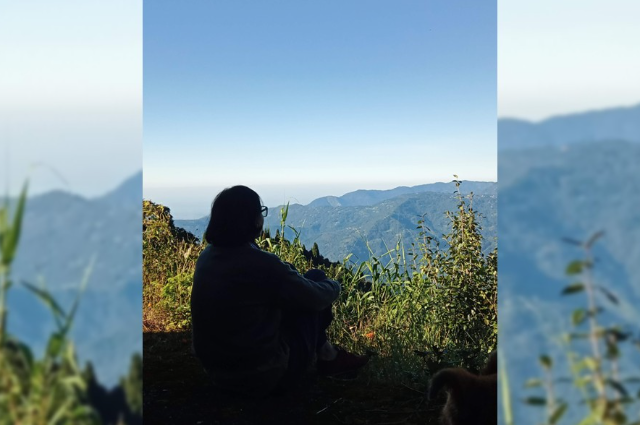
Some places aren’t just visited. They’re felt. They seep in, quiet and slow, until they’re part of the deeper self. Tieedi, hidden in the green folds of Darjeeling, feels exactly that. It isn’t a place just to look at; it’s a place to listen. A forest that moves with its own breath. Every rustling leaf speaks, every droplet on bamboo seems alive. Even the soil holds an ancient quietude, teaching balance without saying a word.
Stepping here feels like belonging to something older. Morning doesn’t arrive here; it grows in. Light seeps between branches, turns the air cold and clean. An early walk toward the Zero Waste Hamlet linked to Tieedi feels quite symbolic, a walk from darkness into awareness. The trail, slick with dew, gleams as a silver thread pulled through the earth. Each step presses soft ground, reminding us that too much is never sustainable. Everything breathes a purpose here: Mud walls to bamboo ceilings, compost pits to art made from scraps. Waste becomes wonder. Nothing leaves this cycle; it just shifts shape. Sustainability isn’t an idea; it’s muscle memory. One begins to see and realise how balance, never excess, is what keeps life steady.
By late afternoon, light begins to fade behind the hills. The forest shifts its colour: green turns to amber, then to a burnt shade of gold. Slowly, evening folds in. Crickets begin their nightly orchestra. The smell of damp wood and smoke from the kitchen fills the air. It’s the kind of smell that makes you nostalgic for something you never had. The night grows dense, like a warm blanket. Stars take over again, and silence thickens until it hums. One starts hearing things differently. The crackle of the fire sounds like a heartbeat. A leaf falls, and it feels significant. Everything does.
Sleeping here in a mud hut, under an open bamboo ceiling, feels almost primitive and perfect. The night stretches wide. Stars blink like they remember things that are forgotten. The sound of the streams runs through the dark and steady calmness. Crickets carry the beat. The forest keeps repeating, almost like a lullaby, take it easy, easy does it. That’s the line from the Ladakhi folk song that has given Tieedi its name. It’s not just a name; it’s a lesson every seeker ends up living. Here, nothing rushes, and that’s exactly how life moves here: slow, unforced, in rhythm with the land. Time doesn’t push forward; it flows, soft as mist between the hills.
Nothing here is wasted. Not a stick, not a scrap, not a moment. Mud walls, bamboo roofs, recycled art, and composting pits all stand as proof that renewal is a choice, not a miracle. Things aren’t thrown away here; they’re reimagined. Sustainability feels natural, not forced. It’s not a policy or slogan; it’s how people breathe. Even the smallest act, turning a leaf pile into compost, feels like participating in something circular, something honest.
A social entrepreneur and environmental activist, Utsow Pradhan built this. Once tied to the corporate grind, he traded a desk for dirt, and he calls himself a learner and a gardener. He turned a barren patch into a living classroom. His version of permaculture isn’t just farming, it’s awareness. The visionary believes in cooperation, not control, which makes the planet thrive. His vision drifts through Tieedi like clear water. No commands, no hierarchies. Everything, trees, water, soil, humans, moves in the same quiet beat. Here, time stretches, and things grow at the pace of a leaf, a stream, a breath.
People with holistic minds come from everywhere to be part of it. Interns, travellers, environmentalists, wanderers. They come not just to explore and work, but to feel useful again, to reconnect. They are seen engaged in planting, building, laughing, and sometimes just sitting in silence. Meals are shared; chores rotate, around the fire, stories rise. Some funny, some tender. Laughter blends with the forest sounds: birds, frogs, insects, and wind. In that moment, the community strips of performance, real and simple.
And somewhere in that stillness, a truth becomes clear: nothing here dies without feeding something else. Each leaf that falls, each seed that decays, every end creates a beginning. That’s the real beauty of permaculture; it mirrors life itself. Waste doesn’t exist. Transformation does. What leaves the branch returns to the soil, and from that, something new begins. Standing there, one can realise it’s the same for people. Growth comes from letting go, from feeding what matters.
Tieedi also teaches patience. Nothing happens fast here. The mist doesn’t hurry to lift, flowers don’t rush to bloom. The forest refuses to match the world’s speed. And in doing so, it shows another kind of success, the quiet one. The kind that isn’t measurable, only felt. This place belongs to listeners. People who find meaning in the small things, the hum of insects, the rhythm of raindrops on bamboo, the deep quiet between bird calls. Tieedi gives space to remember what being alive feels like when it’s simply realising that doing small things with care might be the truest form of devotion. Making compost, sweeping the path, tending to seedlings, it all carries weight. Purpose doesn’t need to be loud.
Permaculture here becomes more than farming. It becomes a philosophy. It reminds the seekers how nature builds community. Trees share sunlight, roots share nutrients. Nothing hoards. Everything gives enough and takes only what it needs. It’s a way of living that feels radical because it’s so old, so forgotten. The forest, in its unbroken patience, becomes a mirror of the balance humans have lost.
And then, morning sprouts again. The first rays spill over the hills, and the light turns the mist to gold. Streams shimmer like they’re breathing. Leaves glisten. Birds start their quiet chorus. The whole forest feels awake, not in noise, but in presence. Tieedi stands still, the same and yet renewed, every single day. It keeps teaching the same things in a hundred different ways. Here, growth is slow, death feeds life, and patience is power. Every part of it whispers the same invitation: to walk lighter, to live kinder, to listen harder.
That’s what Tieedi forest really is, not a place, not a project, but a gentle reminder that the earth doesn’t need saving, it needs understanding. This simplicity is a form of wisdom. The most beautiful kind of progress doesn’t race ahead; it roots deeper. Standing there, under the wide Darjeeling sky, a seeker feels a strange gratitude. For the mud beneath your feet. For the trees that don’t speak, yet say everything and for the silence that heals. Tieedi doesn’t want visitors; it wants witnesses. It wants practitioners who’ll carry its lessons out into the noise again because when one leaves, a part of the forest also leaves. One finds oneself hearing the forest again in city sounds, in rain against windows, in the wind that passes without staying. And maybe that’s enough to have felt it once, to remember it when the world feels too fast.
Tieedi isn’t a place one goes back to. It’s a divine space that keeps returning infinitely.