
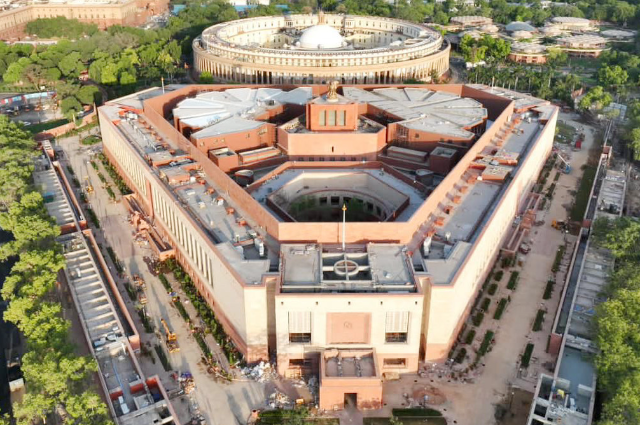
India stands at a constitutional precipice. The proposed expansion to 816 seats is not merely a demographic recalibration; it is a geopolitical masterstroke designed to break the decades-long deadlock over Women’s Representation. By decoupling the 2026 Delimitation from the delayed post-2021 Census and anchoring it to the 2011 map, the state has engineered a ‘Federal Truce.’ This article dissects the 816 Equation: a high-stakes gamble that prioritises Gender Justice (273 seats) over Numerical Precision, while navigating the simmering anxieties of the North-South divide. Is this the birth of a more inclusive Republic, or a ‘Digital India’ governed by an analogue ghost?
The 816 Architecture: Beyond the 543 Ceiling
For over half a century, the number ‘543’ hasn’t just been a statistic in Indian politics; it has been the definitive boundary of our democratic imagination. Since the mid-1970s, the Lok Sabha has operated within a frozen frame, a structural status quo that has remained largely unchanged even as the nation beneath it underwent a tectonic demographic shift. But as we stand in 2026, that ceiling is finally cracking. The proposal to expand the Lower House to 816 seats is not merely an administrative adjustment or a bit of “parliamentary housekeeping.” It is a fundamental redesign of the Indian Republic’s primary engine. To understand the 816 Architecture, one must first understand why the old house, the ‘Club of 543’, became too small for the billion dreams it was meant to shelter.
The current strength of the Lok Sabha was pegged to the 1971 Census, a decision made during the Emergency era to ensure that states succeeding in family planning weren’t “penalised” with fewer seats. It was a temporary freeze that lasted fifty years. In that half-century, India’s population didn’t just grow; it transformed. We transitioned from a largely agrarian, stationary society to a hyper-mobile, urbanising, and youthful nuclear power. Yet, our representation remained trapped in a 1971 time capsule. In many constituencies today, a single Member of Parliament is tasked with representing nearly 2.5 to 3 million people. By comparison, in many Western democracies, that ratio is closer to one representative for every 100,000 citizens. When the gap between the ‘Governor’ and the ‘Governed’ becomes this vast, democracy doesn’t just suffer–it dilutes. It becomes a distant, broadcast reality rather than a localised, lived experience.
The shift to 816 seats is, therefore, a mathematical attempt to bring the ‘Representative’ back into the ‘Representation.’ But the true genius, or perhaps the true controversy of the 816 Architecture, lies in its role as a “Political Safety Valve.” For decades, the primary roadblock to Women’s Reservation was a simple, selfish calculation: if you reserve 33% of 543 seats for women, you effectively tell nearly 180 sitting male MPs that their careers are over. In the ruthless arena of Indian politics, that was a death sentence no party was willing to sign. The 816 Formula solves this by expanding the “pie” instead of just re-slicing it. By increasing the total strength by 50%, the government can accommodate the mandatory 273 women while ensuring that the current number of general seats for men doesn’t drastically shrink. It is a “No-Loss” architecture, a way to build a new wing for the daughters of India without tearing down the existing rooms of the fathers.
However, as a student of history, one must ask: Is an expanded Parliament a more effective one? Architecture isn’t just about floor space; it’s about acoustics, about who can be heard. Critics argue that a House of 816 will be a cacophony, a place where individual voices are drowned out by the sheer volume of the crowd. But this critique misses the sociological point. A larger Parliament allows for a more granular reflection of India’s diversity. It allows for the micro-identities, the smaller linguistic groups, and the marginalised hinterlands to have a dedicated seat at the table. In the old 543-seat model, many distinct cultural pockets were swallowed up by “mega-constituencies.” In the 816-seat model, the “Architecture of Inclusion” becomes a reality. We are finally moving away from a ‘Macro-Democracy’ that sees only the big picture, toward a ‘Micro-Democracy’ that can focus on the nuances of local struggles.
Ultimately, the 816 Architecture represents a “Democracy Reset.” It is an admission that the old structures of the 20th century are insufficient for the complexities of the 21st century. As we move into this new, larger Central Hall, we aren’t just adding chairs to a room; we are expanding the definition of who belongs in that room. It is a bold, perhaps messy, expansion, but in a country as vast and vibrant as ours, a cramped democracy is a dying one. The 816 seats are the new lungs of the Republic, allowing it to finally breathe at the scale of its own population.
The 2011 Anachronism: Governing by an Analogue Ghost
In the fast-paced, digital-first narrative of “New India,” there is a startling contradiction that few dare to vocalise: our democracy is currently being mapped out using the “ghosts” of 2011. As we discuss expanding the Lok Sabha to 816 seats, we are doing so based on a fifteen-year-old demographic snapshot. For a student of sociology, this is more than just a clerical delay; it is an “Anachronism”– a misalignment of time and reality. We are attempting to build a high-tech, futuristic 2029 Parliament on the skeletal remains of a 2011 Census. This gap represents a profound democratic deficit, where the living, breathing reality of a billion people is being managed by data that no longer knows who we are.
To put this into perspective, think about the world of 2011. It was a world before the UPI revolution, before the explosion of 4G, and before the massive internal migrations that redefined our urban landscapes. In 2011, India’s population was roughly 1.21 billion. Today, in early 2026, estimates place us at over 1.44 billion. Those 230 million “missing” people aren’t just numbers; they are voters, students, and workers who exist in reality but are invisible to the current delimitation map. When we redraw the boundaries of 816 seats using 2011 data, we are effectively telling the millions who migrated from rural heartlands to “Tier-2” cities like Pune, Surat, or Bengaluru that their current lives don’t count. We are pinning their political identity to a village they left a decade ago, or a demographic category that has since shifted.
This “Demographic Dissonance” is most visible in our cities. Sociology teaches us that urbanism isn’t just about moving to a city; it’s about a change in political consciousness. Since 2011, India has undergone a “Spatial Reorganisation.” Nearly 38% of our population now resides in urban clusters. Yet, the 816-seat map anchored to 2011 will likely under-represent these urban engines. An urban voter in a sprawling suburb of Delhi or Mumbai ends up with a “diluted” vote because their constituency is packed with double the population it had fifteen years ago, while a stagnant rural seat maintains the same political weight. This creates a “weighted” democracy where some votes are quite literally worth more than others, purely because of when the last census was taken.
Furthermore, consider the “Youth Dividend.” For a student like me, this anachronism feels personal. In 2011, the current crop of first-time voters, the very people who will decide the 2029 elections, were toddlers. They were “statistical noise” in the last census. By 2029, the Gen Z and Gen Alpha cohorts will be the primary stakeholders of the Republic. If we use 2011 data to decide where the 816 seats should go, we are essentially allowing a past generation to dictate the political boundaries of a future they won’t inhabit. It is like trying to run a 2026 smartphone on a 2011 operating system; it might function, but it will lag, crash, and fail to reflect the user’s current needs.
So, why are we doing it? Why cling to this “Analogue Ghost”? The answer lies in the “Federal Truce.” The government knows that waiting for the 2026-27 Census figures would open a Pandora’s Box of North-South tensions. The South has succeeded in population stabilisation, while the North has seen a boom. Using updated data would lead to a massive transfer of power to the North, a move that could destabilise the union. By sticking to 2011, the state is choosing “Social Stability over Mathematical Accuracy.” It is a pragmatic compromise, but a compromise nonetheless.
In the final analysis, the 2011 Anachronism is the price India is paying for its own complexity. We are a nation that moves at multiple speeds, a 21st-century economy governed by 20th-century laws and 2011 data. As we move toward the 816-seat model, we must acknowledge that this map is a temporary bridge, not a permanent destination. We are governed by a ghost because the reality is too politically explosive to handle. But ghosts have a way of haunting the houses they inhabit. Unless we find a way to reconcile our political maps with our demographic reality, the 816 Architecture will remain a beautiful facade built on a foundation of sand.
The Nari Shakti Vandan: 273 Seats of Change
For decades, the Indian Parliament has been a “Boys’ Club” by default, a space where the architecture, the timing of sessions, and the very nature of debate were designed by men, for men. The Nari Shakti Vandan Adhiniyam, integrated into the 816-seat expansion, is the most radical disruption of this patriarchal status quo since the granting of Universal Adult Franchise. By guaranteeing 273 seats to women, we aren’t just performing an act of “political charity”; we are witnessing a seismic shift in the “Grammar of Power.” As a student of sociology, I see this not as a mere numerical adjustment, but as a “Cognitive Re-routing” of the national agenda.
The significance of the number 273 cannot be overstated. In the old 543-seat model, women hovered around a dismal 14-15%. In such a minority, a female representative is often forced to “act like a man” to be taken seriously, adopting the same aggressive rhetoric and prioritising the same “hard” security or infrastructure issues that have historically dominated the floor. However, when you reach a critical mass of 33%, the culture of the room changes. Sociology teaches us that “Critical Mass” is the point at which a minority group no longer feels the need to assimilate into the majority’s culture. With 273 women, the Lok Sabha will move from a “Performative Inclusion” to a “Substantive Transformation.”
What does this change look like on the ground? It looks like a shift from “Hard Infrastructure” to “Human Infrastructure.” While the male-dominated discourse often obsesses over highways and defence budgets, studies at the Panchayat level have shown that female leaders consistently prioritise “Silent Crisis” issues: potable water, maternal health, local education, and the nutritional security of the girl child. When 273 women enter the Central Hall, these “soft” issues will finally be recognised for what they truly are, the hard foundation of a developed nation. We are moving from a “Power over” model (dominance and control) to a “Power with” model (collaboration and care).
However, the 273-seat mandate also brings a unique sociological challenge: the “Proxy” phenomenon. Critics often point to the Sarpanch-Pati culture in villages, where women are elected, but their husbands or fathers pull the strings. But to dismiss the 273 seats based on this fear is to ignore the “Law of Unintended Empowerment.” History shows that even when a woman starts as a proxy, the very act of sitting in the chair of power, of signing the files, of facing the cameras, of navigating the bureaucracy changes her. Power is a pedagogical tool. By the second or third session, the “Proxy” often becomes the “Principal.” By creating a platform for 273 women, India is essentially building a “Leadership Factory” that will produce the next generation of female Prime Ministers, Chief Ministers, and global leaders.
There is also the vital element of Intersectionality. The Nari Shakti Vandan doesn’t just seat “women”; it seats women from the margins. Because the 33% reservation applies to the existing SC and ST quotas, we are ensuring that the most silenced voices– the Dalit woman, the Tribal woman– are at the very centre of the 816-seat architecture. This is “Justice within Justice.” It ensures that the 273 seats aren’t just filled by the urban elite, but reflect the “Rainbow of Resilience” that is the Indian womanhood.
Ultimately, the Nari Shakti Vandan is an admission that a nation cannot fly with one wing tied behind its back. The 273 seats represent the “Feminisation of the State” not in a stereotypical sense, but in the sense of making the state more empathetic, more local, and more accountable. As these 273 women take their oaths in 2029, they won’t just be occupying chairs; they will be dismantling the “Glass Ceiling” of the Central Hall and replacing it with a “Mirror”, a mirror in which every young girl in India can finally see her own reflection in the face of the Republic.
The North-South “Truce”: Math as a Peace Treaty
In the quiet corridors of power, the word “Delimitation” has long been whispered with a sense of dread, particularly in the Southern states of India. For decades, a ghost has haunted our federal structure: the fear that success in governance would be met with a penalty in politics. The Southern states– Tamil Nadu, Kerala, Karnataka, Andhra Pradesh, and Telangana- have been the star performers of India’s developmental story, leading the charge in population stabilisation, healthcare, and education. Yet, the reward for this success was a looming threat that their voice in the Lok Sabha would be drowned out by the sheer demographic weight of the North. The proposal to expand to 816 seats is, at its core, a “Mathematical Peace Treaty” designed to bury that ghost once and for all.
To understand the stakes, one must look at the “Population Penalty” that has frozen our democracy since 1976. Under a strictly population-based redistribution, states like Uttar Pradesh and Bihar, which have seen a demographic explosion, would have seen their seat counts skyrocket, while a state like Kerala might have actually lost seats. This created a perverse incentive: if you follow national policy and stabilise your population, you lose your seat at the table. The 816 Formula breaks this deadlock through the “Pro-Rata” principle. By increasing every state’s representation by exactly 50%, UP goes from 80 to 120, but Tamil Nadu also jumps from 39 to 59. The government is ensuring that the relative weightage remains untouched. It is a brilliant, if mathematically complex, truce: the North gets more seats, but the South doesn’t lose its share of the megaphone.
However, from a sociological perspective, this “Truce” is more than just a calculation; it is an act of Cooperative Federalism. It acknowledges that India is not a monolith, but a collection of regional identities that must feel safe within the Union. If the Southern states felt politically marginalised, the resulting friction could have threatened the very fabric of our national unity. By choosing the 816-seat expansion over a simple redistribution of the 543 seats, the state is signalling that “Developmental Success” will no longer be traded for “Political Influence.” It is a promise that the “Southern Tiger” can continue to grow without fearing that its roar will be silenced in New Delhi.
Yet, as a student of Geography and Economics, I must observe that this truce is not without its silent costs. While the relative power remains the same, the absolute number of seats in the North will still be significantly higher. A larger North-centric bloc, even if proportionally balanced, still holds the keys to constitutional amendments and national policy. This is why the 816-seat expansion must be accompanied by a strengthening of the Rajya Sabha– the Council of States to ensure that the “Federal Balance” isn’t just a matter of seat counts, but a matter of genuine partnership. We are moving from a period of “Demographic Conflict” to an era of “Institutional Innovation,” where math is being used to heal the wounds of a divided map.
Ultimately, the North-South Truce is an admission that in a country as diverse as India, “One Size Fits All” rarely fits anyone. The 816 Equation is a customised solution for a uniquely Indian problem. It tells the South that its progress is valued, and it tells the North that its population is represented. It is a fragile, calculated peace, but in the high-stakes game of Indian democracy, it might just be the most important piece of “Math” ever written.
The Constitutional Tightrope: Jurisprudence vs. Justification
To the casual observer, expanding the Lok Sabha to 816 seats might seem like a simple matter of logistics, more desks, more microphones, and a larger hall. However, for a student of the law, this is a high-stakes “Tightrope Walk” across the most sacred principles of our democracy. The transition from 543 to 816 is not just a physical expansion; it is a legal provocation. It forces us to confront the inherent tension between Article 81, which mandates that seats be allotted based on the latest census, and the pragmatic “workarounds” the state is currently deploying. For the legal minds watching this 2026 Delimitation, the question isn’t just “How many seats?” but “By what authority?”
The primary “Roadblock” lies in the definition of Representation. The Constitution of India operates on the bedrock of “One Person, One Vote, One Value.” Under Article 82, the Parliament is required to readjust the allocation of seats after every census. By choosing to use the 2011 Census as the anchor for an 816-seat house in 2026, the state is effectively de-linking representation from the most recent demographic reality. An advocate would argue: Does a “frozen” census satisfy the constitutional mandate of “Readjustment”? If the data is fifteen years old, is the representation genuine, or is it a legal fiction? This opens the door for a “Basic Structure” challenge, where petitioners might argue that the very essence of a fair franchise is being diluted for political convenience.
Furthermore, there is the hurdle of the 84th Amendment (2001), which froze delimitation until the first census after 2026. By moving the needle now, the government is navigating a legislative “grey zone.” The argument for the 816-seat model is that it is a “Sui Generis” (one of a kind) expansion specifically designed to enable the Nari Shakti Vandan Adhiniyam. Here, the state is pitting two constitutional values against each other: the Procedural Right to an updated census versus the Substantive Right of women to have 33% reservation. In a court of law, which takes precedence? The state’s defence is rooted in “Necessity”, arguing that waiting for the 2027 Census would delay gender justice by another decade. It is a classic “Means vs. Ends” debate that would make any constitutional lawyer salivate.
Beyond the numbers, there is the “Federal Compact.” The Constitution is a treaty between the Union and the States. When we alter the seat count to 816 using a “Pro-Rata” formula, we are essentially changing the terms of that treaty without a fresh demographic mandate. Critics might argue that this bypasses the Delimitation Commission’s traditional role of ensuring “Equitable Distribution.” Is the 816-seat model a “Constitutional Masterstroke” that preserves peace, or is it a “Bypass Surgery” that ignores the underlying health of our federal institutions?
As we analyse these roadblocks, we see that the 816 Equation is more than a policy; it is a Legal Experiment. It tests the elasticity of the Indian Constitution. Can our founding document bend far enough to accommodate the massive 50% expansion and the historic entry of 273 women, or will it snap under the weight of procedural challenges? One must acknowledge that while the “Math” of 816 provides a solution for the politicians, the “Law” of 816 remains a battleground for the advocates. We are witnessing the birth of a new jurisprudence– one where the “Urgency of Justice” is being weighed against the “Certainty of the Law.
The 273-Lottery: The Radical Mechanics of Rotation
If the expansion to 816 seats is the “Body” of this reform, the Rotational Lottery for the 273 women’s seats is its “Nervous System”, complex, unpredictable, and potentially transformative. Unlike the fixed reservations for SC/ST communities, the 33% reservation for women is designed to “rotate” across different constituencies in every general election. This is a radical departure from the way Indian politics has functioned for seventy years. It introduces an element of “Productive Uncertainty” that will fundamentally alter the sociological behaviour of our political class.
The logic behind the “Lottery” is to prevent the “Ghettoisation” of women’s leadership, ensuring that women aren’t confined to a few “token” seats but have a stake in every corner of the country. However, from a sociological perspective, this creates a fascinating “Incumbency Paradox.” If an MP, male or female, knows that their seat might be “drawn in the lottery” for the opposite gender in the next cycle, does their incentive to invest in long-term development projects diminish? Or does it force them to work harder to build a legacy that transcends their own candidacy? Sociology teaches us that people respond to incentives. The 273-Lottery is a massive experiment in “Political Churn,” designed to break the “Dynastic Entrenchment” that often plagues 543-seat politics.
But there is a deeper, more human side to this lottery. It creates a “Shuffle” that could potentially dismantle the “Patriarchal Gatekeeping” of party tickets. In a fixed system, party bosses often pick the “safest” (usually male) candidate. In a rotational lottery, the party is forced to scout, train, and fund female leaders across the map. It moves women from being “fillers” on a stage to being the “Protagonists” of the campaign. The 273-Lottery isn’t just a mechanic; it’s a “Leadership Accelerator.” It forces a male-dominated political culture to finally invest in the “Political Capital” of women, knowing that any seat, at any time, could become a “Nari Shakti” seat.
Of course, the risk of “Proxy Politics” remains. We must be wary of the “Shadow Candidates”, where a relative manages the constituency while the woman holds the title. But as I argued earlier, the “Pedagogy of the Chair” is a powerful thing. Even a “Proxy” candidate, once she enters the 816-seat Parliament, is exposed to the national discourse, the media, and the legislative process. The “Lottery” ensures that this exposure isn’t a one-time fluke but a national standard. It turns the entire map of India into a training ground for a new kind of leadership, one that is less about “Inherited Power” and more about “Rotational Opportunity.”
In the end, the 273-Lottery is a gamble on the “Dynamism of Democracy.” It assumes that our system is strong enough to handle constant change and that our voters are wise enough to choose leaders based on merit, even as the boundaries of identity shift. It is a “Radical Mechanic” for a radical expansion, ensuring that the 816-seat Parliament remains a “Living Organism” rather than a stagnant institution.
The 816 Classroom: Representation vs. Deliberation
As we expand the "House of the People," we must ask a fundamental question: Can 816 individuals actually deliberate, or will the sheer scale of the house lead to a "Cacophony of the Commons"? A larger Parliament is undoubtedly more representative, but is it more functional? This is the central tension of the 816 Classroom. In education, we know that as a class size grows, the quality of individual interaction often drops. The same principle applies to democracy.
The shift to 816 seats means that the "time per member" to speak during a debate will be slashed by nearly 50%. In a 543-seat house, getting time to raise a local issue was already a Herculean task; in an 816-seat house, it might become an impossibility for a first-time MP. This creates a risk of "Executive Dominance," where the government can push through legislation while the massive crowd of 816 members is caught in a procedural logjam. For a healthy democracy, we need more than just "Present" members; we need "Participating" members.
To counter this, the 816-seat expansion must be accompanied by a revolution in Parliamentary Committees. Since the "Big Room" will be too crowded for deep policy analysis, the real work must happen in smaller, specialised groups. This is where the 273 women and the new youth leaders can truly shine, bringing their expertise in sociology, economics, and history to the committee table. We are moving toward a "Split-Level Democracy," where the floor of the House is for the "Spectacle" of representation, but the Committees are for the "Substance" of governance.
Ultimately, the 816 Classroom is a test of our Civic Maturity. It challenges us to move away from the "Hero Culture" of single, powerful leaders and toward a "Collective Intelligence" model. If managed well, 816 members can bring a richness of local data that 543 never could. If managed poorly, we risk turning our highest legislative body into a mere "Voting Machine." The success of the 816 expansion will depend not on how many people we fit into the room, but on how well we listen to them once they are there.
The Price of Progress
The expansion to 816 seats is, by any definition, a messy, complicated, and legally fraught endeavour. It is a "Democracy Reset" that relies on a fifteen-year-old census, navigates a fragile federal truce between the North and South, and attempts to force a patriarchal system into a gender-just future. There will be critics who call it a "Democratic Deficit" because of the 2011 data, and there will be advocates who challenge its "Basic Structure" in the highest courts. But as we analyse the layers of this 816 Equation, one truth becomes undeniable: The status quo was no longer an option.
India has outgrown its old skin. The 'Club of 543' was a house built for a different century, a different population, and a different set of dreams. The 816-seat Parliament is a bold, perhaps desperate, attempt to build a house large enough for all of us. It is a compromise between the "Math of the Past" and the "Morality of the Future." While the use of 2011 data is a flaw, the arrival of 273 women and the potential for a new youth-led mandate is a historic dividend that justifies the "Constitutional Tightrope."
As we redraw our maps in 2026, we are doing more than just shifting administrative boundaries; we are redefining the soul of the Republic. The 816-seat Parliament will be larger, louder, and undoubtedly more chaotic. But for the first time in our history, it might actually look like the India it represents–a vibrant, diverse, and unapologetically ambitious nation that is finally ready to let its daughters and its youth take their rightful place at the table. In the final tally, the 816 Equation isn't about the number of seats; it’s about the Value of the Voice. And in 2029, for the first time, every voice will have a room of its own.
. . .
References:
I. Primary Legal & Statutory Framework
- The Constitution of India: Analysis of Articles 81 and 82 (Composition of the House and Census-linked Readjustment) and the 84th Amendment Act, 2001 (Post-2026 Delimitation Mandate).
- The Constitution (106th Amendment) Act, 2023: Also known as the Nari Shakti Vandan Adhiniyam, serving as the legislative basis for the 273-seat female representation.
- The Delimitation Act, 2002: Utilis for understanding the procedural mechanics of boundary recalibration.
II. Institutional Data & Policy Analysis
- Drishti IAS (March 2026): Daily News Analysis: Balancing the North-South Divide in Delimitation. (Source for the 816-seat projection and the "Pro-Rata" formula used to maintain state weightage).
- Vajiram & Ravi (March 2026): Editorial Analysis: Constitutional Roadblocks in Expanding Lok Sabha Seats. (Source for the "Sui Generis" expansion and legal challenges regarding the 2011 Census).
- Office of the Registrar General of India: Census of India 2011 (Data regarding population projections and rural-urban distribution utilised for the "Demographic Dissonance" argument).
- PRS Legislative Research (2026): Vital Stats: The 2026 Delimitation and Parliamentary Expansion Bill.
III. Scholarly & Geopolitical Commentary
- Observer Research Foundation (ORF): Federalism and the Demographic Challenge: Navigating the North-South Divide (2026).
- Economic and Political Weekly (EPW): Democracy vs. Demography: Critical Perspectives on the 816-Seat Expansion Strategy.
- Duflo, E. (2012): Women Empowerment and Economic Development (Referenced for the sociological impact of the 273-seat surge and the "Pedagogy of the Chair" concept).