
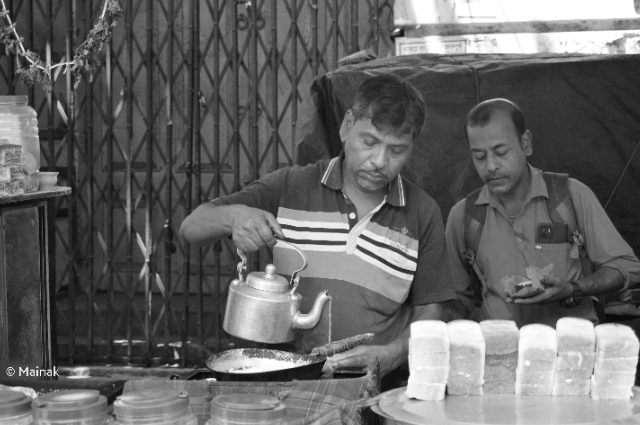
The evening train to Patna always sent a low, rhythmic vibration through the wooden plank of Radhey’s tea stall, rattling the chipped glass tumblers in their tin caddy.
It was seven in the evening. The autumn air in the small district chowk had that peculiar, chalky smell of diesel exhaust, burning cow-dung cakes, and wet dust settling after sunset. Arun sat on the low iron bench, his heels hooked over the lower rung, peeling the blue plastic wrapper off a pack of loose bidis. His hands were broad, the skin around the knuckles dry and permanently rough from eight hours of loading inventory cartons at the local wholesale cooperative down the canal road.
Behind him, Radhey was banging a blackened aluminum pan against the iron stove, splashing sweetened milk into a froth that smelled faintly of boiled cardamom and charred sugar.
"Arun-bhai," Radhey grunted without turning, his tongs clamped around the rim of the pot. "Bari der se baithe ho. Aaj hisaab jaldi band ho gaya kya godam par?"
"Dus minute pehle," Arun said. His voice was naturally quiet, raspy, worn down by years of speaking only when an invoice demanded it. "Ghar jaake bhi wahi hai. Sunita didi ka devar aaya hua hai gaon se. Baithne ki jagah kahan hai wahan."
He lit the bidi with a single scrape of a matchstick, shielding the flame inside his cupped, calloused palms. He took one long, shallow drag, watching the yellow headlights of sputtering auto-rickshaws cut through the fog at the intersection.
Whenever his sister visited from her in-laws’ village in Sasaram, the small brick house by the canal felt like a crowded waiting room. Sunita was thirty-two now, her frame thickened by three difficult deliveries and the relentless drudgery of a courtyard without running water. Whenever she looked at him, her eyes held that quiet, guilty weariness—the look of a sister who knew, without anyone ever uttering the words, that twelve years ago, the money meant to buy Arun a private engineering seat at a college in Bhopal had instead purchased her gold bangles, the stainless steel almirah, and the five-lakh-rupee demand of a sub-inspector’s family who had threatened to walk out if the cash wasn't delivered before the varmala.
“Tahara lekha engineer dhela dhoihe,” his father, Raghav, had spat on the veranda that sweltering July night in 2014, crumbling the printout of Arun’s fifty-thousandth rank in his fist. “Pachaas hazar rank laake hoshiyar banoge? Utna me to do beti ka byah ho jaayi. Padhe me tej naikhe, aur kharcha maangta hai.”
Arun had not argued. In households where rice was measured by the cup, defiance was a luxury reserved for sons who scored under five thousand. He had swallowed his pride, folded the counselling letter, and watched the cash go into red velvet pouches for the wedding party.
"Arey, Arun!"
The voice came from across the road, crisp, clear, and unburdened by the gravel of the street.
A motorcycle—a dark, gleaming dual-sport machine that didn't belong to the neighborhood—slid smoothly to a halt beside the gravel shoulder. The rider kicked the stand down with a polished leather boot, took off a matte-black helmet, and ran a hand through neat, salon-trimmed hair.
Sameer.
He was wearing an olive bomber jacket over an ironed charcoal t-shirt. On his wrist, a smartwatch glowed with muted notifications—emails, Slack pings, numbers from cities Arun had only seen on train reservation boards.
"Kitni der se phone try kar raha tha tera," Sameer said, walking toward the stall with that relaxed, wide-stepped gait of a man whose livelihood did not depend on pleasing any local shopkeeper. He pulled out a sleek smartphone, pocketed it, and slapped a fifty-rupee note onto the tea bench. "Radhey chacha, do kadak. Aur glass dhang se dhona aaj."
Radhey’s face split into a broad, obsequious grin that he never offered Arun. "Arey Sameer babu! Aap toh Dilli se kab laute? Suna hai abki baar ghar hi se kaam chal raha hai?"
"Haan, pichle hafte se," Sameer laughed easily, swinging a leg over the bench to sit beside Arun. "Work from home hai abhi do mahine. Bangalore aur Noida ka chakkar thoda kam hua toh socha Didi ki shaadi ka arrangement yahin baith ke dekh loon."
Arun looked down at his own footwear—cheap faux-leather slippers cracked at the heels—and then shifted slightly to make room. "Kab hai shaadi?"
"February second week," Sameer said, stretching his arms until his spine popped. He smiled, that tired yet triumphant smile of an older brother who had carried a mountain and made it look like a backpack. "Hotel Grand Palace book kiya hai bypass par. Didi bol rahi thi simple hall le lo, par maine kaha nahi. Papa ne jitna dukh jhela loan chukane me, ab kam se kam beti ko bidaai toh aisi doon ki poora town dekhe. Sone ka jo bhi unki pasand tha, sab banwa diya."
Arun nodded slowly, his fingers tapping against his knee. "Chhota wala? Rohit?"
"Uski third-year ki fees kal hi transfer ki," Sameer took the steaming glass Radhey handed him, tapping the rim against Arun’s untouched glass with a clink. "Computer Science me theek chal raha hai uska. US ke client projects par kaam karta hai mera company, toh shayad agle saal usko Bangalore bula loon apne flat par. Tu bata... godam par hi chal raha hai sab?"
The question was innocent, completely devoid of malice, and that was precisely why it bit deep into the meat of Arun's chest. Sameer didn't pity him; Sameer simply inhabited a different density of time.
Twelve years ago, Sameer’s father had also stood on a cracked veranda. Sameer’s rank had been forty-eight thousand—barely two thousand ranks ahead of Arun’s. They had shared the same worn physics guidebooks, cycled to the same coaching center near the railway station, and sat on this very bench calculating whether seventy marks in mathematics would clear the cutoff.
Sameer’s father was a clerk at the collectorate, just as poor as Raghav, just as terrorized by the social shame of an unmarried daughter reaching twenty-four. But on that July night, while Raghav was counting the risks of a daughter growing heavier and harder to marry off, Sameer’s father had mortgaged two kathas of ancestral land near the riverbank. He had signed the loan papers with trembling fingers, eaten salt and boiled potatoes for two winters, and pushed Sameer through the gates of a private engineering college in Greater Noida.
Now, twelve years later, the equation had balanced itself with brutal mathematical clarity.
Sameer was a corporate manager, clearing sixty thousand a month from his laptop on the dining table, paying for his sister’s grand banquet without a single relative’s condescension, and funding his brother’s flight out of the district.
Arun was here. Holding a glass of four-rupee tea, smelling of cardboard glue, wondering if his sister's husband would ask for another motorcycle when their child turned five.
"Haan," Arun said finally, blowing softly on the surface of his tea. "Wahi chal raha hai. Mal aana-jaana. Hisaab."
Sameer took a sip of his tea, squinting out into the darkness where the bypass road curved toward the highway. "Pata hai, Arun, kabhi kabhi lagta hai sab kitna ajeeb hai. Main Noida me baithta hoon toh lagta hai ki bas kal hi ki baat thi jab hum dono cycle se form jama karne gaye the. Agar us saal Papa ne wo zameen na bechi hoti na... toh main shayad aaj wahan chowk par mobile recharge ki dukan chala raha hota."
He laughed, a dry, dismissive chuckle, thinking it was a harmless joke about destiny.
Arun did not laugh. He looked at Sameer’s profile—the smooth jawline, the easy posture, the utter absence of terror in his eyes when he talked about tomorrow.
And in that quiet second, a strange, crystalline thought cracked open in Arun’s mind.
It was not anger. The sharp, bitter jealousy that usually burnt in his throat when he saw the wealthy boys from the civil lines wasn't there. Instead, there was an uncanny, vertigo-inducing sense of recognition.
It felt as though he was looking at his own skin, worn by another man.
The desire to leave this town, the sleepless nights memorizing coordinate geometry under a kerosene lamp, the desperate hunger to walk into an air-conditioned room and earn a living with his mind rather than his spine—that desire had not belonged to him alone. It had been one single, immense wave of hunger moving through this dusty town in 2014.
His father had closed the door on that hunger. Raghav had taken that fire and doused it with cold water to keep the hearth of domestic safety burning. Arun had surrendered his portion of the will. He had given up; he had swallowed his pride; he had stopped trying after the third domestic row.
And because he had let it drop, the universe had not let that unspent momentum die. It had simply funneled itself through the boy sitting beside him. Sameer had taken Arun's share of the risk, Arun's share of the late-night panic, Arun's unbuilt career, and executed it to the last decimal point.
Sameer was not his rival. Sameer was his counterfactual self—the living, breathing proof of what happened when the choice was made without fear.
"Sameer," Arun said softly, the smoke from his bidi curling past his temple into the autumn mist.
"Bol na?"
"Didi ki shaadi me..." Arun paused, looking down into the dark amber circle of tea in his glass, where the lone yellow bulb of the stall reflected like a small, trapped sun. "Sab theek se ho jayega. Tu chinta mat karna."
Sameer looked at him, caught off guard by the sudden gravity in Arun's tone. The corporate polish softened for a moment, revealing the boy who used to share a single samosa behind the coaching class. He smiled gently. "Haan bhai. Tere bina kaise hoga? Card pehla tere hi ghar aayega."
"Aana chahiye," Arun said.
A goods train rumbled past on the tracks a hundred yards away, thirty wagons of raw coal and steel grinding against the iron rails, shaking the bench, the stall, the soil of the town. Sameer checked his watch, threw his empty glass into the bin, and stood up, pulling on his helmet.
"Nikalta hoon," Sameer said, his voice muffled behind the visor. "Maa bula rahi hogi dinner ke liye."
"Ja," Arun said.
He watched the red taillight of the motorcycle flare, bank sharply, and vanish into the traffic of the bypass road, cutting cleanly through the dark.
Arun sat alone on the bench. He finished his tea, feeling the warm, bitter liquid slide down his throat. The cold autumn wind picked up, rustling the dry leaves along the canal. He dropped the stub of his bidi into the mud and ground it out with the worn rubber sole of his slipper.
He stood up, dusted the lint from his coarse trousers, and turned his face toward the canal road, walking steadily into the dark where his father was waiting.