
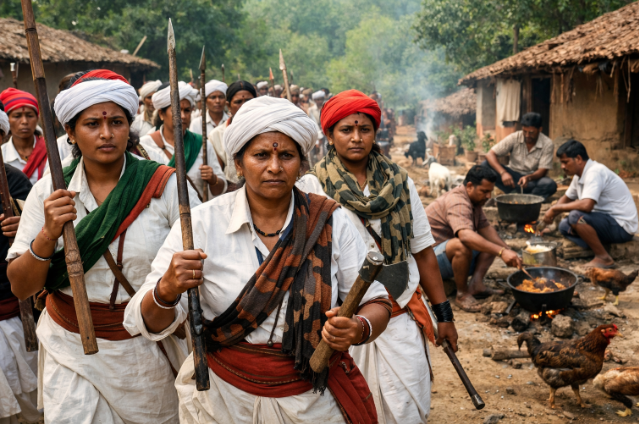
Every twelve years, a ritual called "Jani Shikar" takes place in the rural tribal communities of Jharkhand. It takes them twelve years to prepare, and about 6 times in a person’s life to witness Jani Shikar, so everyone feels a buoyant sense of anticipation. What forms this unparalleled sense of anticipation, though? Jani Shikar is not just a cultural ritual; it commemorates a significant, albeit largely forgotten, chapter of India's tribal history. Throughout the ages, it was not uncommon for tribal women to take up arms to defend their communities, thereby effectively becoming the warfighters. Jani Shikar is a ritual that was born of the fight for women's rights, and is an expression of women's power; to the men of the communities, it represents the loss of male dominance. Jani Shikar is not just the transgression of a patriarchal boundary, but is an act of war. The men of the Adivasi (Indigenous) communities, as a sign of respect, remain silent and do not interfere with the entire ritual. Instead, they stay at home, and the women, for the entire day, are the guardians of the world outside. Jani Shikar excels and surpasses all social expectations in the eyes of women. The men, through this act, surrender to the women the social order that has long placed men in the positions of power.
The origin of the Jani Shikar can be traced back to the 17th century and Rohtasgarh Fort, which is currently in the possession of the Oraon (Kurukh) tribe of Bihar. The tribe is said to have faced multiple invasions from the Mughals in oral traditions (or some accounts say from the Turkish or Cherokee armies). The people who invaded the tribe strategically timed their attacks, knowing that tribal men would be incapacitated due to the traditional rice beer (hariya) by the spring festival (Sarhul). Finding their men in a deep, drunken stupor, the women did not surrender. Led by the legendary Princess Sinagi Dai and her companions Kaili Dai and Champa Dai, they performed a radical act of deception: they cut their hair, donned men's attire, tied turbans, and armed themselves with spears and axes.
The invaders, seeing a massive force of "men" on the fort walls, were repelled not once, but twice. It was only when a spy noticed the "soldiers" washing their faces with both hands—a gesture then considered feminine—that the truth was revealed. Though the fort eventually fell in a third battle, the valor of these women became the bedrock of Adivasi identity.
Today, Jani Shikar is celebrated as a commemoration of this victory. The "Silent Pact" refers to the total social reversal that occurs during the festival; The Gender Swap: Women from the Oraon, Munda, Santhal, and Kharia tribes dress in male clothing, traditionally dhotis and pagris, though modern participants often wear jeans and shirts. They march from village to village in a disciplined relay, hunting small livestock like chickens and goats. The Male Retreat: The Women Hunt; The Men Stay Back. They do the “reproductive labor” ascribed to women: They cook, clean, and look after the children.
This is the center of the pact, that no man dares to question the women’s power or their “right to hunt” on such a day. When a hunting party comes to a nearby village, the men of that village, as a token of their protective status, receive the party, wash their feet, and serve them.
A notorious embodiment of this legacy is the three dots tattooed on the foreheads of many Oraon women. After the Last Defeat at Rohtasgarh, it is said that the forces branded the captured women with three dots, marking them as dissenters and shaming them. The tribe, in an act of reclamation, turned the marks into a symbol of honor, representing the three battles in which they defeated the colonizers. The tattoo, even today, serves as a reminder that power is not a matter of sex.
As society evolves, so does the ritual. While traditionalists once hunted wild animals in the forest, modern Jani Shikar has adapted to contemporary conservation ethics. In many regions, villages now symbolically set aside specific livestock to be "hunted" to avoid conflict with wildlife laws or animal welfare concerns.
Furthermore, the festival has become a rallying point for Adivasi feminism. In a world where indigenous women are often portrayed as passive victims of land-grabbing or marginalization, Jani Shikar offers a counter-narrative. It proves that centuries before modern feminist movements, tribal societies recognized women as strategic leaders and warriors.
Why the Pact Remains Unbroken
The reason no man challenges the All-Female Feast is rooted in deep-seated communal respect. Jani Shikar is not an act of aggression against men; it is a ritualized reminder that power is fluid. By stepping into domestic roles, men honor the sacrifice their female ancestors made to ensure the tribe's survival.
When the sun sets on Jani Shikar, the women return to their villages with their catch. A grand feast is prepared, often joined by the men, and the cycle of 12 years begins anew. But for that one day, the "Silent Pact" holds firm—a vivid, breathing proof that the spirit of Sinagi Dai still walks the forests of Jharkhand, ensuring that her daughters are never forgotten.
REFERENCES